
Anthropic says it will put 5% of its shares into a new entity called the Anthropic Public Benefit Fund, and that the stake can grow as the company does. The announcement, posted on Oct. 18, comes with one condition up front: “Subject to stockholder approval.” At the US$965 billion post-money valuation Anthropic set in its Series H round on May 28, 5% works out to about US$48.25 billion. That is our arithmetic, not Anthropic’s. The post gives no dollar figure, no share count and no date for the stockholder vote.
What happens next is mostly unwritten. Anthropic says it will share more about the fund’s “structure and governance” in the coming months, including the valuation milestones that decide how big it gets. Until then, the headline number is real and much of the machinery behind it is not yet on paper.
Anthropic Public Benefit Fund: what the post actually commits
Read closely, the post makes four concrete commitments and leaves a fifth to the board.
- The starting stake. 5% of Anthropic’s shares, “committed today,” pending a stockholder vote.
- The legal form. The fund is a wholly owned LLC “rather than a 501(c)(3) or other format,” which Anthropic says gives it flexibility between different kinds of giving.
- A politics ban. “None of the Anthropic equity held by the LLC will be used for lobbying or political giving, in the US or abroad.”
- Reporting. Anthropic says it will publish a public benefit report on the fund’s progress.
The fifth item is the escalator: “an additional 2% added at the board’s discretion for every 50% increase in the company’s value above a set baseline.” Note the verb. The board may add shares. Nothing in the post makes the top-ups automatic.
The company frames the fund as a substitute for a familiar Silicon Valley habit. It says equity that would usually flow to executives as escalating compensation awards is going here instead: “We are instead directing that equity to the public benefit.” On uses, the post mentions larger donations to traditional nonprofits and direct distributions to specific groups of people, with work on AI’s labor-market effects given as an example. It also points back to Anthropic’s earlier US$200 million commitment to research on economic futures.
The 2% escalator, worked out two ways
The escalator sentence can be read two ways, and the difference is large.
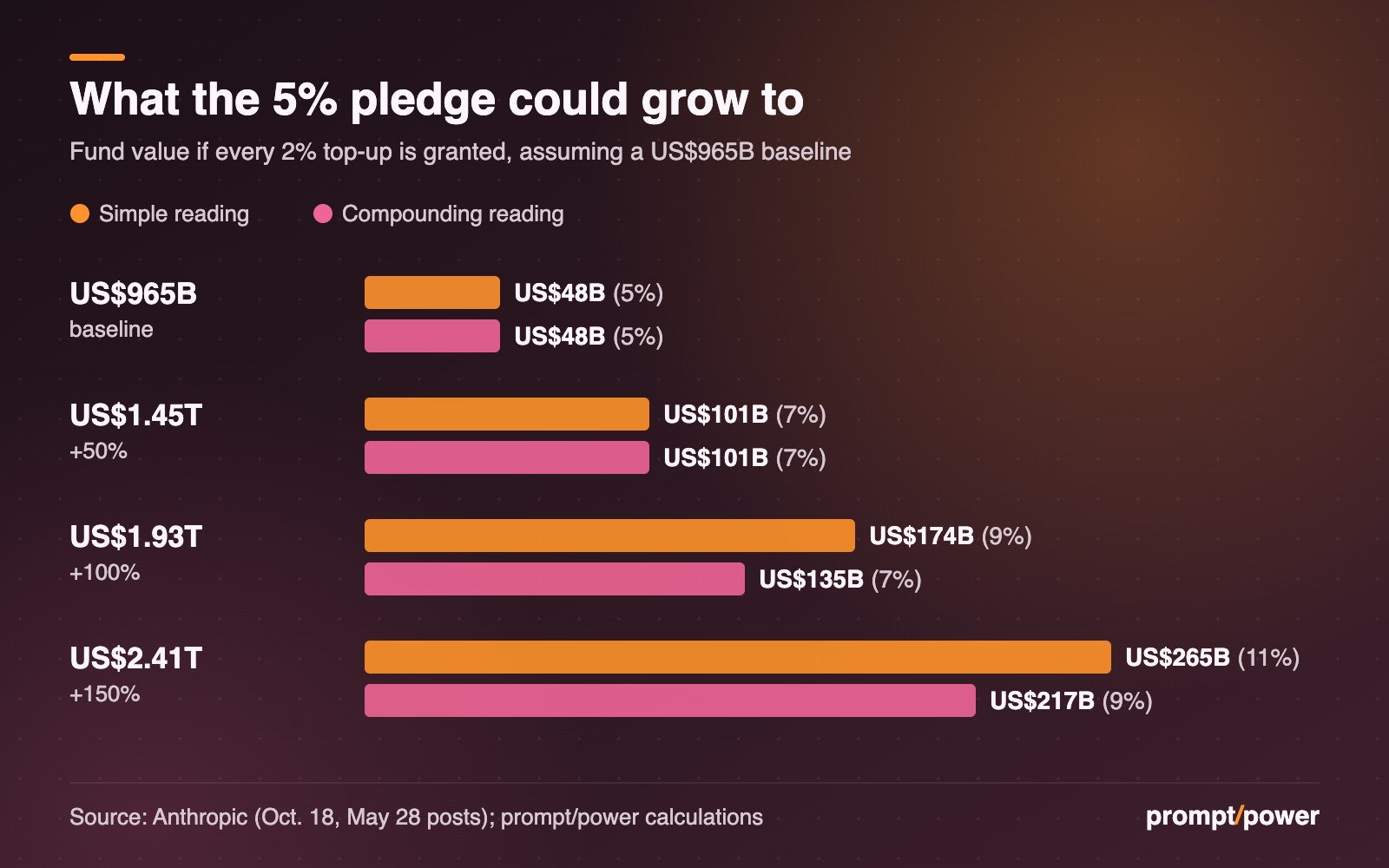
On a simple reading, every 50 percentage points of growth above the baseline adds 2 points to the fund: +50% gets you to 7%, +100% to 9%, +150% to 11%. On a compounding reading, each milestone is 50% above the previous one, so the thresholds sit at 1.5 times, 2.25 times and 3.375 times the baseline. Doubling the company’s value buys only one top-up under that reading, not two.
Anthropic has not disclosed the baseline. To make the stakes concrete, the table below assumes it is the May post-money valuation of US$965 billion. That assumption is ours, and the real baseline could be higher or lower. It also assumes every discretionary top-up is granted and that the 2% is measured against all of Anthropic’s shares, which the post does not specify either.
| Company value (vs. assumed US$965B baseline) | Fund share, simple reading | Fund value, simple | Fund share, compounding | Fund value, compounding |
|---|---|---|---|---|
| US$965B (baseline) | 5% | about US$48B | 5% | about US$48B |
| US$1.45T (+50%) | 7% | about US$101B | 7% | about US$101B |
| US$1.93T (+100%) | 9% | about US$174B | 7% | about US$135B |
| US$2.41T (+150%) | 11% | about US$265B | 9% | about US$217B |
At a doubled valuation, the gap between the two readings is roughly US$39 billion, about the size of the original pledge again. That is a lot of value riding on a definition Anthropic has promised but not yet written.
The doubling scenario is not hypothetical. A draft IPO prospectus that circulated in late September pointed to a target above US$2 trillion, according to reports we covered in our breakdown of Anthropic’s leaked S-1. Anthropic has not confirmed those figures, and the fund post does not mention an IPO.
At a doubled valuation, the two readings of one sentence are about US$39 billion apart.
Where the 20% figure comes from
Anthropic’s most quotable line is that, with this announcement, “roughly 20% of Anthropic shares will be dedicated to the public good,” plus whatever the milestones add. The new fund supplies only a quarter of that.
The rest comes from older promises. According to the post, Anthropic’s co-founders pledged to donate 80% of their equity holdings when the company was founded, and an employee donation-matching program has run since then, with about half of employees taking part. Subtracting the fund’s 5% leaves roughly 15% of shares sitting in personal pledges by founders and staff. At the May valuation, the full 20% would be worth about US$193 billion, again our arithmetic.
Those two pools behave differently. The fund is a company-controlled LLC whose rules are being written now. The founder and employee pledges are commitments by individuals, and the post does not say how they are enforced, when they are paid out or whether they appear in any filing.
Why an LLC instead of a charity
The choice of an LLC over a 501(c)(3) is the detail most likely to draw scrutiny. A 501(c)(3) is a charity status defined in the federal tax code, with the oversight that comes with it. A wholly owned LLC answers to its owner, which here is Anthropic, and the company’s own promised report would be the main public window into it.
Anthropic’s stated reason is flexibility: the LLC can fund nonprofits and also make direct distributions to people. The self-imposed ban on lobbying and political giving with fund equity is a real constraint, but it is a promise in a blog post, not, so far, a clause anyone can read in a governing document.
What the post leaves undefined
For anyone trying to price this pledge, or hold Anthropic to it, these are the open items:
- The baseline. The post says only “a set baseline.” Every escalator calculation depends on it.
- The denominator. Whether the extra 2% means 2 percentage points of all shares, or something else, is not stated.
- Who decides. Top-ups are at “the board’s discretion.” The post does not say which board, or who will run the fund itself.
- Cash versus equity. There is no word on when, or whether, the fund can sell shares to raise money for grants.
- Timing. No date for the stockholder vote, and no schedule for the first distributions.
None of that makes the pledge hollow. A 5% stake in a company valued near a trillion dollars is a large number by any standard, and the lobbying ban is a specific, checkable promise. It does mean the size of the gift depends on terms that do not yet exist. For readers following the IPO, our guide to reading an AI company’s S-1 explains where commitments like this one usually show up once a registration statement is public. More of our coverage is on the business and startups page.
What to watch for
The first concrete test is the stockholder vote, which Anthropic has not scheduled publicly. The second is the governance document promised for the coming months. If it names a baseline at or below US$965 billion and settles on the simple reading, the fund’s paper value at a US$2 trillion company passes US$170 billion before a single dollar is granted.
If the baseline is set at the IPO price instead, the meter starts again at 5%.

Jeff Cameron writes about the business and policy side of AI for prompt/power. A chief operating officer by trade, he also writes for Not An Atlas.
Keep reading

Amazon Eyes Decart for US$7B as Nvidia Weighs Buying Reflection AI

Cohere Opens an Ottawa Office as Its AI Agents Head to Navy Ships

Arena, the Leaderboard That Ranks AI Models, Is Now Worth US$3.1 Billion

Canada’s Instant-Payment Rail Is Coming. Big Six Banks Might Not Be on It
Latest from prompt/power
- Meta Q3 Earnings Oct. 21: The Capex, Ads and Cash Numbers to WatchOct 21
- Commons AI Study Meets Parliament’s Interpreter Math: 44 Passes in 5 YearsOct 21
- CNN All Access Canada Price Is CA$7.99. Americans Pay About 23% MoreOct 20
- DeepSeek Federal Ban: DHS Order Also Covers Apps Built on Its ModelsOct 20
- Google Magic State Cultivation Explained: What Willow Fixed, What It Didn’tOct 20
Leave a Reply