Gemini 4 Argon’s API price doubles Dec. 1. Here’s what it costs in US$, CA$ and £
Google's introductory US$2/US$10 rate for Gemini 4 Argon ends Nov. 30. From Dec. 1 it costs the same as Claude Opus 5.5. We priced a typical month.

If your app runs on Gemini 4 Argon, your bill is about to double. Google launched its frontier model with an introductory API price of US$2 per million input tokens and US$10 per million output tokens, and said from the start that the regular rate would be US$4 and US$20. Google’s developer documentation puts the end of the introductory period at Nov. 30, according to reports of the general-availability release; from Dec. 1 the higher rate applies.
Here’s what that means in real money, in three currencies, and how it lines up with Anthropic’s published prices.
The prices, from the source
Google’s Sept. 30 launch post for Gemini 4 Argon set out both price points: US$2 input and US$10 output per million tokens to start, then US$4 and US$20. Cached input is discounted 95% off the input price. Google opened the model to paying API customers on Oct. 13; reports of the release say Argon isn’t available on the API’s free tier, and that thinking tokens are billed as output.
Anthropic’s pricing page, checked Nov. 15, lists Claude Opus 5.5 at US$4 input and US$20 output, Claude Sonnet 5 at US$2 and US$10, and Claude Fable 5.1 at US$10 and US$50. Prices exclude tax.
So the coincidence is exact: at its introductory price, Argon costs what Sonnet 5 costs. From Dec. 1 it costs what Opus 5.5 costs.
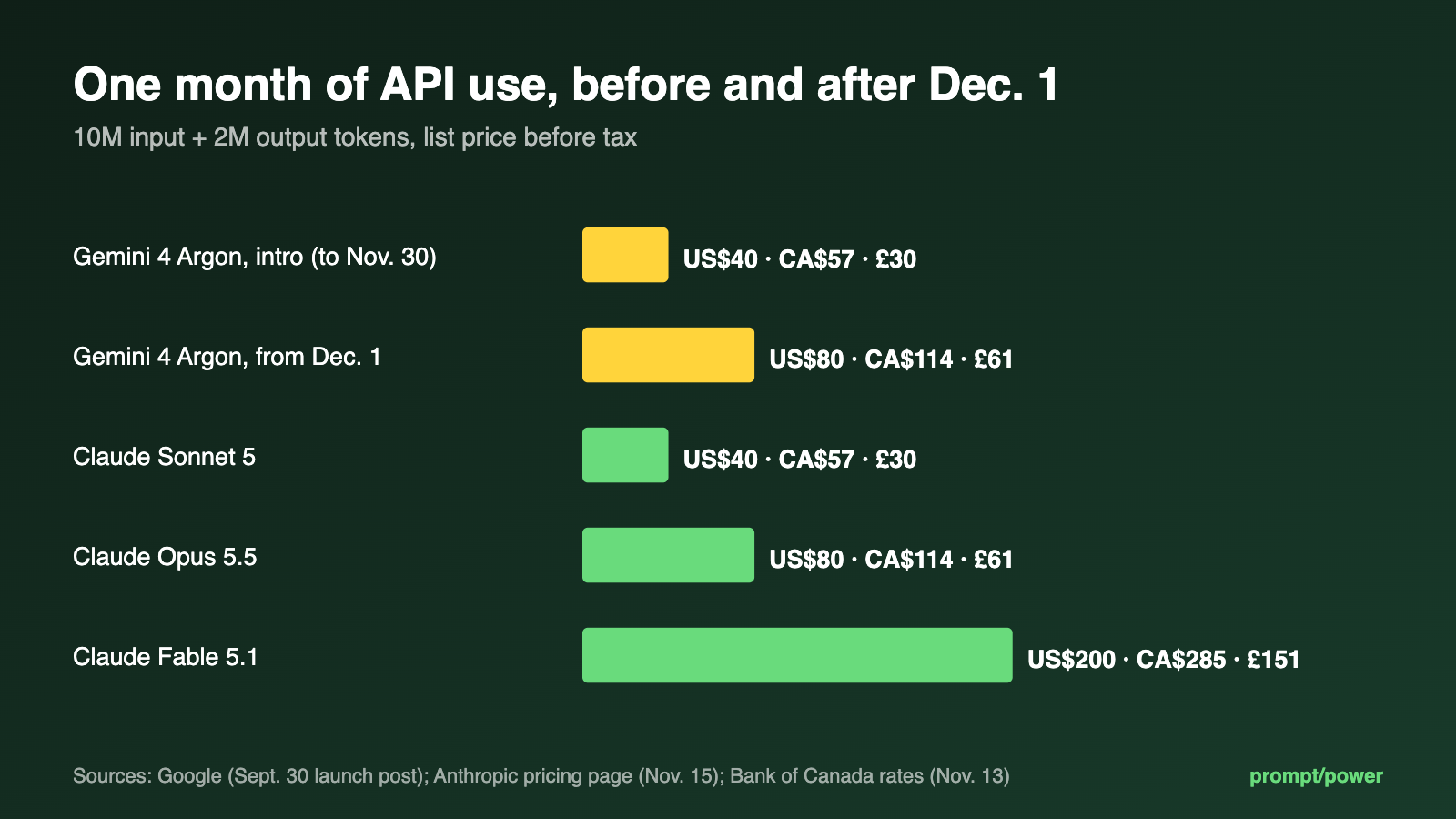
What a typical month costs
To make the numbers concrete, we priced one example workload: 10 million input tokens and 2 million output tokens in a month, roughly a small team’s internal assistant or a modest customer-support bot. We converted at the Bank of Canada’s Nov. 13 indicative rates (US$1 = CA$1.4257; £1 = CA$1.8848).
- Gemini 4 Argon, introductory: US$40 (about CA$57 or £30)
- Gemini 4 Argon, from Dec. 1: US$80 (about CA$114 or £61)
- Claude Sonnet 5: US$40 (about CA$57 or £30)
- Claude Opus 5.5: US$80 (about CA$114 or £61)
- Claude Fable 5.1: US$200 (about CA$285 or £151)
Your mix will differ. Output-heavy jobs, such as long reports or code generation, are hit hardest, because output tokens cost five times as much as input on all five price lists. Reasoning models add a hidden cost: thinking tokens count as output.
What to do before Dec. 1
First, find your real token split in your provider’s usage dashboard rather than guessing. Second, check how much of your input is cacheable: repeated system prompts and documents are billed at a fraction of the input rate on both Google’s and Anthropic’s price lists, and the cached rate matters more once the base rate doubles. Third, if you budget in Canadian dollars or pounds, remember that both providers bill in US dollars, so your card issuer’s foreign-exchange fee sits on top of our figures.
And test before you switch. The price match between Argon and Opus 5.5 after Dec. 1 means the decision comes down to which model does your job better, not which is cheaper.
Prices are list prices as published by Google and Anthropic, before tax. Conversions are ours and indicative only.
More from prompt/power: What GPT-6.1 Terra costs · Cloudflare Workers AI’s GLM 5.3 · Anthropic’s S-1, explained
Researched and drafted with AI tools, fact-checked against primary sources and approved by a human editor before publishing. Prices and dates are as of publication. Our standards →

Alicia Loveday is a senior editor at prompt/power and a mom who works where fashion meets AI. She leads Tech & Your Money: what Canadians actually pay for phones, plans and gadgets, and the fine print that changes the bill. When the news needs her elsewhere, she goes. She believes every algorithm should come with a return policy.
All stories by Alicia →Keep reading



Latest from prompt/power
- Nvidia beats its own forecast with US$115.8 billion, then guides margins lowerNov 18
- Apple, the NSA and Chase: what each says broke in a week of outagesNov 18
- AntiFox: attackers are using an AI pentest agent to steal AWS secrets. Six checks to runNov 17
- TSMC will buy up to US$500 million of Anthropic stock at the IPO price, and put the same into OpenAINov 17
- Jensen Huang’s resignation: what Nvidia’s 8-K says and leaves outNov 16