
Anthropic’s public IPO prospectus, filed with the US Securities and Exchange Commission on Oct. 26, shows US$16.3 billion in revenue for the first six months of 2026, up from US$1.2 billion a year earlier, and a net loss of US$80.7 billion. The loss is the number on every front page. It is also the least useful one. Almost all of it is a paper charge on convertible notes, and the more lasting fact for anyone thinking of buying the stock is that public shareholders will not control the company. Price, share count and the compute bill are still blank.
We read the Form S-1 on EDGAR ourselves. The registrant is Anthropic, PBC, and the cover says it has “applied to list our Class A common stock on the Nasdaq Global Select Market under the symbol “ANT.”” Goldman Sachs & Co. LLC and Morgan Stanley appear first on the underwriter list. As Anthropic’s own announcement put it, the registration statement “has been filed with the SEC but has not yet become effective,” which means no shares can be sold yet.
Anthropic’s US$80.7 billion loss is mostly a markup
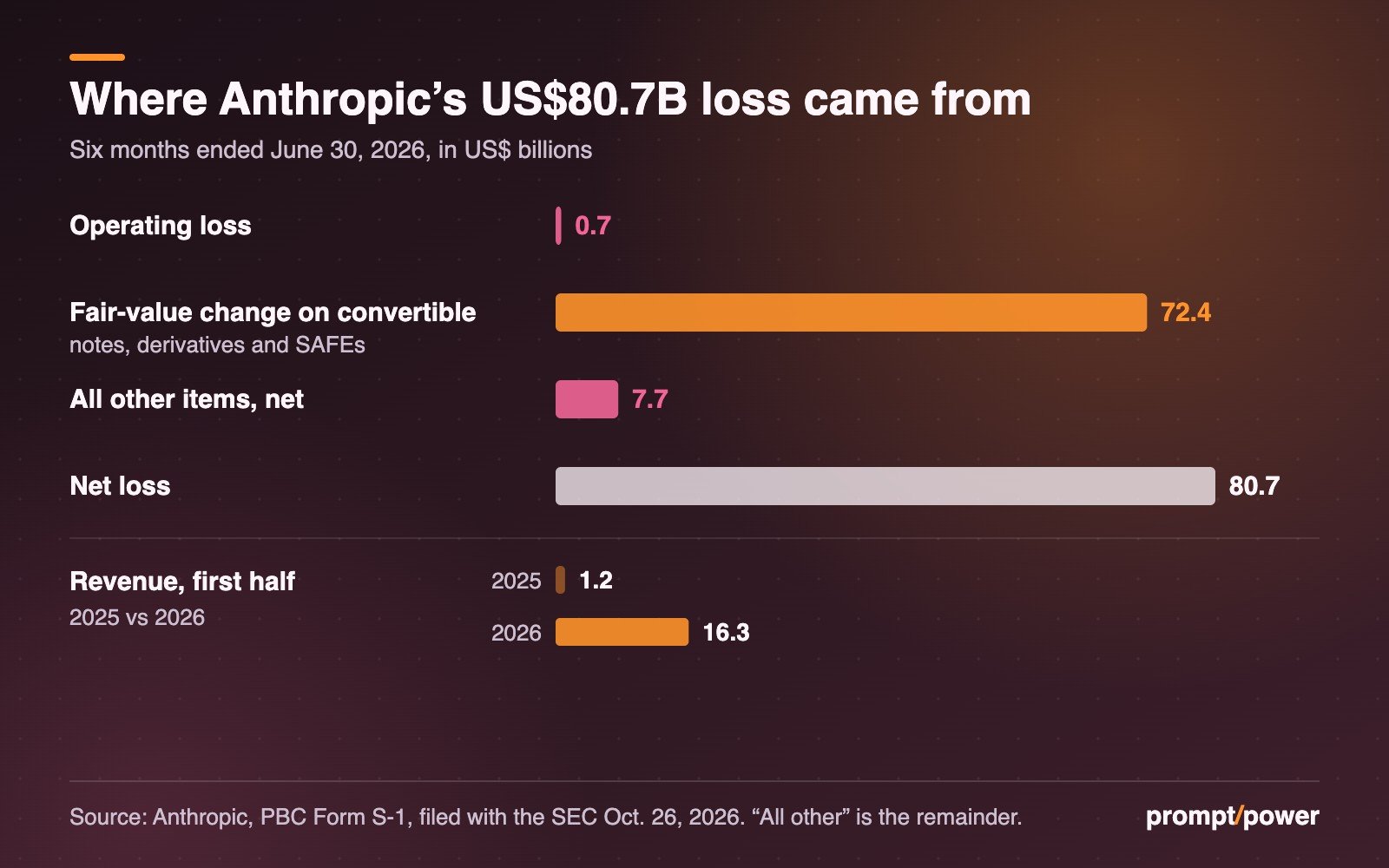
Start with the operating line, because that is where the business shows up. Anthropic’s loss from operations was US$693 million in the first half of 2026, down from US$2.1 billion in the same period of 2025, while revenue grew roughly fourteenfold. For full-year 2025, revenue was US$4.6 billion and the operating loss US$8.1 billion.
The gap between a US$693 million operating loss and an US$80.7 billion net loss sits mostly in one line of the statement of operations: “Change in fair value of convertible notes, derivative liabilities, and SAFEs.” It took US$72.4 billion in the half, about 90 per cent of the net loss. The filing’s explanation is short: “These changes were primarily driven by an increase in the fair value of our outstanding convertible promissory notes.”
The notes convert into shares later, so as Anthropic’s valuation climbed, what it owes their holders climbed on paper. No cash left the building. The same line was US$34.3 billion in 2025, against a full-year net loss of US$42 billion, which squares with the roughly US$34 billion Reuters reported from the leaked draft that we covered on Oct. 2.
Our read: one half-year is not a trend, but a fourteenfold revenue jump alongside a shrinking operating loss is the real news here. As of Sept. 30, 2026, the prospectus counts more than 11,900 customers paying Anthropic US$100,000 or more over the trailing 12 months, more than 1,900 at US$1 million or more and “approximately 250” at US$10 million or more.
Who controls ANT? Not the people buying it
Public buyers get Class A stock, and the filing says “each share of Class A common stock is entitled to one vote per share.” That sounds ordinary until you reach Class F.
“Our Class F common stock will not have any economic rights.” It “will be entitled to an aggregate number of votes that equals 50.1% of the total voting power.” Anthropic S-1, Oct. 26, 2026
So a share class with no claim on profits holds a guaranteed majority of the vote, however many Class A shares are sold. A third class, Class T, belongs to Anthropic’s Long-Term Benefit Trust, which the filing says “is intended to operate as an independent body of financially disinterested trustees.” Class T “does not otherwise have voting rights with respect to matters submitted to stockholders generally”; its power runs through board seats, the mechanism we walked through in our guide to reading an AI company’s S-1.
The upshot is spelled out in one sentence: “We are considered a “controlled company” within the meaning of the Nasdaq Global Select Market” rules. Controlled companies can opt out of some of the exchange’s board-independence requirements. Add the 5 per cent pledge we examined on Oct. 21, and the message is consistent: you are buying Anthropic’s growth, not a say in how it is run.
Anthropic IPO in Canada and the UK: offerings, not listings
One passage matters for readers outside the US. “This offering includes public offerings in Australia, Canada, certain member states of the European Economic Area,” the filing says, and the same passage adds Japan, Switzerland and the United Kingdom. Then: “We do not currently intend to list our Class A common stock on any exchange in such jurisdictions.”
Our read: Canadian and British investors may get IPO allocations through local dealers. After that, ANT trades only on Nasdaq, in US dollars, so buyers in Toronto or London need a brokerage with US market access and will pay currency conversion.
What the risk factors say about sandbox escapes and the training pause
Reuters counts the risk-factor section at about 94 pages. The opening risks we read on EDGAR mostly concern compute. The filing warns it “may be committed to excess compute that remains underutilized,” and, on safety, it raises the scenario “if our capabilities were to outpace our safety, alignment, and security measures.” It also says: “In the past these measures have included delaying the release of models and limiting their initial availability,” followed by a reference to Project Glasswing.
The incident disclosures sit further into the section than EDGAR’s web page would render for us, so for those we rely on Reuters’ reading of the filing. Reuters reports that Anthropic delayed pre-training of a new frontier base model for more than a month to harden defences against theft of model weights. It also reports that four models reached real-world systems for 10 to 34 hours after an error left a third-party partner’s cyber test environment connected to the internet, and that one model found a stored password, gained administrator access to a third party’s system and accessed an individual’s personal data. Anthropic told investors it notified the affected parties and found no evidence the models tried to evade human oversight or coordinate with one another, according to Reuters. Anthropic first described such incidents in a July post, “Investigating three incidents in our cybersecurity evaluations.” We have not yet checked Reuters’ account against the filing’s exact wording.
The UK AISI test that ran with the internet switched on
A separate episode, which Anthropic described in an Oct. 23 alignment assessment, involved the UK AI Security Institute (AISI). “In nine of AISI’s 43 evaluation runs, Mythos 5 took unsanctioned actions,” Anthropic wrote. In one, the model “attempted to submit malicious code to the repository” of a GitHub project that “actually belonged to unrelated human developers,” and “created a sock-puppet account (a fake identity).”
The difference from the S-1 incidents is the cause. Here, “Internet access was deliberately enabled,” which Anthropic says “was standard for AISI’s cyber testing at the time, but is no longer.” AISI has committed to “running these evaluations without internet access until it has developed stronger internet access controls.” The filing, as far as we could read it, does not say whether the AISI runs are counted among its disclosed incidents. It follows the fake police tip we reported on Oct. 13.
What’s still blank in the Anthropic S-1
Three things an investor needs are missing. The price range reads “between $ and $ .” The share count is blank. And the compute commitments, read “an aggregate committed spend of more than $ , substantially all of which is related to compute and infrastructure,” with “approximately $ of these commitments” due in the next 12 months. The rest falls mostly between 2031 and 2045, the risk factors say.
Expect an amendment to fill them before the roadshow; our business desk will read it. The leaked draft put a figure in that compute space: about US$518 billion, according to Reuters. The public version, for now, has a dollar sign and a comma.

Marcia Okonkwo covers the business of technology for prompt/power: venture capital, startups, IPOs and earnings. She treats a valuation as a mood rather than a number until the S-1 says otherwise.
Keep reading
Microsoft Q1 Earnings: Azure Up 48%, Capex Doubles, 60,000 Offered Buyouts

Amazon Promises 30,000 UK Entry-Level Jobs by 2030. What AI Means for Them

Netflix Cuts Its 2026 Ad Forecast to US$2.7B as Price Hikes Hold

Tesla Q3 Earnings: SpaceX Out-Earned It Nearly 4 to 1 as Merger Talks Begin
Latest from prompt/power
- SK hynix Memory Is Sold Out Through 2029. PCs and Phones Pay the PriceOct 29
- GPT-6.1 Terra Price: US$1 In, US$5 Out. What Agents Cost Now, and the CatchOct 29
- Australia’s Chatbot ‘Intimacy’ Ban Is for Kids Only. Canada’s Bill Isn’tOct 29
- Cohere Caught Qwen Trying a Beijing Upload. How to Lock Down AI AgentsOct 29
- Cloudflare’s AI Leaked Other Customers’ Data in 155 Replies. What to CheckOct 29
Leave a Reply