Can an AI chatbot be your therapist? Where the rules stand in the U.S., Canada and beyond
Millions of people now talk to general-purpose chatbots about anxiety, grief and loneliness, and a growing number of apps market AI “therapists” directly. Regulators have only begun to draw lines. Here’s where the rules stand, what a chatbot can and can’t legally be, and what to look for if you use one.
Illinois: the first state to bar AI therapy
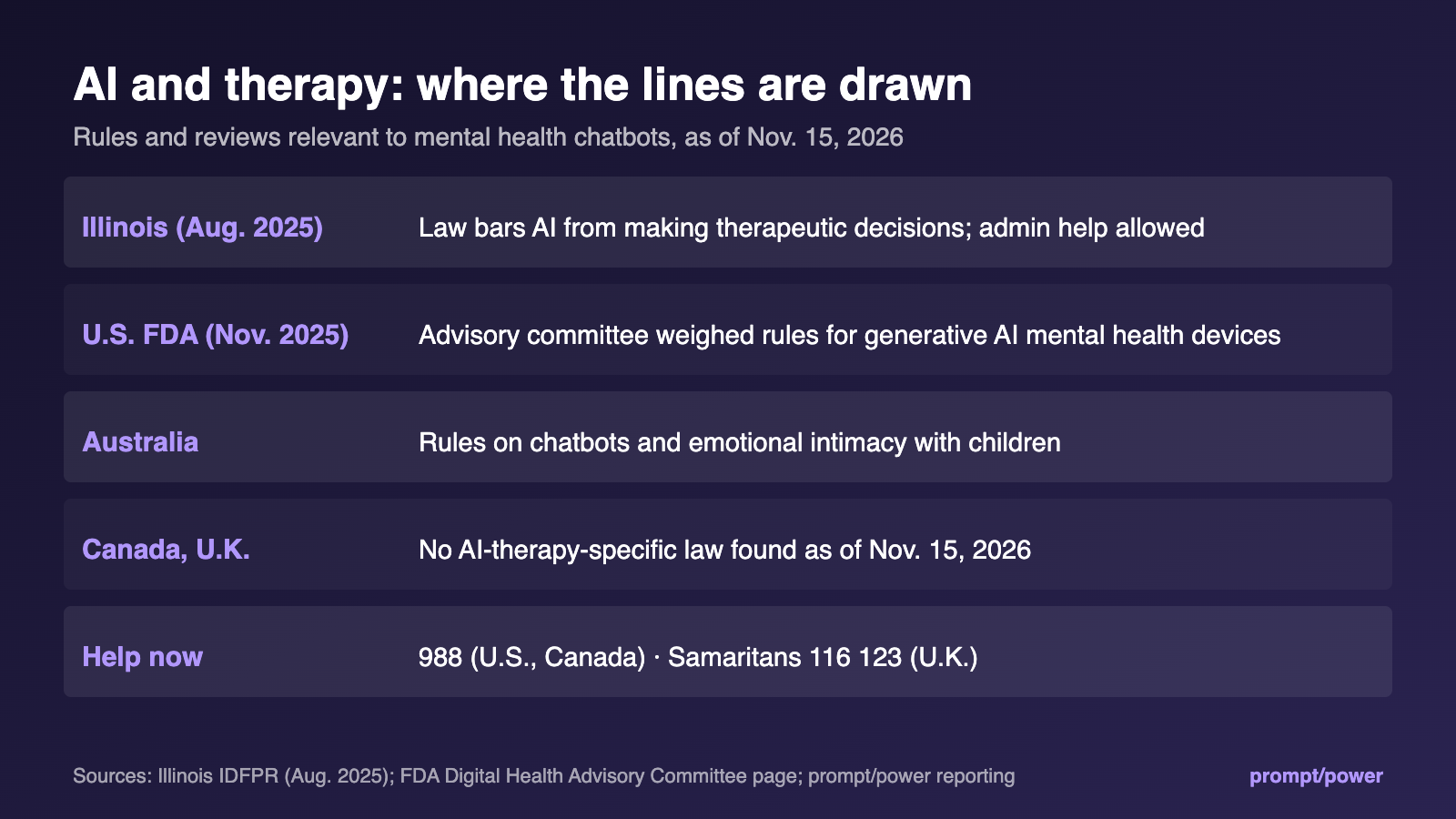
In August 2025, Illinois Gov. JB Pritzker signed the Wellness and Oversight for Psychological Resources Act (HB 1806). According to the state’s professional regulator, the IDFPR, the law prohibits anyone from using AI to provide mental health and therapeutic decision-making, while still allowing licensed professionals to use AI for administrative and supplementary support, such as scheduling or notes. “The people of Illinois deserve quality healthcare from real, qualified professionals,” said IDFPR Secretary Mario Treto Jr.
In practice, that means an app can’t present an AI as the one doing therapy in Illinois. It doesn’t stop people from talking to a general chatbot about how they feel.
The FDA: devices, not chatbots in general
At the federal level, the question is whether a product is a medical device. On Nov. 6, 2025, the FDA’s Digital Health Advisory Committee met specifically on generative AI-enabled digital mental health devices, discussing benefits, risks, possible mitigations, and what evidence should be required before and after approval. The FDA’s page doesn’t list the committee’s specific recommendations, and an advisory committee doesn’t set rules by itself.
The distinction matters. A company that claims its app treats depression is making a medical claim and invites FDA oversight. A general assistant that people choose to confide in isn’t making that claim, which is why most of today’s emotional use of AI falls outside medical regulation entirely.
Elsewhere
Australia has moved on a narrower front, with rules on chatbots and emotional intimacy aimed at protecting children, which we covered last month. In Canada, the federal government’s online safety bill, C-34, introduced in June, would require AI chatbot companies to reduce the risk of harmful content and to have crisis-intervention protocols for self-harm, suicide and violence, Global News reported; trade-press coverage of the draft says it also targets chatbots that falsely present themselves as experts in fields such as medicine. It isn’t law yet, and it would create a new digital safety regulator. In the U.K., we found no law aimed specifically at AI therapy as of Nov. 15; general consumer protection, privacy and professional-licensing rules apply.
If you use a chatbot for support
Some practical checks. Does the app say clearly that you’re talking to an AI, and that it isn’t a licensed clinician? Does it tell you what happens to what you share, and can you delete it? Does it point you to a human when you mention self-harm? Apps that market themselves as “therapy” without a licensed professional involved deserve the most scepticism.
A chatbot can be a place to put thoughts into words. It isn’t a substitute for care when things are serious. If you’re in crisis, call or text 988 in the U.S. or Canada, or call Samaritans on 116 123 in the U.K.
More from prompt/power: Australia’s chatbot rules for children · How to lock ChatGPT chats · How much energy one AI chat uses

Keep reading




Latest from prompt/power
- Quebecor’s offer for TELUS says nothing about TELUS’s AI factories. Here’s what’s at stakeNov 16
- ChatGPT, Claude, Gemini and Copilot: what every AI plan costs in CanadaNov 16
- Nvidia’s first earnings without Jensen Huang: the numbers to watch on TuesdayNov 16
- SoftBank wrote off 39% of its AI power equipment spendingNov 16
- Anthropic’s IPO week: the dates, the numbers and what to watchNov 15
Leave a Reply