
OpenAI’s models are now on Google Cloud, in private preview. Google’s announcement on Oct. 21 names three of them, GPT-Astra, GPT-6.1 Sol and GPT-6 Luna, “rolling out now in private preview to select enterprise customers” in Vertex AI’s Model Garden, billed through Google Cloud Marketplace. OpenAI’s own post says general availability is “planned in the coming weeks.” Neither company published a per-token price or a list of regions.
That last gap is the one that matters to anyone who has to tell a compliance officer where a prompt is processed. So we read the region and model documentation from Microsoft, Amazon and Google to map where OpenAI’s newest models can actually run today, and set them against Anthropic’s Claude and Google’s Gemini. The short version: OpenAI is now sold on all three big clouds, but in Canada none of them, on the pages we read, promise to keep inference inside the country.
What OpenAI on Google Cloud includes
The two announcements overlap but are not identical, and the differences are worth reading closely.
OpenAI describes the deal as bringing its “frontier models and Codex agentic workflows” into Model Garden. It does not name a single model. Google’s post, written by Michael Gerstenhaber, vice-president of product management for Gemini at Google Cloud, does. It describes GPT-Astra as built for “demanding work across coding, computer use, professional tasks, and scientific research,” GPT-6.1 Sol as “near-Astra intelligence at lower cost,” and GPT-6 Luna as “a fast, cost-efficient model for everyday work at scale.”
Google also says customers can “connect their local Codex CLI and Desktop workflows directly to our Gemini platform for inference.” In practice, that means a developer using OpenAI’s coding agent could run it against models billed on a Google invoice instead of an OpenAI one.
The billing line is the commercial heart of this. Because the models are sold through Marketplace, Google says usage “appears on a single Google Cloud invoice, draws down existing cloud commitments,” and counts toward its Flexible Savings Plans. Large companies sign multi-year spending commitments with their cloud provider. Letting OpenAI spend count against a Google commitment removes the main reason a Google Cloud shop would have had to open a separate contract with OpenAI or Microsoft.
Both posts say OpenAI models are coming to more Google products. OpenAI says they “will soon be available in Google Antigravity and the Gemini Agent.” Google’s version says “Gemini for business and Google Antigravity.” We read that as the same plan described in two vocabularies; neither gives a date. Google already routes some Gemini agent work to other companies’ models, as we found when we looked at how Gemini’s agent hands tasks to Claude.
One sentence in OpenAI’s post is aimed at Redmond: “Microsoft remains OpenAI’s primary cloud partner.”
Where OpenAI, Claude and Gemini run: the cloud table
Google framed the launch as a first. Its post says Google Cloud “is now the only hyperscale cloud provider offering access to all three leading closed source LLMs,” meaning Gemini, Claude and GPT. Here is how that holds up against each provider’s own pages, as we read them on Oct. 21.
| Model family | Microsoft Azure (Foundry) | Amazon Bedrock | Google Cloud (Vertex AI) |
|---|---|---|---|
| OpenAI GPT-6 family | Yes. Microsoft is the primary partner | Yes, generally available | Private preview from Oct. 21 |
| Anthropic Claude | Yes | Yes | Yes |
| Google Gemini | No | No | Yes |
| Canada: OpenAI models | Canada Central and Canada East, Global Standard only | From Canada Central and Canada West (Calgary), via cross-region inference | No regions published |
| Canada-only processing for OpenAI | Not offered on the page we read | No. “North America” at best | Not stated |
The sources for each row: Microsoft’s Foundry region availability page; Amazon’s Oct. 20 guide to using OpenAI models on Bedrock from Canada; Anthropic’s announcements of Claude in Microsoft Foundry and AWS’s Claude Opus 5.5 launch post; and Google’s Oct. 21 post for Vertex AI. Gemini’s absence from Azure and AWS rests on Google’s own “only hyperscale cloud provider” claim, which neither rival has disputed on its own pages.
Azure and AWS in Canada: what the documents say
Microsoft’s table is the most detailed. It lists gpt-6-astra, gpt-6-sol, gpt-6-luna and gpt-6.1-sol, plus the GPT-5.6 models and GPT-5.5, as available in both Canadian Azure regions. But only under Global Standard, the deployment type Microsoft sells for capacity and price rather than location. None of those models appear in the page’s regional Standard table for Canada, and the Data Zone tables, Microsoft’s middle option for keeping processing inside a group of regions, list only US regions for them.
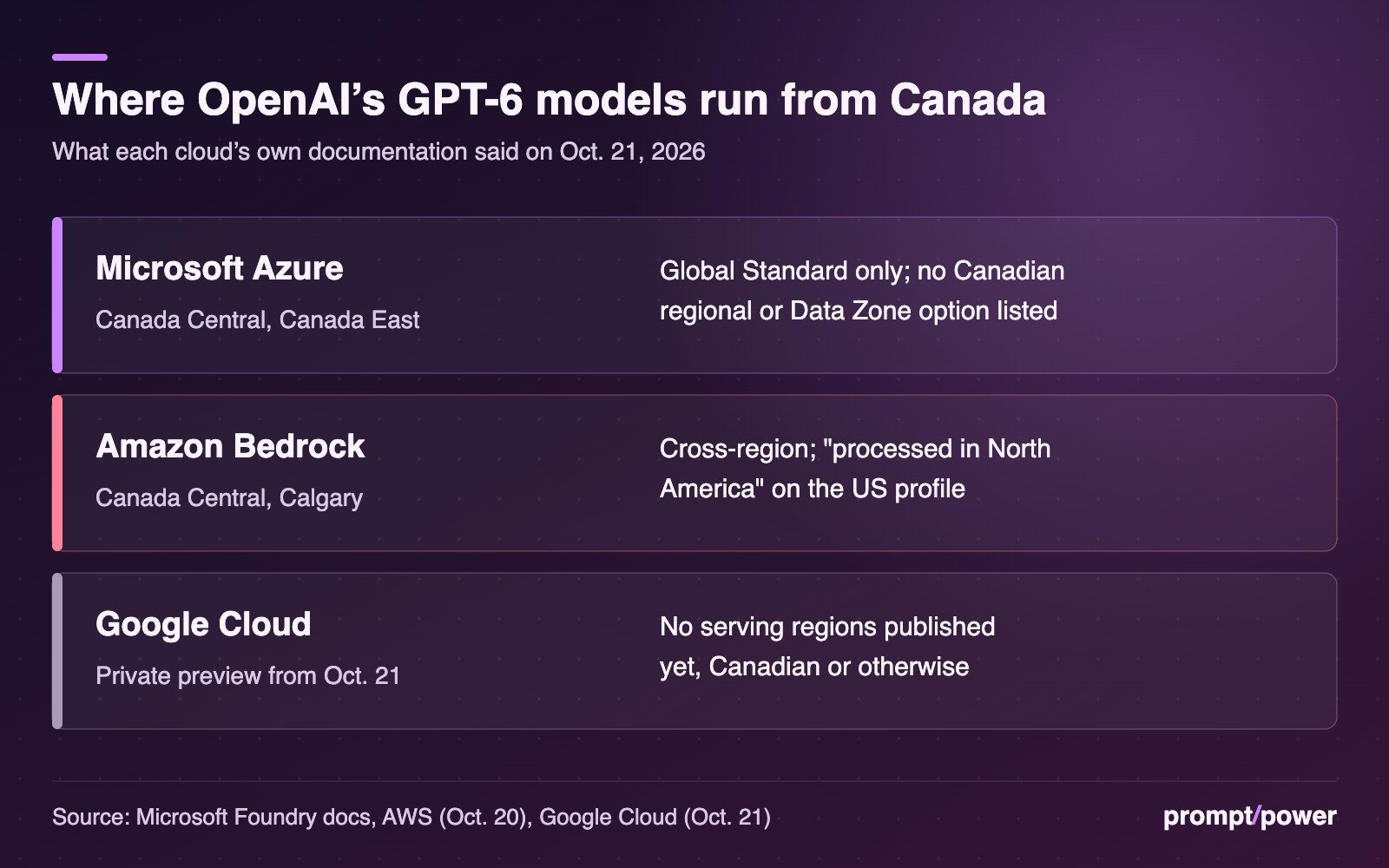
Amazon’s guide, published Oct. 20, is unusually candid. It says GPT-5.6 Sol, Terra and Luna, GPT-6 Astra, Sol and Luna, and GPT-6.1 Sol can be called from the Canada (Central) and Canada West (Calgary) regions using cross-region inference. Then it explains what that means:
- “Inference is processed in North America” when customers use the US geographic profile, which routes to “your Canadian source Region and US Regions.”
- The global profile routes to “supported commercial AWS Regions where the model is deployed,” which is wider still.
- “Your data at rest stays in your source Region by default.”
- Content flagged by abuse classifiers “might be retained for up to 30 days in the destination Region for review.”
The guide’s own example log shows a request made from Canada being served in us-west-2, Amazon’s Oregon region. For a Canadian bank or hospital, that is the sentence to forward to legal.
Amazon’s own example shows a request sent from Canada and answered in Oregon.
What OpenAI’s post leaves out
Against those two documents, the Google launch is thin on specifics. Here is what neither Oct. 21 post says:
- Prices. No per-token rates from either company, and no word on whether Google’s rate will match OpenAI’s own API.
- Regions. No list of Google Cloud regions where the OpenAI models are served, including Montreal and Toronto, Google’s two Canadian regions.
- Data retention. Google says prompts and outputs “remain entirely within your designated data perimeter and are never used to train foundation models,” but Zero Data Retention options are “coming soon,” as is Confidential Compute.
- Which “Astra.” Google’s post says “GPT-Astra.” Azure and Bedrock list the model as GPT-6 Astra. OpenAI shelved GPT-6.1 Astra earlier this month, so the name on Google’s page most likely refers to GPT-6 Astra. Google has not said.
Google does say the models “run on dedicated Google Cloud infrastructure,” which suggests OpenAI is not simply forwarding Google customers’ calls to its own servers. That is a meaningful claim, and one that would be easier to assess with a region list attached.
Why Ottawa’s sovereign compute push matters here
For Canadian public-sector buyers, the question is not which cloud has GPT-6. It is which one will keep the work in Canada. Ottawa has spent 2026 pushing domestic capacity, from the national AI supercomputing initiative announced in April to its sovereign AI infrastructure work with Telus in May.
Today’s documents show the gap that work is meant to fill. The newest OpenAI models reach Canadian cloud accounts on Azure and Bedrock, but the processing guarantees on offer stop at “North America” or at Microsoft’s global pool. Google has not yet said anything about Canada at all.
What to do if you buy cloud AI
- If you are a Google Cloud customer, request access through Google’s interest form, then ask your account team for three things in writing: the serving regions, the price per million tokens, and the date Zero Data Retention arrives.
- If you need processing in Canada, none of the three clouds, on the pages we read, offers OpenAI’s GPT-6 models with in-country processing. Treat any sales claim otherwise as something to verify against the provider’s region table.
- If you are on AWS, pick the “us.” inference profile over “global.” if you want processing kept in Canada and the US. Amazon’s guide gives the example profile name us.openai.gpt-5.6-terra.
- If you are on Azure, check whether your use case can live with Global Standard before building on GPT-6. The older regional deployments are where location is pinned.
The bigger shift is in purchasing power. A year ago, a company that wanted OpenAI’s best models had to sign with OpenAI or Microsoft. As of Oct. 21, the same model can be bought against an Amazon, Microsoft or Google commitment, which makes OpenAI’s models a line item rather than a platform choice. Microsoft’s newest bet on running Copilot on its own Maia chips looks a little different in that light. More of our coverage is on the AI and machine learning page.
Google’s post ends its OpenAI model list with three words: “more coming soon.” Its region list, for now, has none.

Cassandra Lee covers AI and machine learning for prompt/power: the labs, the model releases, the research and the safety fights that come with them. She reads model cards the way other people read horoscopes: skeptically, and mostly for what's left unsaid.
Keep reading




Latest from prompt/power
- Apple ‘Pro and Tell’ Oct. 28: What’s Confirmed and What’s Only RumouredOct 22
- Tesla Q3 Earnings: SpaceX Out-Earned It Nearly 4 to 1 as Merger Talks BeginOct 22
- Meta Q3 Earnings: A US$64.6B Beat, US$34.9B of Capex and Negative Cash FlowOct 22
- PHP2Shell: Ottawa Pulled Websites Offline. Here’s What to Patch NowOct 22
- Ofcom Fines Tismi £437,500 for Leaving 366,000 Numbers Open to ScammersOct 22
Leave a Reply