
Australia’s House of Representatives on Wednesday, Oct. 28, passed the Online Safety Amendment (Digital Duty of Care) Bill 2026 with a late addition aimed at AI companions. Platforms would have to bar “material or conduct that simulates emotional intimacy and encourages or fosters a child’s dependence on it,” in the amendment’s wording as reported by The Next Web. Independent MP Kate Chaney moved it and the government accepted it. It is not law yet. The bill goes to the Senate, where a Greens-led inquiry is due to report in late November, and Labor wants it passed by the end of 2026. The rule protects children only; adults who use AI companions are not covered.
The bill’s page on the Parliament of Australia site was not reachable for us at deadline, so the text we can set beside it is the September exposure draft, read here through Allens’ Sept. 24 analysis. It shows what the chatbot clause is bolted onto, and how it compares with the rules in the US, the UK and Canada, where a bill tabled in June already goes further.
What the Chaney amendment adds to Australia’s duty of care
The core of the bill is one obligation. Anyone responsible for an online service must ensure, “so far as is ‘reasonably practicable’,” that it provides a “safe online environment,” per the draft. It reaches social media, messaging, many websites, hosting providers, search engines and app stores, plus AI tools that let users generate and share content. There is no small-business carve-out, and overseas companies serving Australians are caught. Providers would have to assess the risks of their service in writing at least once a year and keep records for six years.
Chaney’s amendment adds emotional dependence to the list of harms that duty covers. A second Chaney change, also accepted, requires the algorithm opt-out the bill gives social media users to be “accessible, easy to use” and “prominently available.” The Coalition and One Nation voted against the bill, according to The Next Web, which built on The Guardian’s report. The Greens want higher penalties and a right for Australians to sue platforms.
Prime Minister Anthony Albanese said stories of people “identifying a chatbot, a non-person as their best friend” should be “a huge wake up call for every member of this parliament,” as quoted by The Next Web. Communications Minister Anika Wells, who leads the bill, told ABC radio that critics “should bring an amendment, not a slogan to ‘kill the bill’,” the outlet reported.
The A$100 million question
The exposure draft set a civil penalty of up to 60,000 penalty units per breach, about A$100 million by Allens’ reckoning, with infringement notices of up to 600 units, about A$218,000. It is a flat cap. Nothing scales with a company’s size or revenue. Trade outlet Mi-3 headlined the bill as introduced in mid-October as an A$109m bill; we could not check that figure against the introduced text.
Britain’s Online Safety Act works the other way: fines of up to £18 million or 10% of worldwide revenue, whichever is greater. For the largest US platforms, 10% of revenue is many times Australia’s cap. Our read: Australia is betting that counting breaches one by one will make up the difference.
Canada’s chatbot bill targets emotional attachment for every user
Canada’s government tabled Bill C-34, the Safe Social Media Act, on June 10. Law professor Michael Geist’s section-by-section reading shows it regulates chatbots directly. It defines a chatbot service as an AI system that can be used “to simulate a sustained human-like relationship” with a user. Section 53 requires services to mitigate the risk of “using manipulative engagement techniques to encourage a user of the service to form or maintain an emotional attachment.” That applies to every user, not only children. Section 51 requires a chatbot to interrupt the conversation and point to human crisis services when a user expresses suicidal ideation.
The Canadian bill’s maximum administrative penalty is the greater of 3% of gross global revenue or CA$10 million (about US$7.1 million), per Geist. It also bars under-16s from accounts on platforms that cabinet will designate later. Like Australia’s, it is still a bill.
Britain has no dependence rule; California has a three-hour timer
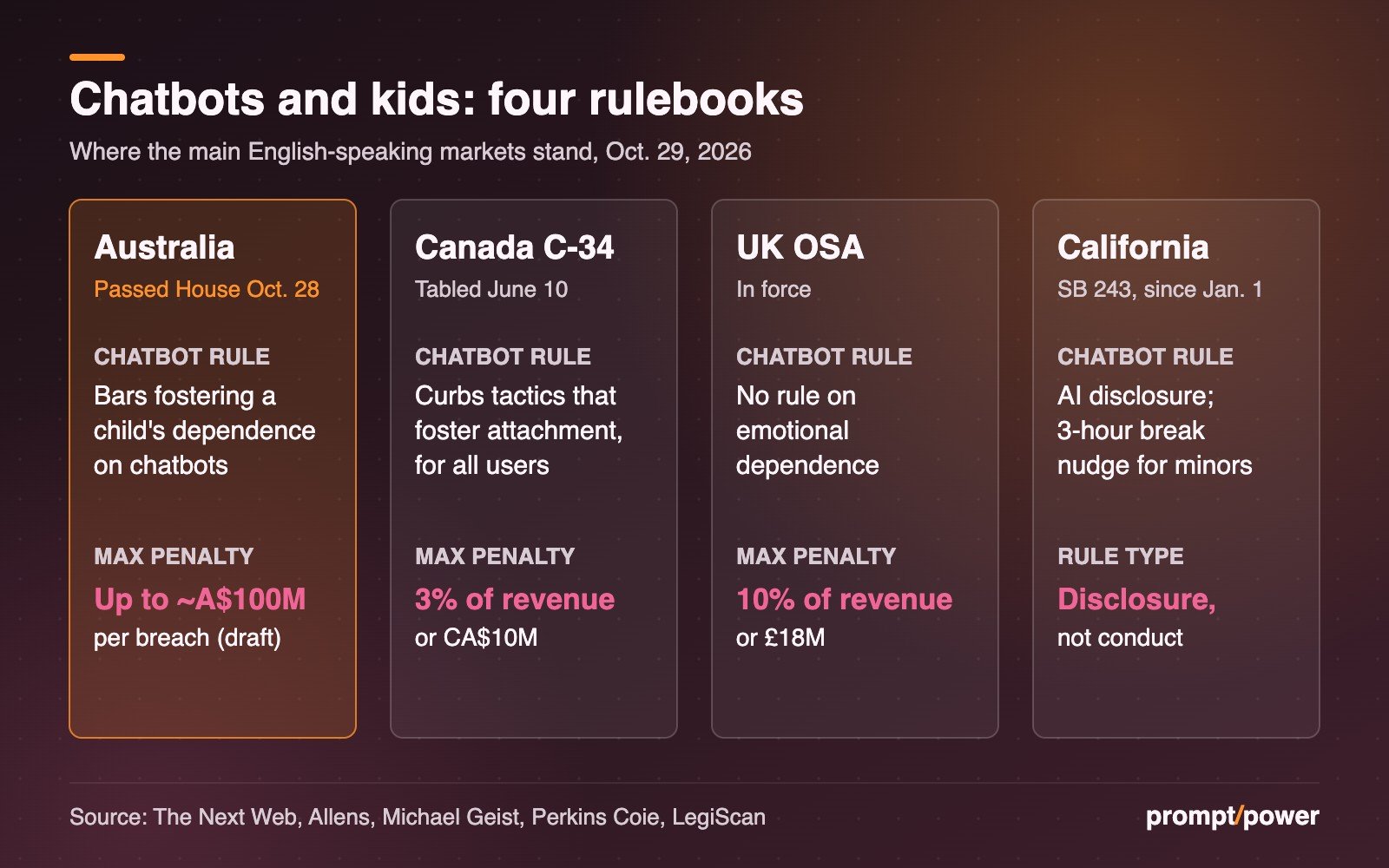
In Britain the Online Safety Act is in force, but nothing in it targets emotional dependence by name, and the regulator’s own scorecard is grim. Ofcom’s Oct. 22 report on content harmful to children found children seeing as much harmful content as before its child-safety duties took effect, MLex reported.
The US has no federal rule. California’s SB 243, in force since Jan. 1, 2026, is the closest thing: under the chaptered text, operators of companion chatbots must disclose that the bot is AI, and for users they know are minors, remind them at least every three hours to take a break. It is a disclosure rule. Australia’s would be a conduct rule, and an untested one, since no regulator has yet had to decide when warmth becomes fostering dependence.
For parents, none of these new rules changes anything yet. The controls that exist today are in our parents’ guide to AI chatbots, and our report on ChatGPT’s teen accounts shows how far they fall short. More on age rules is in our piece on the app-store age-verification fight and across our policy coverage.
The Senate inquiry reports in late November. Until something passes, the only chatbot rule for children in force anywhere in this story is California’s: a reminder, every three hours, that the friend on the screen is software.

Priya Natarajan covers science and society for prompt/power: climate and energy tech, data centres, and the physical cost of the digital world. Every query has a water bill, and she would like to see the receipt.
Keep reading




Latest from prompt/power
- SK hynix Memory Is Sold Out Through 2029. PCs and Phones Pay the PriceOct 29
- GPT-6.1 Terra Price: US$1 In, US$5 Out. What Agents Cost Now, and the CatchOct 29
- Cohere Caught Qwen Trying a Beijing Upload. How to Lock Down AI AgentsOct 29
- Cloudflare’s AI Leaked Other Customers’ Data in 155 Replies. What to CheckOct 29
- Alphabet Q3 Earnings: Cloud Doubled, Then Alphabet Sold US$12.4B of StockOct 29
Leave a Reply