Five years ago, 193 countries agreed on AI ethics. What UNESCO’s recommendation actually asks
In November 2021, all 193 UNESCO member states adopted the first global agreement on AI ethics. What it says about data, surveillance and the environment.

Long before chatbots went mainstream, the world’s governments signed on to a set of rules for artificial intelligence. In November 2021, all 193 member states of UNESCO, the UN’s education, science and culture agency, adopted the Recommendation on the Ethics of Artificial Intelligence. UN News called it “the first-ever global agreement on the ethics of artificial intelligence.” Five years on, it’s worth looking at what it says, and what it can and can’t do.
What it says
The recommendation sets out shared values and principles for how AI should be built and used. Three provisions stand out.
Personal data. It calls for people to get more protection over their data, with transparency, control and agency over how it is used.
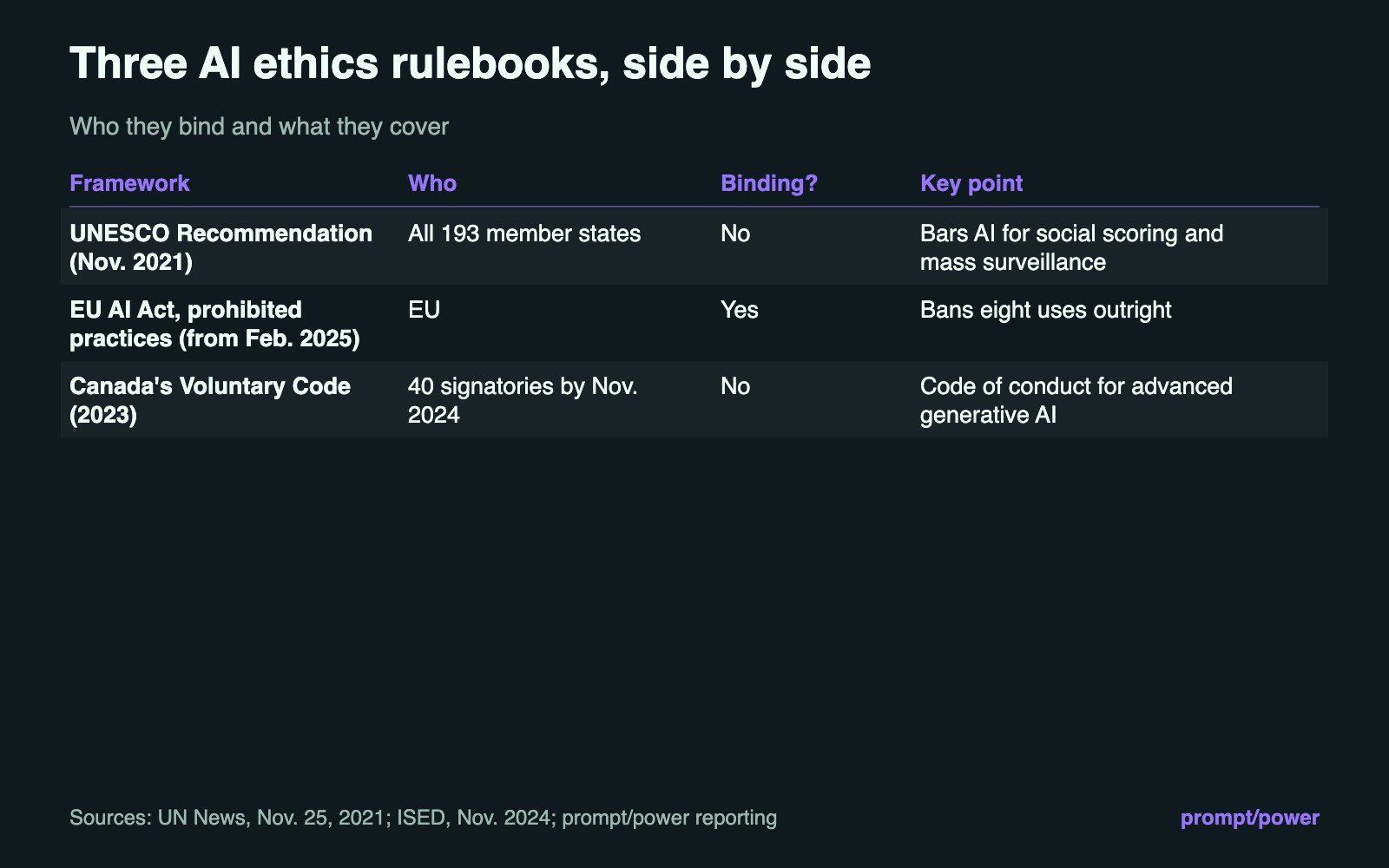
Social scoring and mass surveillance. It says AI systems should not be used for social scoring or for mass surveillance. Social scoring later appeared on the European Union’s list of banned uses too.
The environment. It asks people who build and deploy AI to favour methods that are efficient with data, energy and resources, so that AI helps address climate change rather than adding to it.
UNESCO’s director-general, Audrey Azoulay, summed up the case at the time: “The world needs rules for artificial intelligence to benefit humanity.”
What it can’t do
A UNESCO recommendation isn’t a treaty with penalties. Each country applies it in its own way, and UNESCO’s role is to support governments and ask them to report on their progress. In practice, that makes it a reference point rather than a rulebook. Nobody gets fined under it.
That is the key difference with the EU AI Act, whose bans on certain uses have applied since February 2025 and carry penalties. Canada sits somewhere in between: its Voluntary Code of Conduct on the Responsible Development and Management of Advanced Generative AI Systems, launched in 2023, had 40 signatories by November 2024, according to Innovation, Science and Economic Development Canada, but signing is optional.
How do countries actually use it?
Mostly as a checklist. UNESCO built a readiness assessment methodology that governments can use to measure where they stand against the recommendation: their laws, institutions, skills, infrastructure and data. Countries that run it get a report on gaps and suggested policies. It’s a voluntary diagnostic, not an audit, and the results are only as useful as the government’s willingness to act on them.
Is the U.S. still part of it?
Not for much longer. On July 22, 2025, the Trump administration announced that the United States would leave UNESCO for the second time, two years after rejoining, with the withdrawal taking effect in December 2026, PBS NewsHour reported. The State Department cited UNESCO’s admission of “the ‘State of Palestine'” among its reasons. Director-General Audrey Azoulay said she “deeply” regretted the decision, adding: “UNESCO’s purpose is to welcome all the nations of the world, and the United States of America is and always will be welcome.”
The recommendation doesn’t bind anyone, so U.S. withdrawal changes little legally. It does mean the world’s largest AI producer will sit outside the one global body whose AI ethics text almost every government signed. Canada and the U.K. remain members.
Why it still matters
The environmental clause looks more relevant now than in 2021. AI’s energy use has become a public question, and only a handful of companies publish what a single prompt costs in energy. A global agreement that asks for efficient methods gives regulators and the public a principle to point to, even if it can’t enforce it.
The social-scoring and surveillance language matters too. When governments write their own AI laws, the UNESCO text is one of the few documents almost every country has already endorsed. That makes it a useful baseline for a simple question: is a new AI system doing something the world already said it shouldn’t?
Last checked Nov. 24, 2026.
Sources
- UNESCO, Recommendation on the Ethics of Artificial Intelligence, adopted November 2021
- UNESCO, Readiness assessment methodology
- Innovation, Science and Economic Development Canada, Even more organizations adopting Canada’s voluntary code of conduct on artificial intelligence development, November 2024
- PBS NewsHour, U.S. to leave UNESCO again, 2 years after rejoining, July 22, 2025
More from prompt/power: The AI uses Europe has banned · What is an AI ‘safety case’? · How much energy does one AI chat use?
Researched and drafted with AI tools, fact-checked against primary sources and approved by a human editor before publishing. Prices and dates are as of publication. Our standards →
Sources- unesco.org — Recommendation on the Ethics of Artificial Intelligence
- unesdoc.unesco.org — readiness assessment methodology
- pbs.org — PBS NewsHour reported
- canada.ca — Even more organizations adopting Canada's voluntary code of conduct on artificial intelligence…

Jessie Isberg is a Toronto psychotherapist and musician. She also writes for Not An Atlas and The Remote.
All stories by Jessie →Keep reading



Latest from prompt/power
- TSMC’s US$165-billion Arizona plan: what’s running and what’s still promisedNov 26
- The WHO’s 40-plus rules for AI in health care, and why they matter nowNov 26
- Celestica and Nvidia now share the lead in AI network switches as Ethernet sales more than double, Dell’Oro saysNov 26
- Can you return a tech gift? Your rights in Canada, the U.S. and the U.K. are not the sameNov 26
- When will Anthropic join the Nasdaq-100 and the S&P 500? The rules, and ANT’s datesNov 25