The WHO’s 40-plus rules for AI in health care, and why they matter now
The World Health Organization's guidance on large multi-modal models lists five health uses and more than 40 recommendations for governments, developers and providers.


Generative AI arrived in health care faster than most rulebooks. One of the more complete attempts to set ground rules came from the World Health Organization, which on Jan. 18, 2024, published guidance on the ethics and governance of large multi-modal models, the kind of AI that can take in and produce text, images and other data. It contains more than 40 recommendations for governments, technology companies and health-care providers.
Nearly three years later, with AI scribes in clinics and health coaches in wearables, it reads less like a forecast and more like a checklist.
Five places it’s showing up
The WHO named five broad uses: supporting diagnosis and clinical care; patients exploring their own symptoms and treatment options; clerical and administrative work, such as visit notes and summaries of records; medical and nursing education, including simulated patient encounters; and scientific research and drug development.
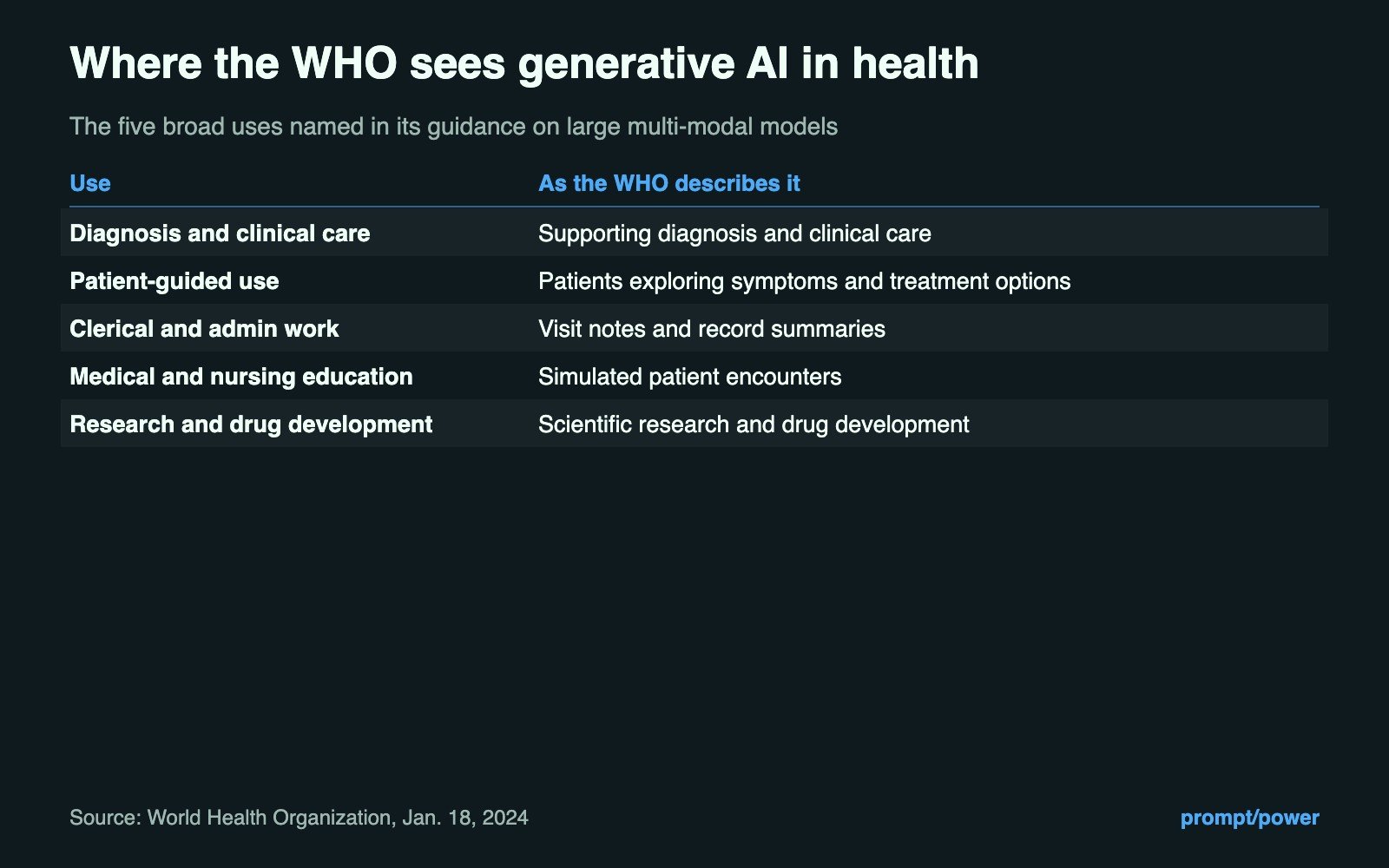
Every one of those is now real. That’s why the risks the guidance flags matter more than they did in 2024.
What risks does it name?
Four stand out, in the WHO’s own words:
- Wrong answers. Models carry “documented risks of producing false, inaccurate, biased, or incomplete statements,” which could harm people making health decisions.
- Over-trust. They can “encourage ‘automation bias’ by health care professionals and patients, whereby errors are overlooked.” That’s the risk with AI scribes: a doctor who stops reading the note closely.
- Security. They “are also vulnerable to cybersecurity risks that could endanger patient information.”
- Access. The guidance flags the “accessibility and affordability of the best-performing LMMs,” meaning the best tools may reach rich health systems first.
What it asks of governments
The WHO says governments should invest in public computing power and datasets, with ethical conditions attached to using them. It asks them to apply laws and rules so that AI used in health meets ethical and human-rights standards, to assign a regulator to assess and approve these models for health use, and to “Introduce mandatory post-release auditing and impact assessments, including for data protection and human rights,” when systems are deployed at scale.
“Governments from all countries must cooperatively lead efforts to effectively regulate the development and use of AI technologies, such as LMMs,” said Alain Labrique, the WHO’s director for digital health and innovation.
What it asks of developers
For companies building the models, the guidance says clinicians, researchers, patients and other affected people should be involved from the earliest stages of design. Systems should be built for well-defined tasks with the accuracy and reliability those tasks need, and developers should anticipate unintended effects.
That last point is the hardest. A general-purpose chatbot that wasn’t designed for medicine but is used for it anyway sits awkwardly in any regulatory system.
How it lines up with national rules
The WHO can’t enforce any of this. National regulators do. In Canada, Health Canada’s guidance for machine learning-enabled medical devices asks for representative data, plain labelling and a plan for how models will change after approval. In the U.K., NHS England has issued its own guidance on AI note-taking tools. In the U.S., some states have moved to limit AI therapy apps.
“Generative AI technologies have the potential to improve health care but only if those who develop, regulate, and use these technologies identify and fully account for the associated risks,” the WHO’s chief scientist, Jeremy Farrar, said at the launch. For patients, the WHO’s list doubles as a set of fair questions about any AI tool in their care: who approved it, who audited it, and what was it built to do?
Last checked Nov. 24, 2026. This is general information, not medical advice.
Sources
- World Health Organization, WHO releases AI ethics and governance guidance for large multi-modal models, Jan. 18, 2024
More from prompt/power: Can an AI chatbot be your therapist? · An AI may be taking notes at your doctor’s appointment · How Health Canada reviews AI medical devices
Researched and drafted with AI tools, fact-checked against primary sources and approved by a human editor before publishing. Prices and dates are as of publication. Our standards →
Sources- who.int — published guidance

Jessie Isberg is a Toronto psychotherapist and musician. She also writes for Not An Atlas and The Remote.
All stories by Jessie →Keep reading




Latest from prompt/power
- TSMC’s US$165-billion Arizona plan: what’s running and what’s still promisedNov 26
- Celestica and Nvidia now share the lead in AI network switches as Ethernet sales more than double, Dell’Oro saysNov 26
- Can you return a tech gift? Your rights in Canada, the U.S. and the U.K. are not the sameNov 26
- When will Anthropic join the Nasdaq-100 and the S&P 500? The rules, and ANT’s datesNov 25
- Dario and Daniela Amodei each sold about US$280 million of Anthropic stock in the IPO, filings showNov 25