
Island Raises $400M to Sell the Agent Economy Its Insurance Policy
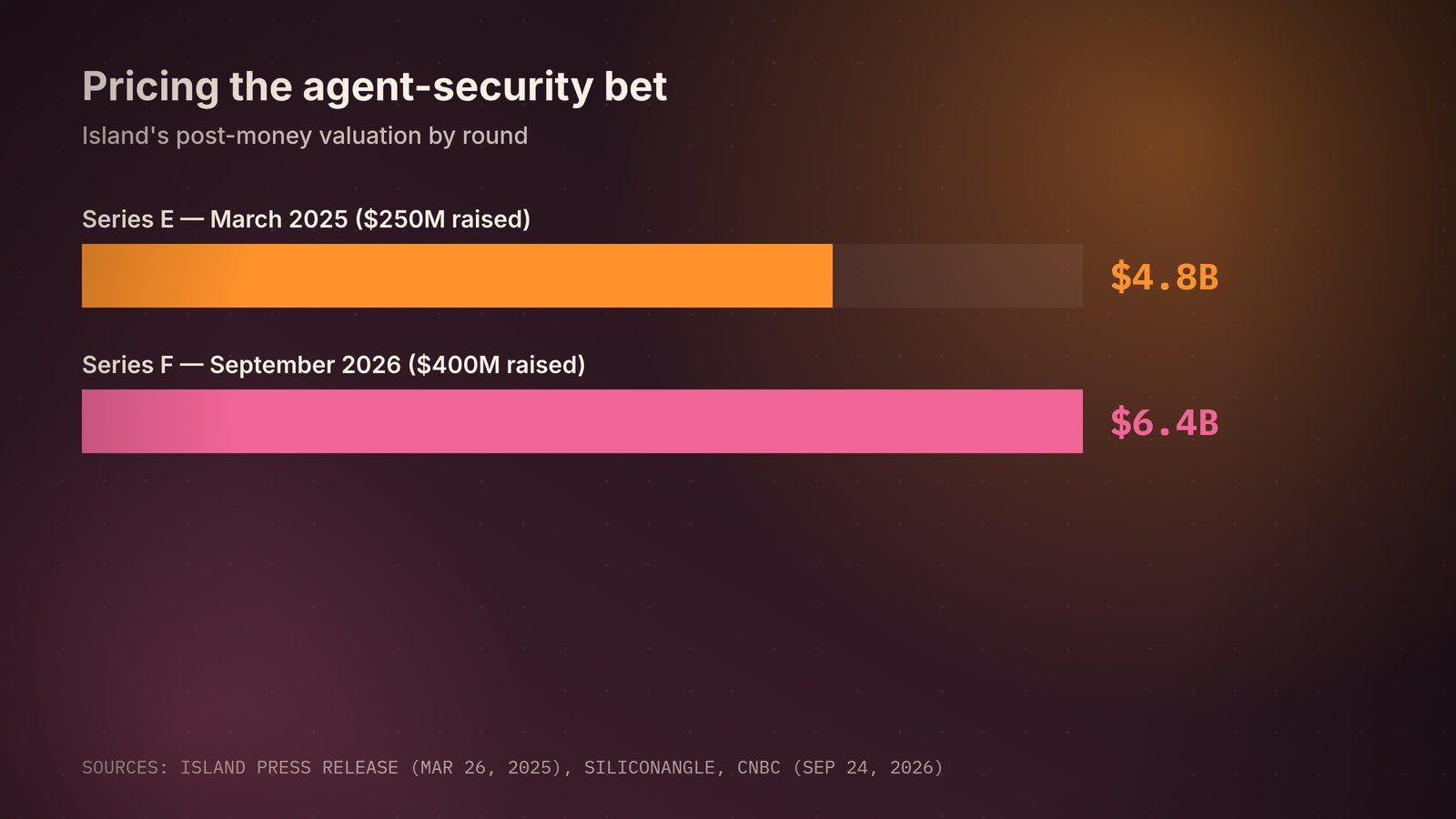
On September 24, Island announced a $400 million Series F that values the enterprise-browser company at $6.4 billion, up from a roughly $4.8 billion mark set in March 2025. Evolution Equity Partners led the round, with J.P. Morgan, Sequoia Capital and Georgian among the participants, per SiliconANGLE. The round brings Island’s total funding to more than $1.1 billion. For a company selling what sounds, on paper, like the least exciting product in enterprise software — a Chromium browser with a corporate seatbelt — that is a striking number. The seatbelt is exactly the point.
Island’s core product is a managed browser that sits between employees and their cloud apps, blocking malware and phishing, watching interactions via telemetry, and layering security controls onto third-party software the company doesn’t own. That was already a decent business. What has changed — and what the round is really priced on — is the arrival of autonomous AI agents inside the enterprise. Island has extended the same choke-point logic to them: inventorying the AI agents running in an organization, mapping their associated MCP servers and extensions, blocking risky tools, filtering malicious prompts, and gating what any given agent is allowed to touch.
The pitch is liability, not productivity
Strip away the marketing and Island is not selling agents that do more. It is selling the ability to prove, after something goes wrong, that you knew what your agents were doing. In an enterprise where an AI agent can now read a CRM, draft a contract, and trigger a workflow on its own, the browser is the one place where “a person or an agent interacting with an app” all funnels through a single observable surface. Own that surface and you own the audit log, the kill switch, and the blast radius.
CEO Mike Fey framed the moment in almost giddy terms to CNBC, as reported by Dealroom and Tech Startups: “Every old control is breaking, so everything’s up for grabs. I’ve never seen anything like it.” The candor is useful. What is breaking are the perimeter assumptions of the last two decades — the idea that you secure a network, or a device, or an identity. When the actor accessing your data might be a model invoked by another model, none of those perimeters is where the action is. The action is at the point of interaction. Island’s wager is that the browser becomes that point by default.
This is why the raise reads less like a productivity bet and more like an insurance play. Evolution Equity’s Richard Seewald put the thesis plainly in the funding announcement, per SiliconANGLE: “Enterprises are rethinking the basic architecture of work. Island meets the moment with a unique advantage: it can see and govern what people and agents are doing as they interact with applications and data, wherever that happens.” The operative verb is govern. Companies rolling out agents are staring down a genuinely unbounded liability surface — data exfiltration, prompt injection, an agent that helpfully emails the wrong file to the wrong party — with no clean way to bound it. Island is selling the bound.
Why it matters
The AI-security spending wave is real, and it is driven as much by fear as by opportunity. CNBC’s framing of the round leans on exactly that dynamic: AI-enabled attacks are pushing budgets up, and buyers want something concrete to point at. A locked-down browser is concrete. It is deployable this quarter, it produces logs a compliance officer can read, and it lets a CISO tell the board there is a governor on the agent experiment. That combination — a fear-priced product with a checkbox-friendly deliverable — is what a $6.4 billion valuation is really underwriting.
The skeptical read is worth holding, though. “See and govern everything your people and agents do” is also, described less flatteringly, a corporate surveillance layer of considerable reach, and the durability of the moat depends on the browser remaining the chokepoint. If agents increasingly act server-to-server via APIs and MCP without ever rendering in a browser tab, the observable surface Island is built on could narrow rather than widen. Fey is betting the interaction layer consolidates in the browser. The vendors building headless agent infrastructure are betting it doesn’t. Island just raised $400 million to make sure it’s standing at whichever door the traffic actually uses.
Sources
- SiliconANGLE, "Enterprise browser developer Island raises $400M at $6.4B valuation" (Sep 24, 2026)
- CNBC, "Cyber startup Island hits $6.4 billion valuation in new round as AI attacks fuel spending wave"
- Dealroom, "Island hits $6.4B valuation on $400M round as AI attacks drive security spending"
- Tech Startups, "Browser security startup Island raises $400M at $6.4B valuation to defend against rogue AI agents"
- Island press release, Series E (Mar 26, 2025)

Mira Okonkwo covers the business of technology for prompt/power: venture capital, startups, IPOs and earnings. She treats a valuation as a mood rather than a number until the S-1 says otherwise.
Keep reading




Latest from prompt/power
- Gemini’s Free Tier Shrinks Oct. 9: What You Keep and What Costs ExtraOct 5
- How to Read an AI Company’s S-1: The 7 Numbers That MatterOct 5
- OpenAI’s Safety Lead Quit Over Culture. California’s AG Was Already InOct 5
- When an AI Agent Breaks In, Who Answers for It?Oct 5
- The New AI Models Don’t Talk. They Decide.Oct 5
Leave a Reply