Data centres lost 40 of 41 ballot votes. One came down to 31
The 3-to-1 shorthand fits the typical Nov. 3 result but misses the close ones, including a Columbus suburb that voted itself a veto by nine points. We sorted all 41 measures by what they actually do.

The closest data-centre vote in the country on Nov. 3 was in Sprigg Township, in Adams County, Ohio, where a citizen-initiated zoning plan for the township’s unincorporated land passed 332 to 301, according to Ballotpedia’s results page. Thirty-one votes. Hold on to that number.
Everywhere else, it wasn’t close. Ballotpedia counts 41 local data-centre measures on Nov. 3 ballots in 10 states, and voters sided with limits on development in 40 of them: they approved 27 measures that restrict data centres and defeated 13 that would have made building them easier. The lone exception was Harwood, N.D. Kedrick Whitmore of the law firm Venable, writing the day after, said the results “almost unanimously skewed against data center development.”
That 40-of-41 figure has made the rounds this week. We wanted to see what sits under it, so we built our own tally.
How we counted
We took every Nov. 3 measure on Ballotpedia’s list and recorded the yes and no votes it reports, then checked individual results against local reporting where it existed. That included Fox 8 Cleveland’s rundown of Ohio’s 21 measures and Wisconsin Public Radio’s report on Janesville, which cites unofficial Rock County returns of 62.82% yes. Ballotpedia’s figure for Janesville matches that to the hundredth. We then sorted each measure by what it does and scored every result by the share of voters who took the limiting side, whether that meant voting yes on a ban or no on a rezoning.
Ballotpedia shows an outcome for all 41. Treat every number below as unofficial until county canvasses finish, because some are still moving: Fox 8’s Nov. 8 rundown, which attributes its breakdown to Redbud Consulting, had Sprigg Township at 53% and Granville at 84%. Ballotpedia now shows 52% and 82%.
Even the count is contested. Fox 8 says Redbud tracked 47 measures in 12 states on Nov. 3. Industrial Info Resources refers to 40 jurisdictions in one place and 41 initiatives in another, within the same article. We use Ballotpedia’s 41 because it publishes every row.
Bans, caps, moratoriums and the rest
Ohio dominated, with 21 measures in 18 jurisdictions. Illinois had seven, Maine four and Kansas three. California, Florida, Nevada, New Jersey, North Dakota and Wisconsin had one each.
The breakdown by what the measures do is our classification, built from Ballotpedia’s descriptions.
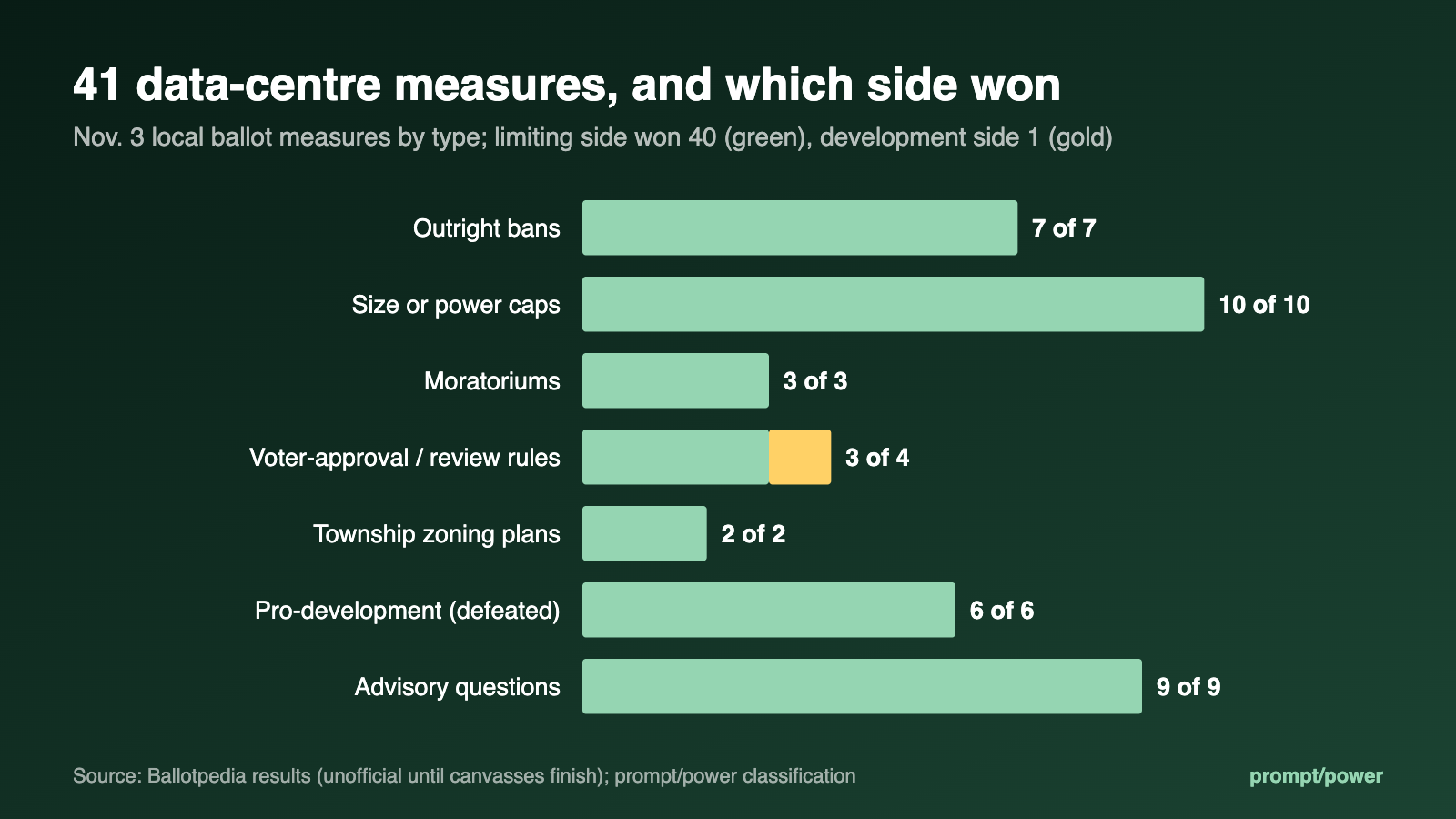
Seven were outright bans, and all seven passed: Alhambra, Calif., Edgewater, Fla., and five Ohio cities (Granville, Hubbard, Piqua, Upper Sandusky and Urbana).
Ten more banned data centres above a size or power threshold. All passed. Five of them drew the same 25-megawatt line: Ottawa, Kan., plus Conneaut, Defiance, Oregon and Sunbury in Ohio. North Berwick, Maine, measured floor space instead and set its limit at 25,000 square feet. The rest are Trenton and Pataskala in Ohio and El Dorado and Emporia in Kansas.
Maine also accounted for all three moratoriums, in Peru, Wells and Wiscasset. Each passed.
Four measures set voter-approval, review or guarantee rules, and three of them passed. Grove City, Ohio, now requires a public vote on big projects, and Janesville, Wis., requires one before development of the former GM/JATCO site can go ahead if the project tops US$450 million. Perry, Ohio, went further. Fox 8 reports its ordinance requires hyperscale developers seeking tax breaks to post a bond covering projected tax revenues across the project’s 31-year lifespan, and to keep noise below 50 dBA by day and 45 at night. Harwood’s review measure was the one that failed.
Two township zoning plans passed, in Monroe and Sprigg townships, both in Adams County, Ohio.
Six binding measures would have helped development along, and voters defeated every one. Four were in Wilmington, Ohio, where voters overturned rezonings covering about 546 acres, by Ballotpedia’s per-parcel acreage. The other two were a data-centre agreement in Ashville, Ohio, and a land question in Boulder City, Nev.
That leaves nine advisory questions. They are nonbinding, and all nine went the limiting way. Five Illinois communities, plus Monroeville, Ohio, and Downe Township, N.J., rejected questions asking whether they supported data centres; Bloomington and Morgan County, Ill., endorsed restrictions.
Strip out the advisory questions and the pattern holds: 31 of the 32 binding measures went against development.
How lopsided, exactly

Industrial Info Resources, citing Ballotpedia, describes margins of 3-to-1 or 4-to-1. That fits the typical result. It also hides the close ones.
By our math, 31 of the 41 cleared 2-to-1 and 25 cleared 3-to-1 (75% or better on the limiting side). Only 10 cleared 4-to-1. The median result was about 77%. Across all 41 questions, roughly 188,000 votes went to the limiting side and 69,000 to development, about 73%. That total counts Wilmington’s voters four times, once per rezoning question; dropping three of those doesn’t move the share by more than half a point.
The blowouts were mostly small places. Morgan County, Ill., backed its advisory restriction with 88%. Monroeville, Ohio, rejected data centres 394 to 55, and Downe Township, N.J., said no 425 to 62. Perry’s guarantee ordinance passed with 87%.
The tight ones were Sprigg Township (52%), Grove City (55%, or 11,317 to 9,411), Monroe Township (59%, decided by 149 to 102) and Emporia, Kan. (60%). Look hardest at Grove City. It is a suburb of Columbus that cast more than 20,000 votes and passed a rule requiring a public vote on any development over 50 acres, 20 megawatts or 500,000 gallons of water a day. A suburb voting itself a veto by nine points is a different signal from a village of a few hundred voting 88%.
“The theme of these ballot measures is really accountability, and that anger out of being shut out.” Stephanie Justice, spokesperson, Americans for Responsible Innovation, to Wisconsin Public Radio
The biggest electorates were Bloomington, Ill. (about 28,200 votes on an advisory moratorium question), Janesville (26,700), Alhambra (22,700), Grove City and Joliet, Ill. (18,000). Joliet’s voters rejected an advisory question on approving AI data-centre construction by 79%.
The one town that sided with the data centre
In Harwood, a town of about 940 people roughly 10 miles from Fargo, voters rejected a charter amendment that would have imposed requirements such as independent reviews and public hearings for industrial projects, 325 to 105. Fortune reports that a group called Voices of Harwood put it on the ballot, and that Applied Digital is already building a data centre there with Oracle as the end user. Mayor Blake Hankey opposed the measure and, per Fortune, said the project would bring in US$1.65 million in taxes by 2028.
Our read: Harwood is the one Nov. 3 vote we found where a data centre was already being built and the mayor publicly opposed the measure. One town is not a trend. It does suggest the arguments land differently once the tax money has a date attached.
Not settled yet
Passing isn’t the end. Business groups sued Port Washington, Wis., over the voter-approval rule it adopted in April; WPR reports an Ozaukee County judge dismissed the suit, but it could still go to a higher court. The Metropolitan Milwaukee Association of Commerce, in a statement quoted by WPR, said requiring a referendum like Janesville’s “introduces another level of uncertainty that can cause investment to move elsewhere.” Venable’s Whitmore writes that state legislatures “are likely to propose many changes in 2027.”
We found no Canadian equivalent of this ballot wave. In Ontario, the fight has run through council chambers instead: The Canadian Press reported in September that Hamilton council rejected a one-year freeze in July and that Oakville became the first Ontario municipality to pass a moratorium in August.
And the year’s US votes aren’t finished. Ballotpedia lists two bond questions in Clarksville, Ark., on Dec. 1, and on Dec. 15 Mandan, N.D., votes on a ban for data centres with 25 megawatts or more of expected demand. That is the threshold five communities just adopted. In Sprigg Township, it took 31 votes to change the zoning.

More from prompt/power: San Francisco and Oakland pause new data centres · Hydro-Québec wants data centres to pay double · AI’s electricity bill in six numbers
Researched and drafted with AI tools, fact-checked against primary sources and approved by a human editor before publishing. Prices and dates are as of publication. Our standards →
Sources- ballotpedia.org — Ballotpedia's results page
- venable.com — "almost unanimously skewed against data center development."
- fox8.com — Fox 8 Cleveland's rundown of Ohio's 21 measures
- wpr.org — Wisconsin Public Radio's report on Janesville
- industrialinfo.com — Industrial Info Resources
- fortune.com — Fortune reports

Catherine Crowe covers AI explained for prompt/power: the plain-English guides that break down how the technology works, what the jargon means and what it changes for everyday people. Originally from Canada, she writes from New Zealand.
All stories by Catherine →Keep reading




Latest from prompt/power
- Nvidia beats its own forecast with US$115.8 billion, then guides margins lowerNov 18
- Apple, the NSA and Chase: what each says broke in a week of outagesNov 18
- ChatGPT for Healthcare now has agents that click through hospital software. The fine print is all AmericanNov 17
- ChatGPT Wallet lets an AI agent pay for you. Here’s who can use it, and why Canada and the U.K. waitNov 17
- Gemini 4 Argon’s API price doubles Dec. 1. Here’s what it costs in US$, CA$ and £Nov 17
[…] RelatedData centres lost 40 of 41 ballot votes. One came down to 31 […]