
Ando Raised $20M to Give AI Agents a Seat in the Chat. The Hard Part Is What Happens Next.
Ando launched publicly on September 24, announcing $20 million in funding and positioning itself squarely against Slack and Microsoft Teams. The money came from Accel, Index Ventures and Emergence Capital, according to the company’s announcement, which also lists Contrary Capital as a backer; TechCrunch describes the total as combined pre-seed and seed capital. The founder is Sara Du, a second-time founder and Thiel Fellow who previously started Alloy Automation.
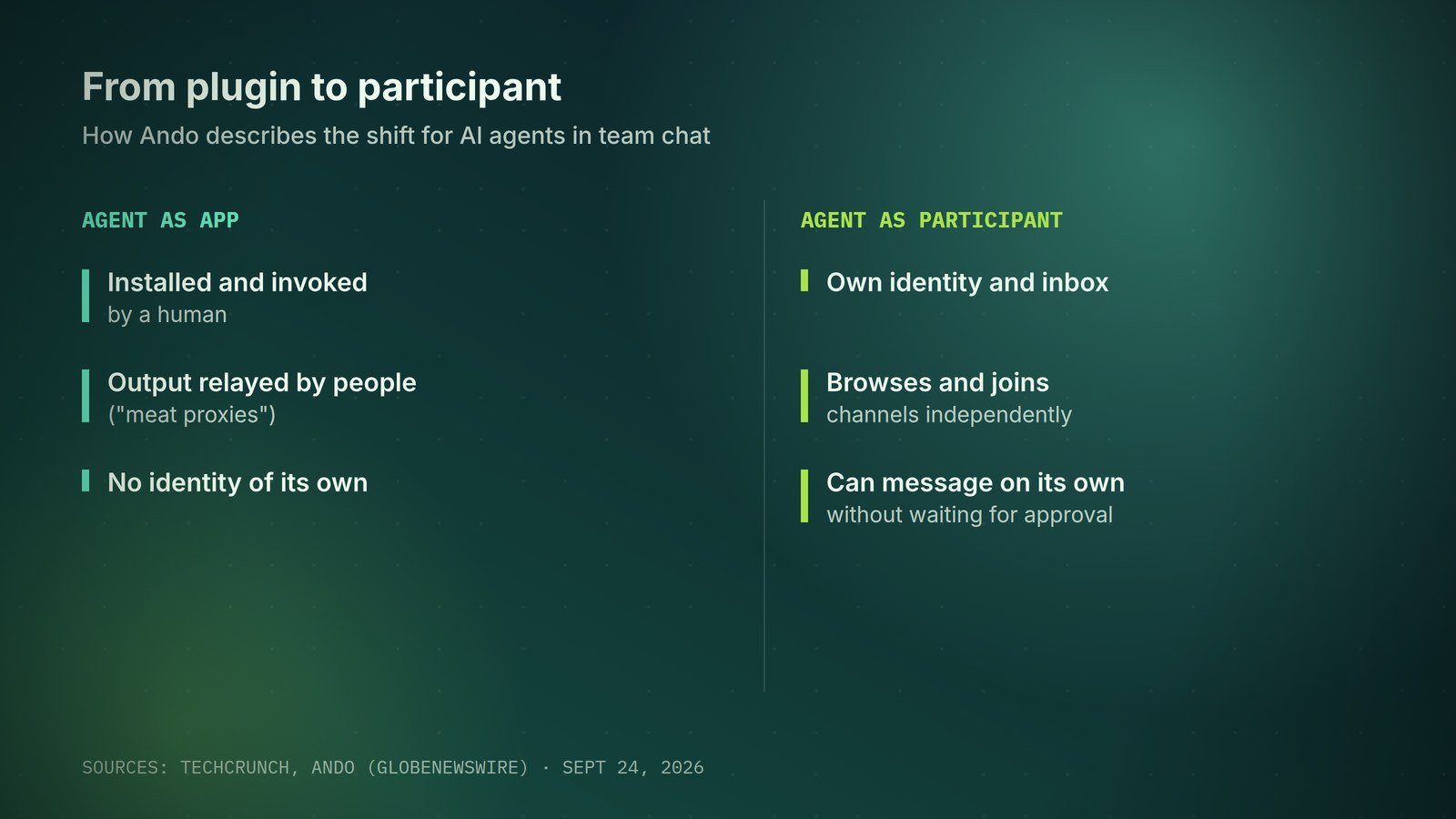
The product is a team-messaging platform built, in Ando’s framing, so that AI agents are participants rather than plugins. In a conventional workspace, an agent is an app you install and invoke. In Ando, per the company and TechCrunch, agents get individual identities and their own inboxes, can browse channels, join them independently, and — this is the load-bearing claim — initiate messages without waiting for a human to summon them. The platform carries the familiar furniture: channels, direct messages, group conversations, and live calls with transcription (Ando calls the real-time sessions “Jams”). It is pitched as agent-agnostic, working across providers including Codex, Claude, and others. Ando says its own team has run exclusively on the product since January 2026, and that customer teams already use it across roughly fifteen countries in software, real estate, and financial services.
The diagnosis is sharper than the product
Du’s framing of the problem is genuinely good, and worth quoting. “Agents were treated as apps you install even as they were becoming participants in the team,” she told TechCrunch. Her term for the failure mode — humans reduced to relaying agent output to other humans — is “meat proxies,” and anyone who has copy-pasted an AI’s answer into a Slack thread so a colleague could see it will recognize the indignity instantly.
That diagnosis is why the round is defensible even in a crowded market. The insight is that as agents move from tools to teammates, the substrate they work in stops being a document or an IDE and becomes the communication layer itself. If that is right, the workspace where humans and agents share one addressable identity space is a real category, and being early to define it is worth $20 million to its investors.
The bet is a behavior problem, not a technology one
Here is the skeptical read. Everything Ando describes is buildable — none of it requires an unsolved technical breakthrough. Giving an agent an inbox and letting it post unprompted is a permissions decision, not a research problem. Which means the risk was never whether Ando could ship it. The risk is whether people want to work this way.
An agent that, in TechCrunch’s words, “can message them on its own rather than waiting for approvals” is, from the human side, a colleague who can interrupt you and cannot read the room. Slack fatigue is already a real tax on knowledge work; a workspace that adds tireless, always-available non-human participants who can start threads is a plausible route to making it worse, not better. The value of a message has always depended partly on the cost of sending it. Agents have no such cost. The unglamorous, decisive work ahead of Ando is not identity plumbing — it is the etiquette layer: when an agent should speak, how its messages are ranked against a human’s, and who is accountable when an agent-initiated action or claim is wrong.
None of the coverage details that governance layer, and the company is early enough that it may not be fully built. That is not a knock; it is the actual frontier. Ando has correctly identified that the org chart is quietly growing rows that are not people. The seed round buys it the right to find out whether teams will treat those rows as colleagues — or mute them by Friday.
Sources

Andrew Lovesey is the editor-in-chief of prompt/power and the founder of Loveseyland, a Toronto studio that builds worlds and the companies inside them. Before that he spent 12 years at Canadian Geographic and the Royal Canadian Geographical Society, finishing as Director of Digital and Video, and later led the digital practice at Navigator. He is a Fellow of the RCGS and received its Quest Medal for his part in the expedition that located the wreck of Shackleton's Endurance. At prompt/power he covers Apple and writes the big-picture analysis. He has helped find a ship lost for more than a century, and still can't reliably find a phone charger that works.
Keep reading

Latest from prompt/power
- Gemini’s Free Tier Shrinks Oct. 9: What You Keep and What Costs ExtraOct 5
- How to Read an AI Company’s S-1: The 7 Numbers That MatterOct 5
- OpenAI’s Safety Lead Quit Over Culture. California’s AG Was Already InOct 5
- When an AI Agent Breaks In, Who Answers for It?Oct 5
- The New AI Models Don’t Talk. They Decide.Oct 5
Leave a Reply