Samsung Q3 Profit Hits a Record US$80 Billion as Galaxy Prices Climb
Samsung’s estimate fits in a two-line table: sales of about 195 trillion won, operating profit of about 107.4 trillion won. The second number, roughly US$80 billion (about CA$111 billion) for July through September, is the largest quarterly profit any South Korean company has posted.
Samsung Electronics published the preliminary guidance on Oct. 8, and almost all of that profit appears to come from one place: memory chips sold into AI data centres. The same shortage is why a Galaxy S26 in Canada costs CA$150 more than it did at the end of September.
Samsung Q3 2026 profit: the numbers
According to Samsung’s release, third-quarter operating profit will land between 107.3 trillion and 107.5 trillion won, on sales of 194 trillion to 196 trillion won. A year earlier, the company earned 12.17 trillion won on 86.06 trillion won in sales. Profit is up about 782% year over year; sales have more than doubled. Against the second quarter’s 89.49 trillion won, profit rose about 20%.
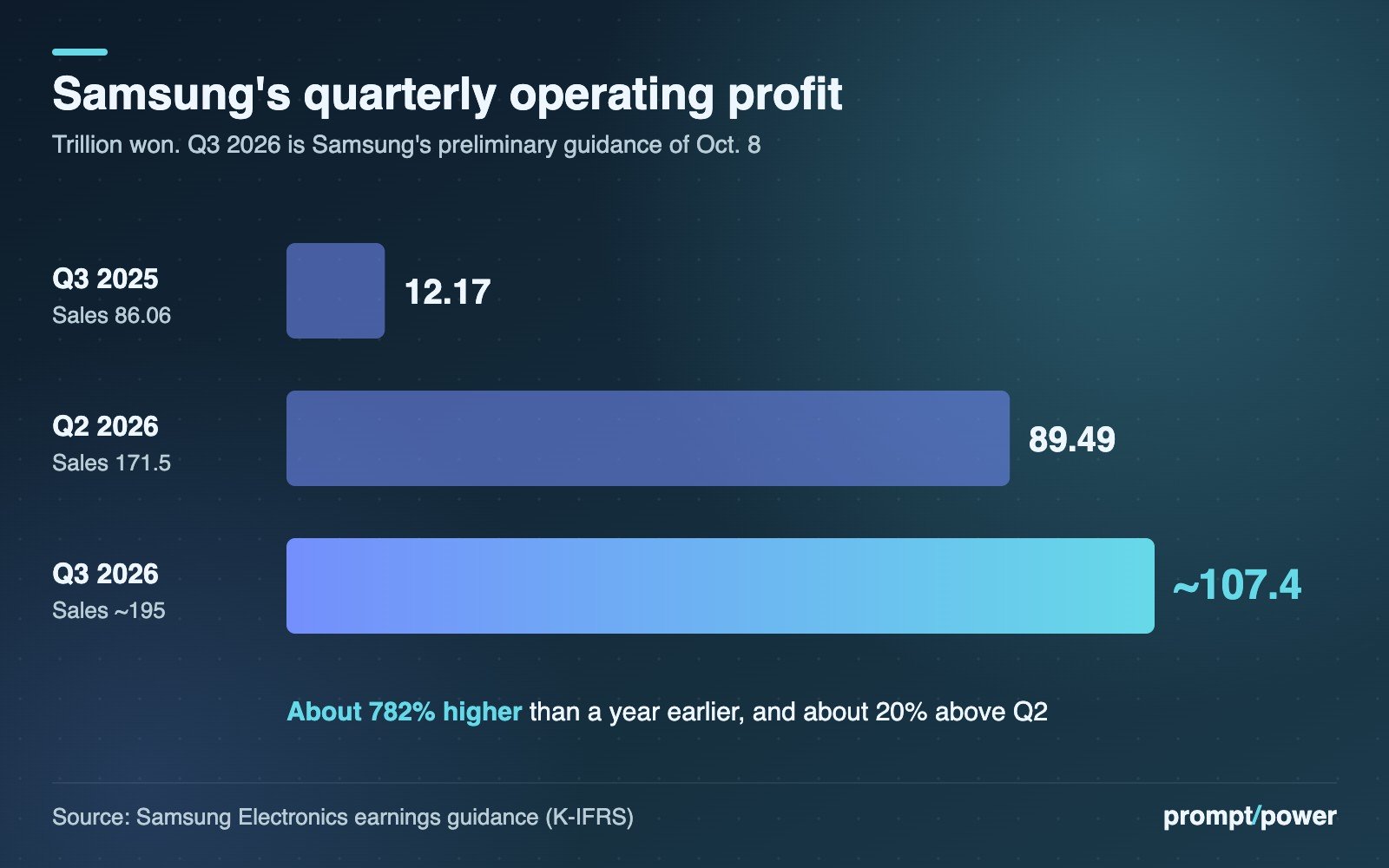
By our arithmetic, Samsung kept about 55 cents of operating profit on every won of sales. For a company that also makes washing machines and televisions, that is a strange-looking margin.
The figure beat the LSEG SmartEstimate of 106.1 trillion won and is Samsung’s fourth straight record quarter, The Next Web reports, citing TrendForce for the first-Korean-company-over-100-trillion milestone. The guidance comes without a divisional breakdown. Full results, with segment numbers, are due Oct. 29.
Where the money came from: AI memory
The driver is memory used in AI servers. Supply of standard DRAM and NAND flash is tight, which pushes prices up, and demand for high-bandwidth memory (HBM), the stacked chips that sit beside AI accelerators, is still climbing. Douglas Kim of Douglas Research Advisory estimates Samsung’s HBM shipments grew close to 50% from the previous quarter, per The Next Web. SamMobile reports Samsung is already selling HBM4 to Nvidia and has reportedly won Nvidia’s quality approval for HBM4E.
Then there is the estimate that tells the real story. The Korean daily Chosun Ilbo, as reported by TrendForce, puts the chip division’s profit at about 110 trillion won on its own. That is more than Samsung’s entire guided profit. If it holds on Oct. 29, everything else the company sells lost money as a group.
SamMobile’s estimates break that down: an operating loss of about 1.5 trillion won (about US$1.1 billion) at the MX mobile division and about 500 billion won (about US$370 million) at digital appliances and TV, both blamed on the rising cost of memory. Those are analyst projections, not Samsung figures.
Samsung is on both sides of the memory trade
Here is the awkward part. Samsung’s phone business is one of the customers paying those memory prices.
On Oct. 1, Samsung raised U.S. prices on the Galaxy S26, S26+ and S26 Ultra by US$100 (about CA$139), and the 1TB Ultra by US$200 (about CA$278), according to The Next Web, which reported that Samsung blamed the memory shortage. In Canada the change appeared on Samsung.ca the same day with no announcement, MobileSyrup reported: the Galaxy S26 256GB went from CA$1,249.99 to CA$1,399.99, and the 1TB S26 Ultra from CA$2,599.99 to CA$2,849.99. The cheaper Galaxy S26 FE was left alone. Our full Canadian price list has every model.
The chip division sells memory at prices that, by analyst estimates, push Samsung’s own phone division into the red. The price tag on a Galaxy is where some of that loss goes.
Our read: Samsung is on both sides of this trade, and the side with the 55% margin is winning. Raising phone prices doesn’t fix the mobile division’s problem, because the memory it buys keeps getting more expensive. It does move part of the bill to you.
What it means if you’re buying a phone
Don’t count on relief soon. The Next Web says the gap between AI demand and memory supply is expected to last into 2027, and SamMobile cites analyst estimates that Samsung’s operating profit next year could reach 550 trillion won (about US$410 billion). Nobody forecasts that while expecting memory prices to fall.
- If you need a phone now, look at models that weren’t repriced on Oct. 1, such as the Galaxy S26 FE, and at carrier promotions, which can absorb part of a list-price hike.
- If you can wait, wait for a sale rather than for prices to come down. The increase is in the list price, not in what retailers discount from it.
- Check memory-heavy configurations twice. In both the U.S. and Canada, the 1TB Ultra took the biggest jump, which is what you would expect if the cost being passed on scales with memory.
Laptops and consoles are exposed to the same shortage; our memory-shortage buying guide covers how to shop around it. The number to watch on Oct. 29 is the MX division’s line. If it is negative, expect the next Galaxy to launch at the new prices, not the old ones.
For scale: Samsung’s operating profit for all of the third quarter of 2025 was 12.17 trillion won. At this quarter’s pace, it now earns that in about 10 days.

Elena Vasquez covers space and frontier tech for prompt/power: launches, satellites, robotics, autonomy and defence tech. She counts rocket launches the way some people count sheep, and somehow sleeps less for it.
Keep reading




Latest from prompt/power
- Claude Haiku 5.5 Price: 90% Cheaper Until Your Prompt Hits 100K TokensOct 10
- Bell, Virgin, Public Mobile Plan Changes: The New Canadian Price ListOct 10
- Manus Raises More Than US$500 Million After China Blocked Meta’s DealOct 10
- Elon Musk’s Alberta Separation Posts Expose Canada’s Thin Platform RulesOct 10
- Microsoft’s H-1B Green Card Freeze Puts Canada’s Promise to the TestOct 10
Leave a Reply