
YouTube Will Let You Prompt Your Own Feed. Creators Should Read the Fine Print.
At Made on YouTube 2026 on September 23, the platform announced a broad rollout of Custom Feeds, after a limited test that began in May: a feature that lets viewers type what they want into a prompt box and have Google’s Gemini assemble a homepage tab around it. Want 30-minute video podcasts for your commute, or relaxing commentary to wind down to? Describe it, and the feed appears as a pinned tab alongside the main home page. Viewers can build several. Crucially, these feeds supplement the standard recommendation feed rather than replacing it — the algorithm you already have is not going anywhere; you are just being handed a second set of controls.
Emily Moxley, YouTube’s VP of Product Management for Viewer AI, pitched the scale that makes it plausible. “There’s over 20 billion videos in the YouTube corpus, so you’re always one search away from a treasure trove of topics,” she said. Custom Feeds rolls out beginning next month — sources describe a US launch across web, mobile, and TV in the fall — making it one of the few announcements of the day with a stated rollout window.
It did not arrive alone. YouTube also previewed an expanded “Ask YouTube,” which answers conversational questions, including about products; Gemini-based chat editing for Shorts inside the Create app; live auto-dubbing for streams; expanded likeness detection for AI-generated voice and face; and serialization tools that let Shorts run as seasons and episodes. But Custom Feeds is the headline, because it changes the fundamental question of who decides what a viewer sees.
From “the algorithm chose” to “I asked for it”
For most of its history, YouTube discovery has been a black box that creators optimize against by proxy — thumbnails, retention curves, packaging, posting cadence. The implicit deal was that if you fed the recommendation engine the right signals, it would put you in front of people who had never searched for you. That serendipity — the algorithm surfacing a creator to a viewer who did not know to want them — has been the single most important growth engine on the platform.
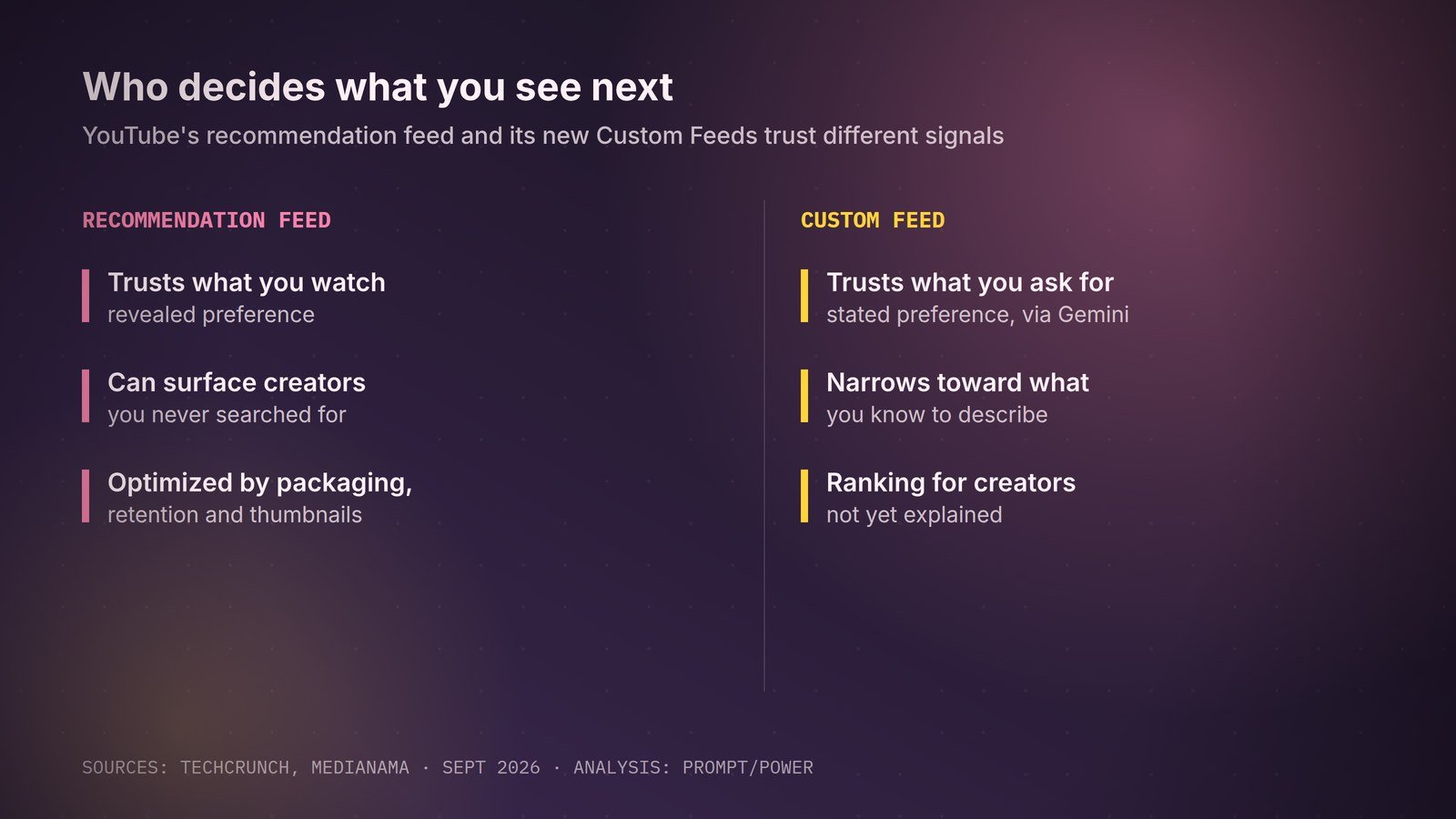
Custom Feeds does not kill that engine. But it introduces a competing one that routes around it. When a viewer builds a feed by stating an intent — “calm woodworking, no talking, over 20 minutes” — Gemini is now matching that stated preference against the corpus. And stated preferences and revealed preferences are famously not the same thing. People say they want educational content and watch drama. The recommendation algorithm has always trusted what you do over what you claim. A promptable feed trusts what you claim.
What this does to discovery
Here is the tension worth flagging, and it is analysis, not something YouTube said from the stage: neither the platform nor its coverage has specified how Custom Feeds affect creator visibility or ranking. That silence is the story. If viewers increasingly curate by explicit prompt, discovery narrows toward what people already know to ask for — named genres, established formats, creators specific enough to describe. The channel that grows by ambush, by landing in a recommendation feed for someone who would never have typed its name, has fewer at-bats.
There is an upside case, too, and it is real: a viewer who prompts “independent climate documentaries” is expressing durable, high-intent demand that a mid-sized creator in that lane could never have surfaced against the pull of mega-channels in the generic feed. Prompting could be a leveler for niche work — if YouTube surfaces the long tail honestly rather than defaulting to the safe, big names Gemini already knows.
Which is exactly why creators should not celebrate or panic yet. The feature that lets viewers describe what they want is only as good for discovery as the model’s willingness to answer with something they had not heard of. YouTube has shipped the prompt box. It has not shown its work on who gets returned. Until it does, “build your own algorithm” is a promise to viewers whose bill, if there is one, gets paid by the creators who used to depend on not being asked for by name.
Sources

Casie Stewart covers the creator economy, social platforms and wellness tech for prompt/power: who gets paid, who gets seen, and what the algorithm is really asking of the people who feed it. She has been publishing online since 2005, long before "creator" was a job title, and has spent most of that time on the other side of the platforms she now writes about. Based in Toronto. Her rule for any new app: if it promises to save you time, check how much of it you just spent reading the onboarding.
Keep reading



Latest from prompt/power
- Gemini’s Free Tier Shrinks Oct. 9: What You Keep and What Costs ExtraOct 5
- How to Read an AI Company’s S-1: The 7 Numbers That MatterOct 5
- OpenAI’s Safety Lead Quit Over Culture. California’s AG Was Already InOct 5
- When an AI Agent Breaks In, Who Answers for It?Oct 5
- The New AI Models Don’t Talk. They Decide.Oct 5
Leave a Reply