AI Water Use: Google’s Five Drops vs the UN’s Nine Trillion Litres
Google says a Gemini prompt uses 0.26 mL of water. The UN University says data centres' power will need 9.3 trillion litres in 2030. Each counts the water the other leaves out.

Updated Oct. 19, 2026: We rebuilt this story on Google’s own methodology post and the UN University report itself. The report shows its 9.3 trillion litres is a projection for 2030, covers all data centres rather than AI alone, and counts only the water used to generate their electricity, not on-site cooling. Its 2025 estimate is about 4.5 trillion litres.
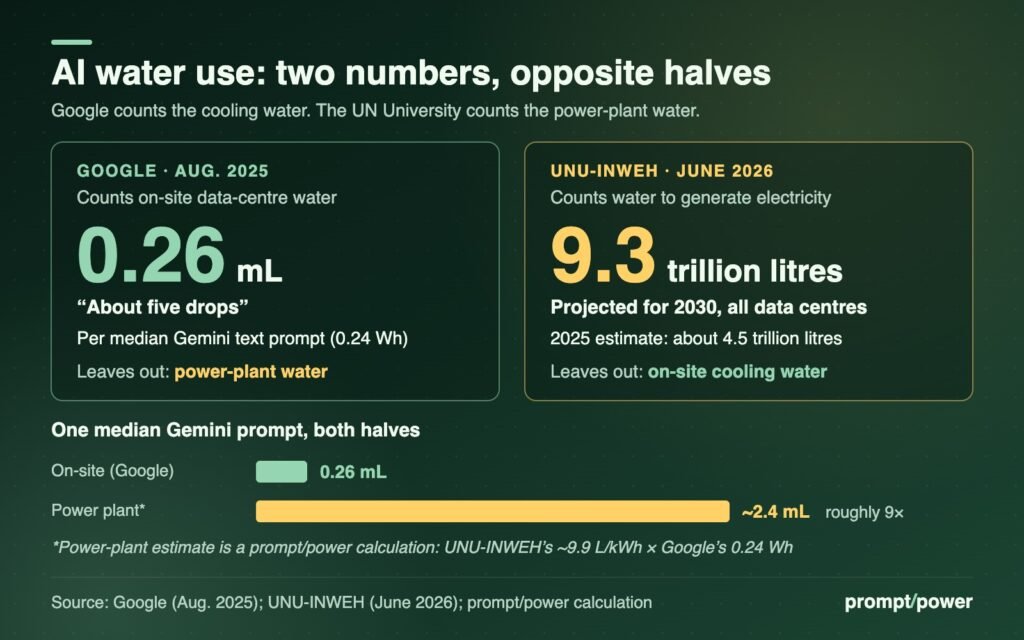
Two numbers dominated the AI water argument as Climate Week NYC got under way on Sept. 21: Google’s “about five drops” per Gemini prompt and the UN University’s 9.3 trillion litres. They look like opposing verdicts on the same question. They are not. Google’s figure, from an Aug. 21, 2025 post, is water consumed at its data centres for a single median text prompt. The UN figure, from a June 3, 2026 report by the Ontario-based UNU Institute for Water, Environment and Health, is the water needed to produce the electricity every data centre in the world is projected to use in 2030. Each number counts the half of the problem the other one leaves out.
Google’s five drops: what the 0.26 mL counts
The post, by Google’s Amin Vahdat and Jeff Dean, gives the headline in one sentence: “we estimate the median Gemini Apps text prompt uses 0.24 watt-hours (Wh) of energy, emits 0.03 grams of carbon dioxide equivalent (gCO2e), and consumes 0.26 milliliters (or about five drops) of water.” It adds that the energy is “equivalent to watching TV for less than nine seconds.” A longer technical paper sets out the method.
Google says its boundary is more complete than methods that count only the chips doing the work. It counts idle machines held in reserve, host CPUs and memory, and data centre overhead such as cooling and power distribution. Using a narrower method that counts only active TPU and GPU chips, Google says, the same prompt would come out at 0.10 Wh and 0.12 mL.
The water figure is derived, not metered. A footnote says water per prompt “was estimated based on energy per prompt, and applying Google’s 2024 average fleetwide water usage effectiveness,” a measure of water used at Google’s facilities. The post ties data centre water use to cooling. It does not mention water consumed at the power plants that supply those facilities.
Two caveats from Google’s own footnotes belong next to any use of the number. The figures “do not represent the specific environmental impact for all Gemini App text-generation prompts,” and “the data and claims have not been verified by an independent third-party.” Google also says the median prompt’s energy fell 33-fold between May 2024 and May 2025.
The UN’s nine trillion litres: what it measures
The report, Environmental Cost of AI’s Energy Use: Carbon, Water and Land Footprints, is by Miriam Aczel, Kaveh Madani and four co-authors. Its water headline sits in the key points on page 10: “The associated water footprint of projected 2030 electricity consumption of data centers is 9.3 trillion liters.” The release compares that to the basic annual domestic water needs of 1.3 billion people in sub-Saharan Africa.
Three details change how the number should be read.
- It is a 2030 projection. It rests on the report’s estimate that, “If current trends hold, data center electricity consumption could exceed 945 TWh by 2030” (page 32). For 2025 the report puts the same footprint at “around 4.5 trillion liters” (page 33).
- It is all data centres. The 945 TWh covers data centre electricity in general, not only AI workloads.
- It is power-plant water only. The method on page 33 is “the average water footprint of producing the required electricity,” using global average intensities. The report discusses on-site cooling but does not add it to the 9.3 trillion figure.
The report does not say whether its footprint is water withdrawn or water consumed. It does not cite Google’s 0.26 mL figure. Its own per-prompt energy assumption is “a conservative 0.42 Wh per text prompt” (page 13), and it puts the electricity-associated water for a single AI image at about 29 mL.
“If we keep judging AI sustainability by carbon alone, we might think that renewables make AI infrastructure clean.”
Miriam Aczel, lead author, UNU-INWEH release
That line is about the report’s other finding: switching electricity from coal to bioenergy can cut its carbon footprint by about 70% while raising its water footprint more than thirtyfold.
AI water use: the two metrics side by side
| Google, Aug. 2025 | UNU-INWEH, June 2026 | |
|---|---|---|
| Headline number | 0.26 mL (“about five drops”) | 9.3 trillion litres |
| Unit | One median Gemini Apps text prompt | All data centres worldwide, one year |
| Period | May 2025 measurement | Projected 2030 (2025: about 4.5 trillion litres) |
| Water counted | Water used at Google’s data centres, via its 2024 fleetwide water usage effectiveness | Water to produce the electricity, at global average intensities |
| Not counted | Power-plant water (not mentioned) | On-site cooling water |
| Energy basis | 0.24 Wh per prompt, full system | 945 TWh in 2030; 0.42 Wh per text prompt |
| Independent check | None, Google says | Not stated; method set out in report text |
| Source | Google Cloud blog | UNU-INWEH report |
Putting a power plant behind the five drops
The report does not print a litres-per-kilowatt-hour factor, but its own numbers imply one. Divide 9.32 trillion litres by 945 TWh and you get roughly 9.9 litres of water per kWh of data centre electricity, at global average generation.
Apply that to Google’s 0.24 Wh and a median Gemini prompt would carry about 2.4 mL of power-plant water, roughly nine times the 0.26 mL Google reports for its facilities. At the report’s own 0.42 Wh assumption it is about 4.1 mL.
That is our calculation, and it is rough. It mixes Google’s measured energy with a global average grid, and Google’s own grid mix will differ from the global average. It still makes the point the two headline numbers obscure. The five drops and the nine trillion litres are not in conflict. One is the cooling tower, and the other is the power plant, and the public conversation has been comparing them as if they were the same pipe.
We made the same argument about electricity estimates in AI’s electricity bill in six numbers: most disagreements come from different boundaries, not different facts.
What Climate Week added
AI was a theme from day one in New York. The Associated Press’s Sept. 21 curtain-raiser ran under the headline “Climate Week talks balance hope for clean energy against uncertainty over artificial intelligence.” The same day, Bloomberg covered remarks by UN climate chief Simon Stiell under the headline “‘Energy-Guzzling’ AI Must Rein in Its Emissions, Says UN Climate Chief.” We could not find a UNFCCC transcript of those remarks as of Oct. 19, so we are relying on Bloomberg’s account.
Stiell’s framing was emissions. The UN University report argues that emissions alone mislead, because the cleanest-looking power can be the thirstiest. Siting fights are where that lands locally, from the San Francisco and Oakland pause on new data centres to Greenwich’s objection to a Charlton site. More in our climate coverage.
What it means
- When you see “five drops”: it is one company’s on-site estimate for a median text prompt, unaudited, and it leaves out power-plant water.
- When you see “nine trillion litres”: it is a 2030 projection for all data centres, counting only electricity-generation water. The report’s 2025 figure is about half that.
- What would settle it: the report’s call for standardized footprint reporting, covering both cooling and generation water, by the companies that actually know their numbers.
Mir Matin, manager of UNU-INWEH’s Geospatial, Climate and Infrastructure Analytics Programme, put the local stakes plainly in the release: “And the communities living near these sites are not necessarily the ones using the AI being run there.” Five drops is what the user sees. The 9.9 litres per kilowatt-hour falls on somebody else’s river.
Researched and drafted with AI tools, fact-checked against primary sources and approved by a human editor before publishing. Prices and dates are as of publication. Our standards →
Sources- cloud.google.com — Aug. 21, 2025 post
- unu.edu — June 3, 2026 report
- arxiv.org — technical paper
- storagehub.homnya.net — Environmental Cost of AI's Energy Use: Carbon, Water and Land Footprints
- wral.com — Climate Week talks balance hope for clean energy against uncertainty over artificial…
- bloomberg.com — 'Energy-Guzzling' AI Must Rein in Its Emissions, Says UN Climate Chief

Priya Natarajan covers science and society for prompt/power: climate and energy tech, data centres, and the physical cost of the digital world. Every query has a water bill, and she would like to see the receipt.
All stories by Priya →Keep reading



Latest from prompt/power
- How to read an IPO prospectus in 10 minutes, using Anthropic’s as the exampleNov 20
- ChatGPT Pro, Claude Max or Google AI Ultra? What CA$140 a month buysNov 20
- Anthropic’s first day, studied: who made money, what it left on the table, and what ANT is now worthNov 20
- Google’s Gemini health coach costs CA$12.99 a month, or nothing with AI Pro. What it does and doesn’t doNov 20
- Broadcom’s AI chip sales now outstrip its entire business from a year ago. What to watch on Dec. 9Nov 19