
Five Drops, Nine Trillion Litres
Climate Week NYC opened on Monday, September 21, 2026, and AI and data centers were among the hottest topics on the agenda — the machines being sold as the solution.
United Nations climate chief Simon Stiell put it about as sharply as a diplomat does. “Energy-guzzling artificial intelligence is driving up planet-heating pollution from coal, oil and gas while ratcheting up energy costs for households and businesses,” he said, per Associated Press coverage of the week’s opening. “AI leaders are now on thin ice when it comes to license to operate, and sinking deep underwater when it comes to public support.”
That is a striking thing to hear from the UN’s top climate official about the sector Silicon Valley has spent two years pitching as climate’s best hope. To understand why the mood has turned, you have to understand the two numbers that were quietly at war all week.
The number the industry likes
The industry’s preferred frame is the per-query metric, and its cleanest example is Google’s own disclosure. In August 2025, Google published figures stating that a median Gemini text prompt consumes about 0.24 watt-hours of energy and 0.26 milliliters of water — a quantity the company described as “about five drops,” alongside energy it compared to “watching TV for less than nine seconds.”
Five drops is a genuinely reassuring image, and the number is not fake. It is also, as critics noted immediately, doing a lot of quiet work. As DataCenterDynamics reported, Google’s water figure counted only cooling water used on-site and excluded the water consumed by the power plants feeding the data center — the indirect footprint of generating the electricity. Shaolei Ren of UC Riverside, one of the researchers who first put AI water use on the map, said the company was “hiding the critical information” and “spreads the wrong message to the world.” The paper had not been peer-reviewed at publication.
So the per-query number is real, favorable, and incomplete — three things that can be true at once.
The number the UN likes
The other number arrived in June 2026, when the UN University’s Institute for Water, Environment and Health (UNU-INWEH) published Environmental Cost of AI’s Energy Use: Carbon, Water and Land Footprints. Its 2030 projections do not fit on a reassuring infographic. The report estimates AI could account for roughly 945 terawatt-hours of electricity, 399 million tonnes of carbon, some 14,500 square kilometres of land — and 9.3 trillion litres of water a year. That last figure, the report notes, is comparable to the basic annual domestic water needs of about 1.3 billion people in Sub-Saharan Africa.
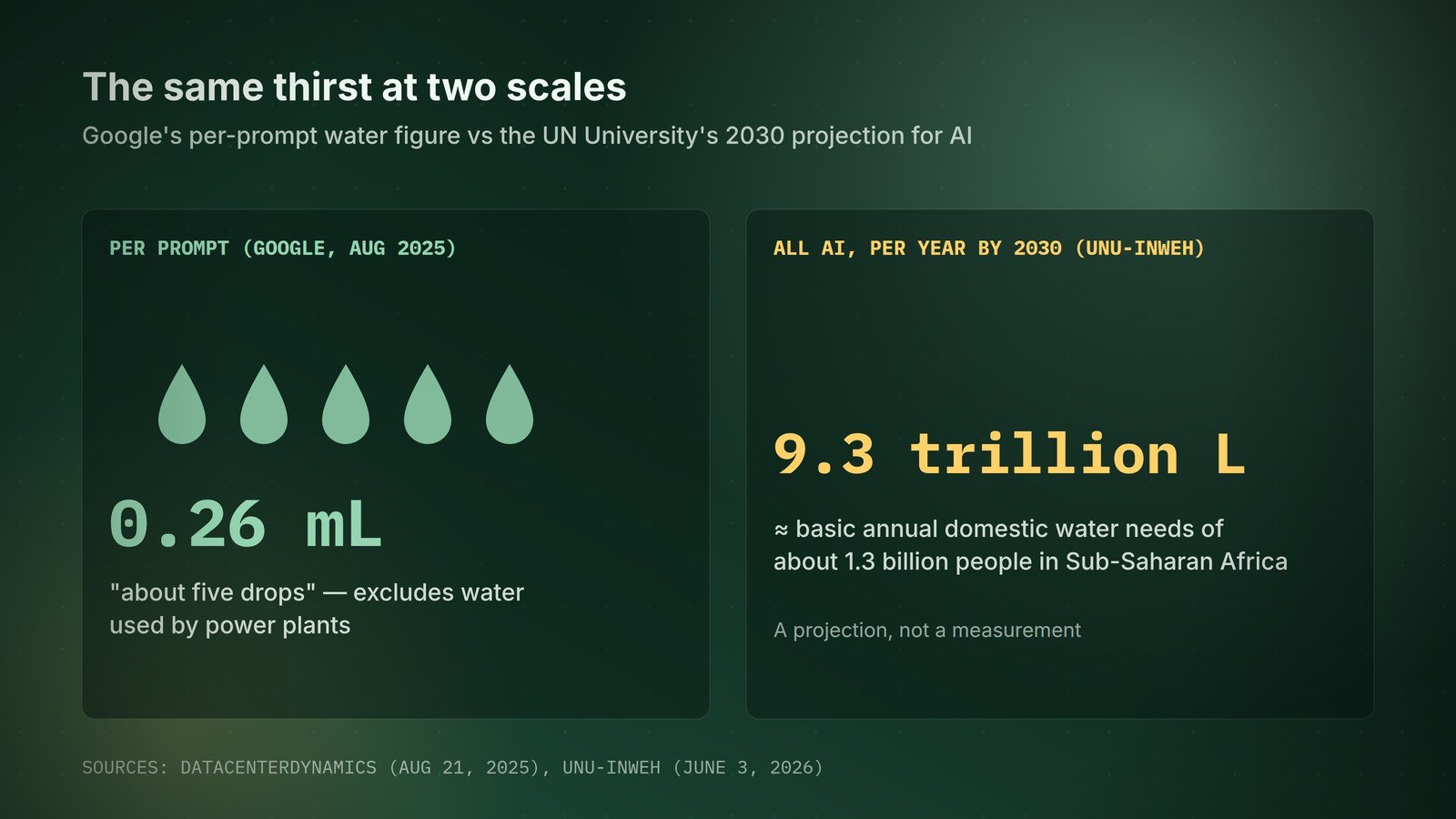
Here is the part that matters, and it is not a gotcha about any single company. The two numbers are not in contradiction. They are the same phenomenon measured at different scales, and the mechanism that connects them is efficiency itself.
Why efficiency is the trap, not the escape
Kaveh Madani, director of UNU-INWEH, named the paradox directly: “More efficient and affordable AI and energy mean more consumption of AI, making the overall footprint far bigger than what we save through efficiency gains.”
This is the Jevons paradox, and it is the crux of the whole dispute. Every time a model gets cheaper and greener per query, more queries get run — embedded in search, in email, in every app, invisibly and by default. The per-drop number falls while the reservoir number climbs, and both movements are caused by the same engineering wins the industry cites as its defense. Efficiency is not slowing the aggregate; it is the accelerant.
There is a second trap the report flags, which is that optimizing for the metric everyone watches can quietly worsen the ones they do not. “What surprised us most is how often the choices that look greenest from a carbon perspective end up worse for water or for land,” said Miriam Aczel, the report’s lead author. To take one illustration of that trade-off (ours, not the report’s): a data center that shifts to evaporative cooling to cut energy-related emissions can drink far more water; a facility sited for cheap clean power can sit on land and aquifers a community was counting on.
Why it matters
The per-query framing is not a lie, but it is an argument dressed as a fact, and it is winning by default because it is the number companies choose to publish. The honest accounting is the one that survives Madani’s paradox: measure the aggregate, count the indirect water, and treat every efficiency gain as a reason to expect more demand, not less. Stiell’s warning about “license to operate” is really a warning about which number the public ends up trusting. Right now the industry controls the denominator, and as long as it does, the drops will keep looking small while the reservoir keeps draining.
Sources
- AP-syndicated coverage of Climate Week NYC 2026 opening (WDBO/Cox Media)
- UNU-INWEH, "Environmental Cost of AI's Energy Use: Carbon, Water and Land Footprints"
- DataCenterDynamics, "Google: Median Gemini prompt uses 0.24 watt hours of power and consumes 0.26ml of water"
- The Business Journal / AP, "World leaders in New York to grapple with climate. Fuel prices, AI and disasters complicate things"

Priya Natarajan covers science and society for prompt/power: climate and energy tech, data centres, and the physical cost of the digital world. Every query has a water bill, and she would like to see the receipt.
Keep reading




Latest from prompt/power
- Gemini’s Free Tier Shrinks Oct. 9: What You Keep and What Costs ExtraOct 5
- How to Read an AI Company’s S-1: The 7 Numbers That MatterOct 5
- OpenAI’s Safety Lead Quit Over Culture. California’s AG Was Already InOct 5
- When an AI Agent Breaks In, Who Answers for It?Oct 5
- The New AI Models Don’t Talk. They Decide.Oct 5
Leave a Reply