Apple Finally Folds: The iPhone Duo Is Late, Lavish and Very Deliberate
Every so often Apple waits out a category until the rough edges are sanded off, then walks in as though it had been there all along. It did it with smartwatches and with wireless earbuds. On September 9, at its first fall event under chief executive John Ternus, it did it again with the foldable phone.
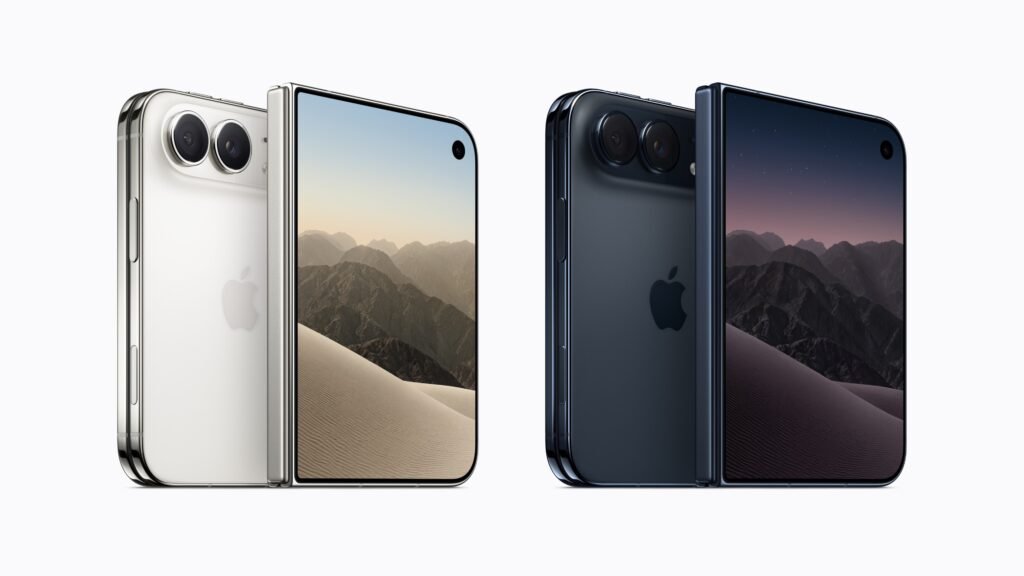
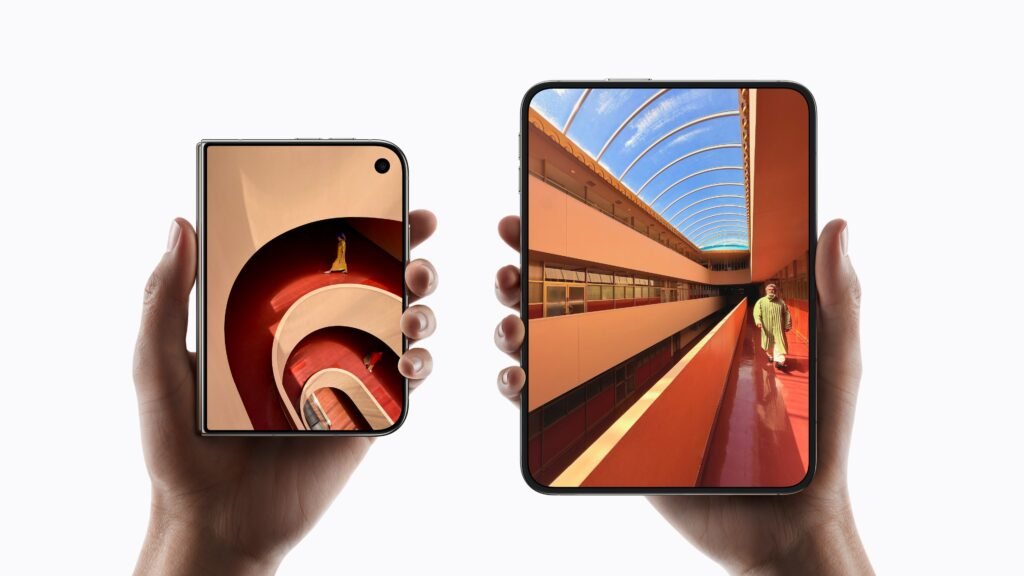
The iPhone Duo opens like a paperback into a 7.6-inch Super Retina XDR display and closes to a 5.4-inch outer screen that, Apple says, offers 90 percent of the screen area of an iPhone 18 Pro. Both screens share the same aspect ratio, so an app doesn’t have to rearrange itself when you open or close the phone. Opened, Apple says, it is the thinnest iPhone it has ever made. Inside is the same A20 Pro chip as the new Pro models, a custom-designed vapour chamber and a dual-battery design, and it ships running iOS 27.1 with Apple Intelligence and the new Siri AI.
The big claim
Ternus, who succeeded Tim Cook in April when Cook became executive chairman, didn’t hedge. “iPhone Duo is the most transformational change to iPhone since the original,” he said in Apple’s announcement, calling it proof of “what’s possible when hardware and software are engineered together.”
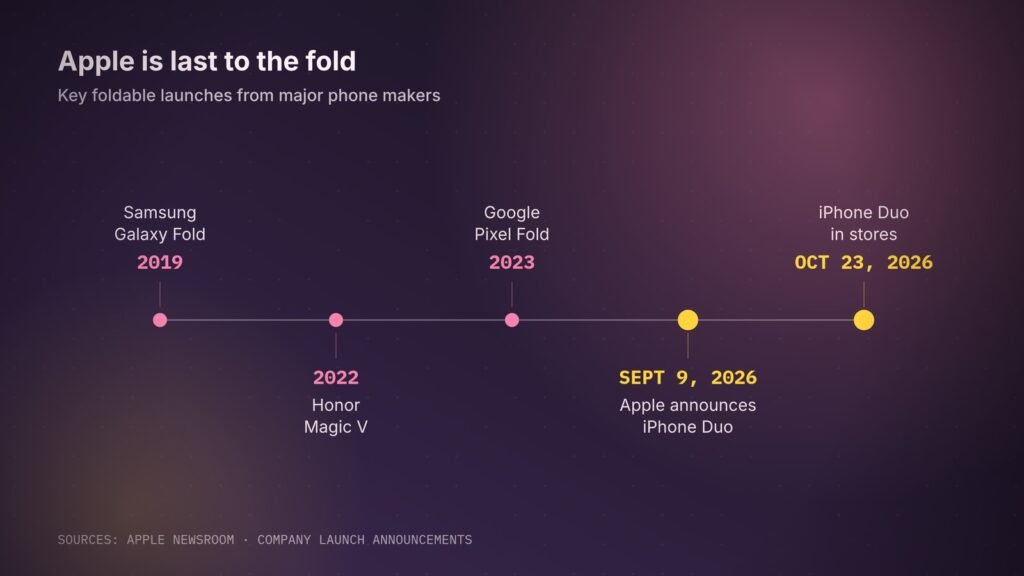
That is a big sentence to hang on a form factor Samsung first shipped in 2019, and one Google and Honor have iterated on for years since. But it tells you how Apple sees its role. It isn’t claiming to have invented the folding phone. It’s claiming to have finally made one worth owning.
What Apple waited for
The fold was never the hard part. The trouble has always been everything around it: creased displays, fragile hinges, thick closed profiles and software that treats the second screen as an afterthought. Apple’s answer is a “precision hinge,” built from more than 100 components, that it says delivers “a smooth, satisfying feel with every use,” plus a version of iOS reworked for both postures, with apps like Netflix, Zoom and Slack shown adapting across the fold.
Whether that hinge survives tens of thousands of openings, and whether the inner crease is as invisible in hand as it is in the renders, are questions only time and independent testing will answer. Apple has earned the benefit of the doubt on build quality many times. This is still its first try.
The camera is the sleeper feature
The more interesting argument for the Duo may be photographic. Apple says the folding design unlocks “fun new ways to use the camera that aren’t possible on any other iPhone.” The obvious one: the outer display becomes a viewfinder for the main 48MP cameras, so you can frame yourself, or show your subject the shot, with the best lenses on the phone rather than the selfie camera. Half-fold it and it becomes its own tripod. Anyone who has tried to film a group shot at a trailhead, or a time-lapse on a windy lakeshore, will understand the appeal immediately.
The price
Then there’s the number. The iPhone Duo starts at US$1,999 (CA$2,999), or about US$83 (CA$125) a month over 24 months, across 256GB, 512GB, 1TB and 2TB capacities. That is the highest starting price Apple has put on any iPhone. The iPhone Duo Case is US$79 (CA$99), and the Folio with a kickstand is US$129 (CA$179). It comes in two colours, star white and night sky.
The Duo also won’t arrive with the rest of the fall lineup. The iPhone 18 Pro, new Apple Watches and AirPods 5 reach stores September 18. Duo pre-orders don’t open until Friday, October 16, with availability on Friday, October 23 in more than 70 countries and regions, Canada among them, with Bell, Freedom and Rogers on board at launch.
Read one way, the five-week gap gives Apple’s most complex new product room to ramp. Read another, it’s a sign of how Apple is framing it: a statement device for committed early adopters, not the product it’s betting the quarter on. Analysts have projected sales in the single-digit millions for 2026, a sliver of iPhone’s annual volume.
The verdict, for now
Apple has built a foldable that, on paper, goes straight at the category’s known weaknesses, and priced it so that its most devoted customers will be the ones to find out whether it worked. The company that usually wins by being late is late again. Whether the Duo turns out to be “transformational” or merely “finally” is something we’ll know once a few million hinges have some kilometres on them.
Prices are Apple’s U.S. and Canadian list prices. Specifications and performance claims are Apple’s, pending independent review.
Sources

Andrew Lovesey is the editor-in-chief of prompt/power and the founder of Loveseyland, a Toronto studio that builds worlds and the companies inside them. Before that he spent 12 years at Canadian Geographic and the Royal Canadian Geographical Society, finishing as Director of Digital and Video, and later led the digital practice at Navigator. He is a Fellow of the RCGS and received its Quest Medal for his part in the expedition that located the wreck of Shackleton's Endurance. At prompt/power he covers Apple and writes the big-picture analysis. He has helped find a ship lost for more than a century, and still can't reliably find a phone charger that works.
Keep reading


Latest from prompt/power
- Gemini’s Free Tier Shrinks Oct. 9: What You Keep and What Costs ExtraOct 5
- How to Read an AI Company’s S-1: The 7 Numbers That MatterOct 5
- OpenAI’s Safety Lead Quit Over Culture. California’s AG Was Already InOct 5
- When an AI Agent Breaks In, Who Answers for It?Oct 5
- The New AI Models Don’t Talk. They Decide.Oct 5
Leave a Reply