Analysis: John Ternus’s First Fall Shows an Apple That Perfects, Not Pioneers
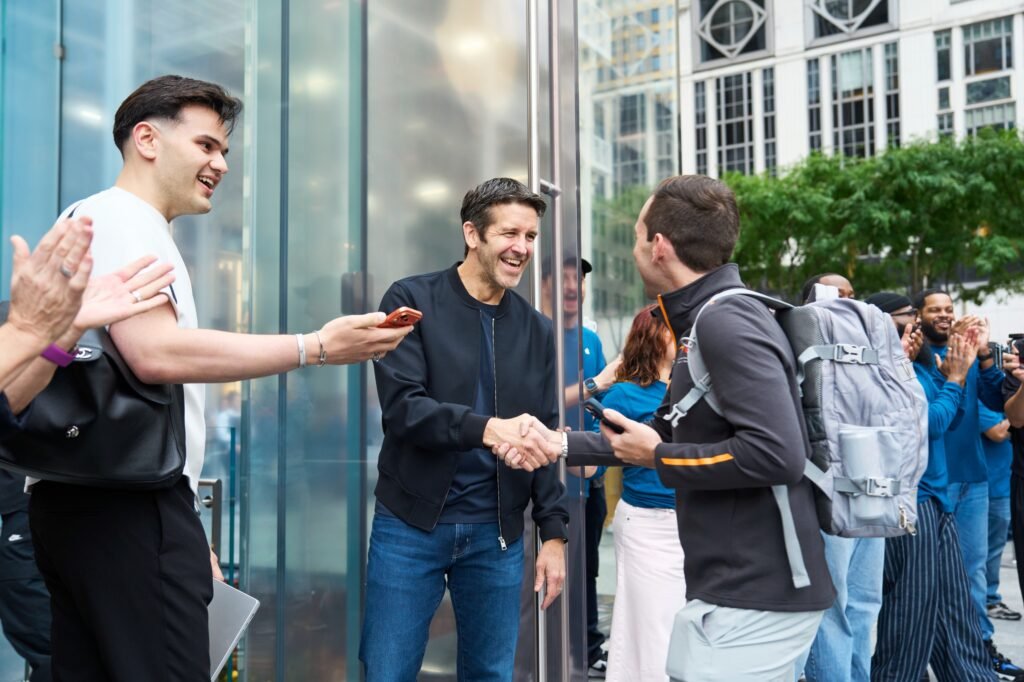
Every Apple fall event is a portrait of the company’s confidence. The September 2026 edition, the first with John Ternus as chief executive after Tim Cook became executive chairman in April, is a revealing one.
Taken product by product, it’s a strong lineup. Taken together, it’s the sound of the world’s most influential consumer-tech company doing things its rivals did first, and doing them, in the Apple way, later, more expensively and often better. That isn’t a criticism so much as a diagnosis. The era of Apple defining categories has quietly given way to an era of Apple perfecting them.
Following, then finishing
Look at the throughline. The iPhone Duo is a foldable, a form factor Samsung shipped in 2019. Siri AI is a conversational, context-aware assistant, the thing OpenAI and Google made table stakes years ago and that Apple itself promised in 2024, then repeatedly delayed. The Apple Watch’s new readiness score is a metric Oura and Whoop built entire companies on. Even the event’s most satisfying piece of engineering, the iPhone 18 Pro’s variable aperture, follows Samsung’s dual-aperture Galaxy S9 from 2018 and later variable-aperture flagships from Huawei and Xiaomi.
There’s nothing wrong with being the best fast follower in the world. It has made Apple extraordinarily rich, and it’s often what customers actually want: the version that works. But it changes how Apple’s claims should be read.
The superlative problem
This event leaned hard on superlatives only Apple has tested. “The most accurate heart rate sensing in a wearable.” “The industry’s best Active Noise Cancellation in an open-ear design.” “The most advanced camera Apple has ever made.” Each traces, in Apple’s own footnotes, to Apple-run testing against competitors Apple selected.
That’s standard industry practice, and it’s precisely why independent reviews exist. When a company is leaping past its rivals, the leap speaks for itself. When it’s catching up, the gap between “we tested it and we win” and “reviewers tested it and you win” is the whole story.
Where the confidence shows: price
Lay the fall lineup end to end and the posture becomes obvious.
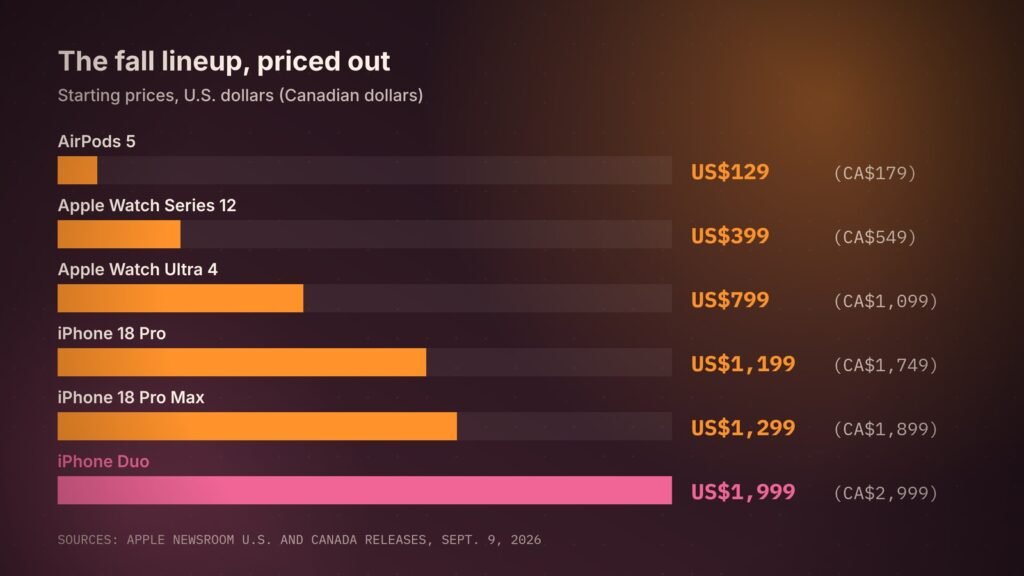
- AirPods 5: US$129 (CA$179)
- Apple Watch Series 12: US$399 (CA$549)
- Apple Watch Ultra 4: US$799 (CA$1,099)
- iPhone 18 Pro: US$1,199 (CA$1,749)
- iPhone 18 Pro Max: US$1,299 (CA$1,899)
- iPhone Duo: US$1,999 (CA$2,999)
The Duo is a first-generation device carrying the highest starting price of any iPhone, arriving five weeks after the rest of the lineup, into a market analysts expect to measure in single-digit millions of units this year. That’s not a volume play. It’s a halo: proof that Apple can enter a category at the very top of its price range and let its most committed customers pay for the first generation.
The one aggressive price points the other way. AirPods 5 bring noise cancellation to Apple’s cheapest buds at US$129, the old price of AirPods without it, which quietly erodes the case for AirPods Pro. Apple competing hardest on price against itself is its own kind of tell.
The AI story is the one to watch
Apple is furthest behind, and most exposed, on AI. Siri AI shipped September 14 as a beta, in English only, and not at all on iPhone, iPad or Apple Watch in the European Union, or in China. Two of the world’s largest markets don’t get Apple’s flagship intelligence on its flagship devices, a casualty of Apple’s standoff with EU regulators over the Digital Markets Act and of China’s approval process.
Apple spent two years being mocked for an AI it promised and couldn’t deliver. It has now delivered one it can’t yet deliver everywhere. For a company whose entire pitch is that hardware and software are engineered as one seamless whole, an assistant that works differently, or not at all, depending on where you switch on your phone is a crack in exactly the story Apple sells. How quickly that crack closes will say more about the Ternus era than any hinge or aperture.
Good products, new posture
None of this makes the products bad. The iPhone 18 Pro’s camera is a genuine advance for the iPhone. AirPods 5 may be the value buy of the year. The Watch’s new health system is a substantial step. The Duo, if its hinge holds up, takes direct aim at the category’s known weaknesses.

What it means is that the company behind them has changed posture. In Ternus’s first fall, Apple looks less like the firm that tells the industry where to go and more like the one that arrives last, polishes hardest, prices highest and asks you to take its word, for now, that it was worth the wait. Independent testing, not keynote superlatives, is what should settle that.
Prices are Apple’s U.S. and Canadian list starting prices.
Sources
- Apple Newsroom: Apple unveils iPhone Duo
- Apple Newsroom: Apple debuts iPhone 18 Pro and iPhone 18 Pro Max
- Apple Newsroom: Introducing Apple Watch Series 12
- Apple Newsroom: Apple unveils Apple Watch Ultra 4
- Apple Newsroom: Apple introduces AirPods 5
- Apple Newsroom: Major updates for Apple's software platforms are now available
- Apple Newsroom: Tim Cook to become executive chairman, John Ternus to become CEO
- Digital Camera World: Why don't all phones have a variable aperture?
- GuruFocus: iPhone Duo unit projections for 2026

Andrew Lovesey is the editor-in-chief of prompt/power and the founder of Loveseyland, a Toronto studio that builds worlds and the companies inside them. Before that he spent 12 years at Canadian Geographic and the Royal Canadian Geographical Society, finishing as Director of Digital and Video, and later led the digital practice at Navigator. He is a Fellow of the RCGS and received its Quest Medal for his part in the expedition that located the wreck of Shackleton's Endurance. At prompt/power he covers Apple and writes the big-picture analysis. He has helped find a ship lost for more than a century, and still can't reliably find a phone charger that works.
Keep reading
Latest from prompt/power
- Gemini’s Free Tier Shrinks Oct. 9: What You Keep and What Costs ExtraOct 5
- How to Read an AI Company’s S-1: The 7 Numbers That MatterOct 5
- OpenAI’s Safety Lead Quit Over Culture. California’s AG Was Already InOct 5
- When an AI Agent Breaks In, Who Answers for It?Oct 5
- The New AI Models Don’t Talk. They Decide.Oct 5
Leave a Reply