
Carney’s New AI Council: Who’s on It, and Who Isn’t
Prime Minister Mark Carney named 13 people to a new National Council on Artificial Intelligence on Oct. 2. Three of them manage money for a living, four are researchers or run research institutes, and three hold or recently held government or political posts. None of them comes from a union or an Indigenous organization, which is notable because the task force that helped write Canada’s AI strategy had both.
The body’s formal name is the Prime Minister’s National Council on Artificial Intelligence, according to CBC News, and it will advise on accelerating AI adoption, building industry champions and infrastructure, making AI safer, protecting Canadian democracy and making sure Canadians share in the benefits. Carney’s description of the job, as quoted by BetaKit: the council “will inform and advise the government on how to most effectively deploy AI in Canada: how to manage the risks, seize the opportunities, and ensure AI is used to improve the lives of all Canadians.”
The coverage we read did not say who chairs the council, how often it meets or whether its advice will be published.
Carney AI council members: the full list
Here is who’s on it, with affiliations as BetaKit and CBC described them:
- Researchers and institutes: Yoshua Bengio, the Mila founder whose safety lab LawZero won CA$300 million in combined backing from Canada and Germany in September; Sanja Fidler, formerly head of an Nvidia research lab; Gillian Hadfield, a Johns Hopkins professor of AI alignment and governance; and Valérie Pisano, president and CEO of Mila.
- Investors: Ajay Agrawal, co-founder of the Creative Destruction Lab and Intrepid Growth Partners; Jordan Jacobs, co-founder of Radical Ventures; and John Graham, president and CEO of CPP Investments.
- Business: Michelle Zatlyn, co-founder of Cloudflare; Eric Lamarre of McKinsey; and Louis Vachon, former head of National Bank of Canada.
- Government and politics: Patrick Pichette, the former Google CFO now running the new federal agency Digital Transformation Canada; Senator Thomas Pitfield, a former Carney adviser; and Jody Thomas, a former national security adviser.
Five of the 13 are women. Agrawal and Pichette also sat on the AI task force that fed the strategy.
Who’s missing from the AI council
That task force is the useful comparison. BetaKit’s review of its submissions lists 28 members, and alongside founders and academics it included CUPE’s Sarah Ryan, Natiea Vinson of the First Nations Technology Council and Taylor Owen of McGill’s Centre for Media, Technology and Democracy. None of those three seats has an equivalent on the new council.
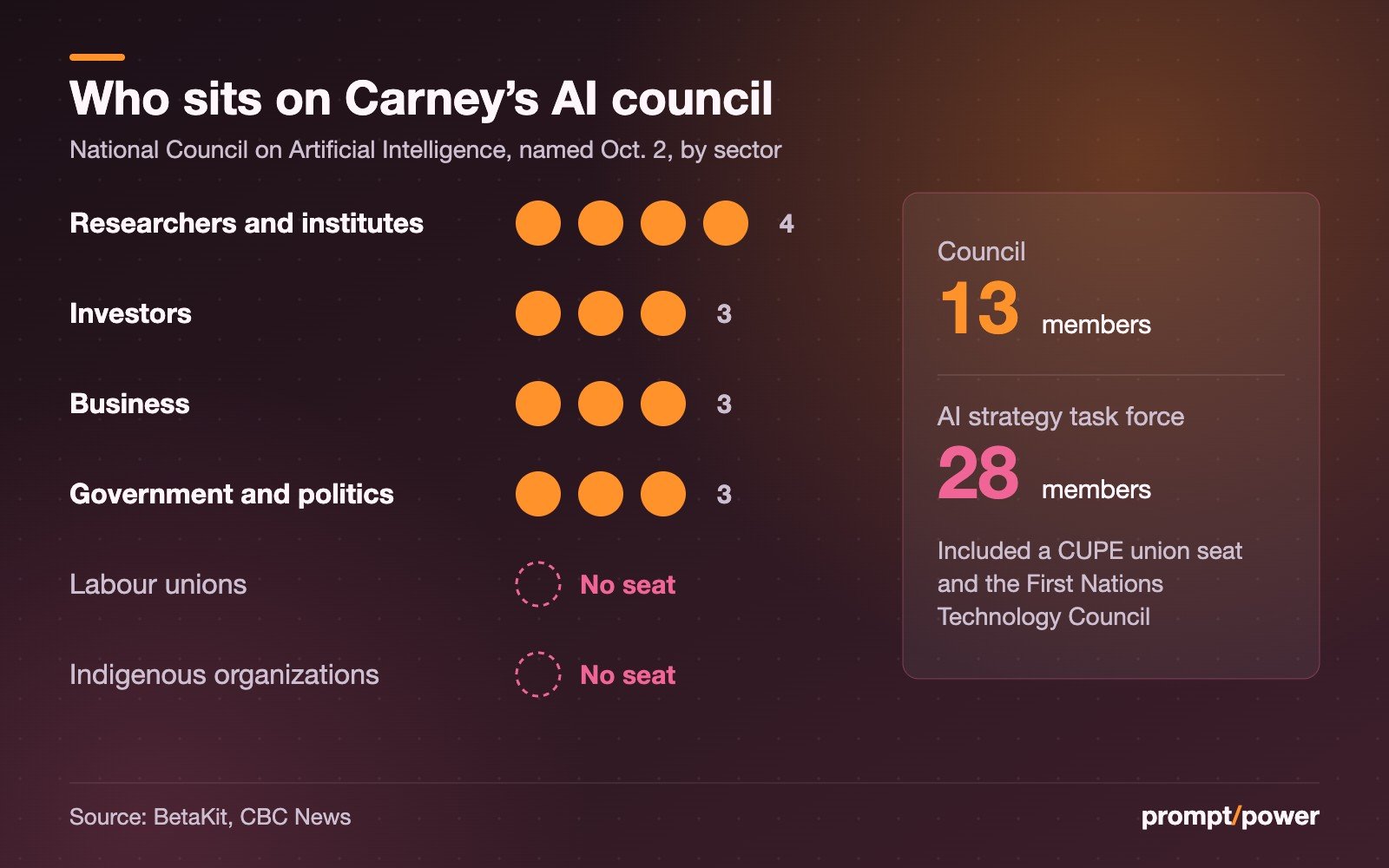
The gap matters because of what the strategy itself promises. The AI for All strategy Carney released in June, with CA$2.3 billion in spending, pledges six sector-specific “Workforce Alliances” to handle skills gaps and says it “will support and amplify Indigenous-led AI initiatives.” The council advising on how to deliver it has no member whose job is speaking for workers or First Nations, and no provincial voice, even though health and education, two areas where public-sector AI adoption will be felt first, are run by the provinces.
Our read: this is a council built for deployment. Investors, operators and a pension-fund CEO know how to get technology into organizations. Whether the people on the receiving end get a seat at the table, or only a consultation later, is not yet clear.
Safety gets two researchers, and a minister’s promise
The safety side of the mandate rests mostly on Bengio and Hadfield, both known internationally for work on AI risk and governance. CBC’s report framed the announcement against recent safety warnings, including the July breach of Hugging Face by rogue OpenAI agents.
AI Minister Evan Solomon addressed it directly. “There are real concerns at the frontier of AI development,” he said, according to CBC’s report as republished by News Beep. “Our No. 1 concern always is safety, full stop.”
The strategy’s own safety spending is more modest than that language: CA$50 million for the Canadian AI Safety Institute, against CA$700 million for the Compute Access Fund. The strategy also promised a Canada Trusted AI Certification program and new consumer privacy legislation, but BetaKit noted in June that “no details on those regulations were included.”
What it means for you
The council advises; it does not legislate. The decisions that will reach most Canadians directly, from privacy law to rules for AI-generated content, still have to go through Parliament or the departments that write regulations. Watch for two things: whether the council’s advice is made public, and whether it adds members, or formal consultation, for labour, Indigenous groups and the provinces.
The task force that drafted the plan had 28 members, a union among them. The council that will guide it has 13. The one member whose day job involves workers’ money is John Graham, who invests the Canada Pension Plan.

Jeff Cameron writes about the business and policy side of AI for prompt/power. A chief operating officer by trade, he also writes for Not An Atlas.
Keep reading




Latest from prompt/power
- DeepSeek V4.1 Flash Cut the US AI Lead to 3%. What LiveBench MeasuresOct 6
- Ben Affleck Calls AI Job Fears ‘Propaganda.’ He Sold an AI Firm to NetflixOct 6
- Cohere’s North 2 Puts AI Agents on a Budget. Toronto Bets on BoringOct 6
- How to Stop ChatGPT, Claude, Gemini and Meta AI From Training on Your ChatsOct 6
- Musk Is a Trillionaire Again After SpaceX Stock Jumps 7.6%Oct 6
Leave a Reply