Surface Laptop Ultra Is CA$3,899.99 in Canada. Here’s the Real Markup
Microsoft’s new 15-inch Surface Laptop Ultra starts at US$2,599.99 (CA$3,899.99), and the CA$1,300 gap between those two numbers, announced at the Oct. 7 Windows and Surface event in San Francisco, looks like a steep Canada tax. It is also the least useful number in the launch. Convert the US price at about 1.39 and it comes to roughly CA$3,614. The Canadian markup is closer to CA$286, or about 8%, and both prices are before sales tax.
The more important number is 24. That is how many gigabytes of memory the CA$3,899.99 model has, and it decides how much of Microsoft’s local-AI pitch the entry machine can actually deliver.
Surface Laptop Ultra price in Canada, and the trade-in offer
iPhone in Canada reports that Canadian preorders are open through Microsoft’s Canadian store, with deliveries starting Oct. 16. The base configuration pairs Nvidia’s RTX Spark N1X with an 18-core CPU, a 5,120-core GPU, 24GB of unified memory and a 512GB SSD. Higher tiers step up to a 20-core CPU, a 6,144-core GPU, up to 128GB of memory and up to 2TB of storage. BGR’s event liveblog lists the 6,144-core model at US$3,699.99 in the US; we found no Canadian price for it.
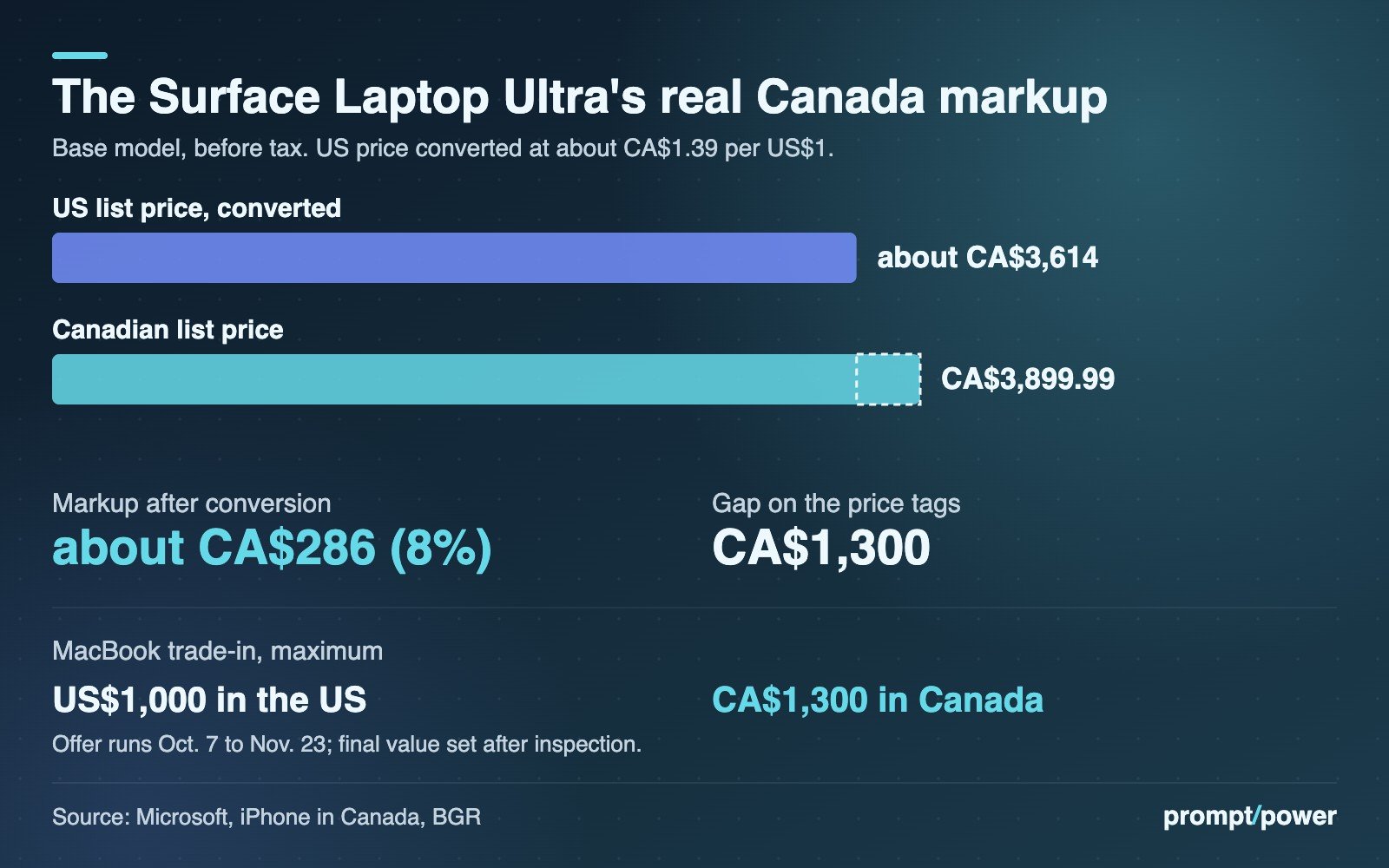
Microsoft is also courting Mac owners. Its product page promises “up to $1,000” back for trading in an eligible MacBook, on purchases from Oct. 7 to Nov. 23, through the Microsoft Store online in the US and Canada. In Canada, iPhone in Canada puts the ceiling at CA$1,300. Fine print matters here: the amount varies by device, the MacBook must power on and hold a charge, and the value is set by trade-in firm Teladvance after inspection.
For comparison, MacRumors notes that Apple’s 16-inch MacBook Pro starts at US$2,999 (about CA$4,170), and that Microsoft pitches the Surface as lighter.
What Nvidia’s RTX Spark chip changes for Windows PCs
RTX Spark is an Arm chip. Nvidia’s event post describes a Blackwell RTX GPU with up to 6,144 cores joined to an up-to-20-core Grace CPU at 600 GB/s, sharing up to 128GB of unified memory, and rated at one petaflop of FP4 AI compute. Microsoft’s own footnote describes that kind of figure as “theoretical FP4 TOPS using the sparsity feature.” That is a peak number at the lowest precision, not what a typical app will see.
The practical shift is that a Windows laptop now gets the Mac’s main trick, one large pool of memory the GPU can use, while keeping Nvidia’s CUDA software, which most AI developer tools assume. The cost is architecture. MacRumors points out that the machine runs Windows on Arm, so older x86 apps go through Microsoft’s Prism emulation.
Surface is not alone. Lenovo’s Yoga 9n 2-in-1, the Asus ProArt P14, Dell’s XPS 16, the MSI Prestige N16 and HP’s OmniBook Ultra 16 opened for preorder the same day and ship Oct. 16, per BGR; none had public prices. Microsoft also announced a US$5,999 (about CA$8,340) Surface RTX Spark Dev Box, and Nvidia says compact RTX Spark desktops go on sale in November.
As we argued in our AI PC buying guide, memory comes before TOPS. Microsoft’s “120 billion parameter” local-model claim is a ceiling for the high-memory builds. A 24GB machine shares that memory with Windows and your apps, which leaves room for far smaller models.
Windows bets on local AI agents, not Windows 12
There was no Windows 12. The software news was Windows 11 rebuilt around agents. Per BGR’s liveblog, Copilot will be able to search local files and act on them with permission; the demo found tax documents, moved and renamed them and drafted an email to an accountant with the files attached. BGR reports they arrive “over the next couple months.” A “Hybrid Intelligence” layer decides whether a local or cloud model handles a task, and Meta’s Muse agent is coming to Windows natively.
“We needed to make the desktop the most secure place for agents to execute.” Satya Nadella, as quoted by Nvidia
That line, from Nvidia’s account of the keynote, explains the plumbing Microsoft spent its stage time on. Microsoft Execution Containers, which let agents run in the background under operating-system control, are now generally available. Our read: Microsoft wants the PC, not the browser, to be where agents live, and it needs hardware like RTX Spark so those agents can run without a cloud bill. Muse arriving natively matters for the same reason; Meta’s agent passed 5 million downloads faster than ChatGPT did, and Windows now gives it a front door next to Copilot.
Should Canadians buy the Surface Laptop Ultra?
- Don’t pay for the headline specs you won’t get. If local models are the reason to buy, the 24GB base model is the wrong one. Wait for Canadian pricing on higher-memory builds.
- Do the trade-in maths first. A CA$1,300 rebate is a ceiling, and Teladvance sets the real number after inspection.
- Check your apps. Anything built only for x86 runs through Prism emulation. Confirm the plug-ins, drivers and tools you depend on support Windows on Arm.
- Wait for reviews. The petaflop and brightness claims are Microsoft’s and Nvidia’s own. Independent tests should land around the Oct. 16 ship date.
One footnote on Microsoft’s product page is worth reading before you preorder. Its battery testing used preproduction units with a 6,144-core GPU, 64GB of RAM and 1TB of storage. The CA$3,899.99 laptop has 5,120 cores, 24GB and 512GB.

James Whitfield covers hardware for prompt/power: chips, semiconductors, laptops, components and the benchmarks behind the launch-day claims. He thinks the most important number on any spec sheet is usually the one in the footnote.
Keep reading



Latest from prompt/power
- National Medal of Science Goes to Musk, Brin, Huang and Su. Nvidia Pledged US$1BOct 10
- TikTok Placebo Safety Test: New York Says Teens Got a Fake Feed ResetOct 10
- Waymo Takes Its First Loan, US$5 Billion, as Robotaxis Head OverseasOct 10
- Claude Haiku 5.5 Price: 90% Cheaper Until Your Prompt Hits 100K TokensOct 10
- Bell, Virgin, Public Mobile Plan Changes: The New Canadian Price ListOct 10
Leave a Reply