Elon Musk’s Alberta Separation Posts Expose Canada’s Thin Platform Rules
Musk told Quebec, Alberta and Saskatchewan to separate on Oct. 7, and Carney hit back at "large tech firms" a day later. With Alberta voting Oct. 19, Canada's online harms bill hasn't reached second reading.
Elon Musk needed two replies on X to weigh in on three provinces. On Oct. 7, responding to a post about Quebec premier-designate Paul St-Pierre Plamondon’s goal of sovereignty, he wrote: “Good. Quebec should separate,” BNN Bloomberg and CTV News reported. In a second reply he added, “They would be better off. Alberta and Saskatchewan should separate too,” according to The Canadian Press.
Updated Oct. 19, 2026: Albertans vote today, with polls open until 8 p.m., after a record early vote: Elections Alberta says 1,356,873 people, or 43.1% of eligible electors, voted in advance or by special ballot. No official results had been posted when this update was written, and Bill C-34 has still not begun second reading.
Saskatchewan Premier Scott Moe answered on X with one word: “No.” Alberta Premier Danielle Smith, who says she will vote to stay in Canada, issued a statement saying she strongly disagreed, GX94 Radio reported. Former Alberta premier Jason Kenney went further, saying that if Musk “still holds Canadian citizenship,” he should renounce it.
He does hold it. Musk was born in South Africa, but his mother, Maye Musk, was born in Regina, which gives him the right to Canadian citizenship, CBC News explained in 2025, when a House of Commons petition to strip it passed 263,000 signatures. Under current law it cannot be revoked unless it was obtained by fraud.
On Oct. 8 in Sherbrooke, Que., Prime Minister Mark Carney said Canada’s future “will be decided by Canadians,” and that any discussion of it should be “free from interference from foreign governments and large tech firms that think they can tell us what to do,” Global News reported. He was in town to announce a CA$2-billion heat pump rebate, according to BNN Bloomberg. Carney’s line was a political answer, and no policy came with it.
Alberta referendum on Oct. 19: what’s on the ballot
Alberta votes on Oct. 19 on ten questions. Elections Alberta says Question 10, the separation question, will be issued and counted first at every voting location. It asks: “Should Alberta remain a province of Canada, or should the government of Alberta commence the legal process…” to hold a binding provincial referendum on separation, according to Global News. A vote to leave would not end the matter. It would start a second, binding referendum.
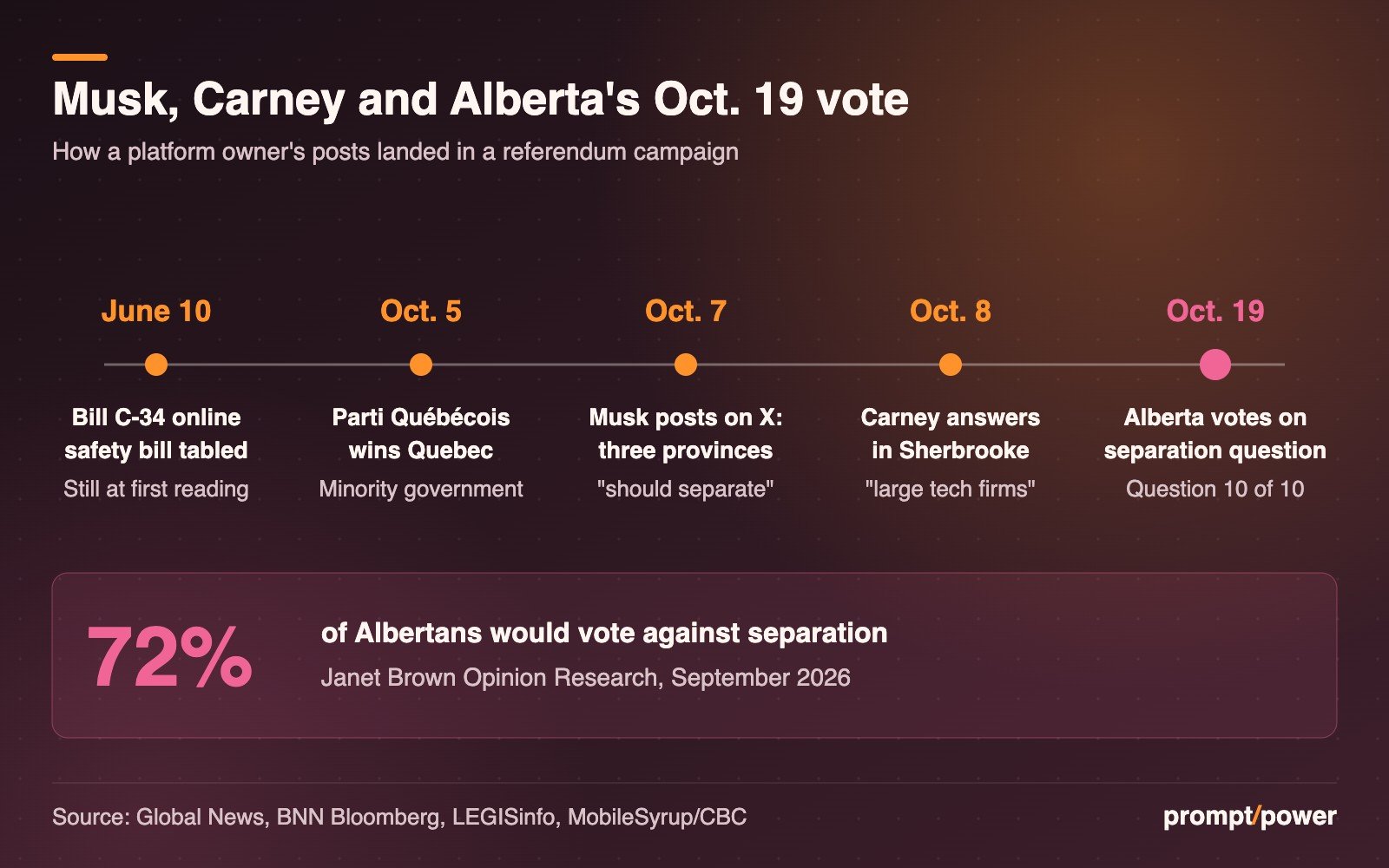
The polling points one way. A September survey by Janet Brown Opinion Research found 72% of Albertans would vote against separation, MobileSyrup reported, citing CBC News. Quebec’s referendum is further off: St-Pierre Plamondon, whose Parti Québécois won a minority on Oct. 5, has said he will not hold one while Trump is in office, BNN Bloomberg noted.
Why Musk’s posts are a platform story
A premier’s opinion and a platform owner’s opinion travel differently. Musk owns X, sets its rules and decides what its recommendation systems push. (For a sense of the scale of his business empire, see our report on Musk becoming a trillionaire again.)
The content around the referendum already carries his products’ fingerprints. A TikTok account called “Alberta Radio Show” posted a video credited to a University of Alberta student named “Leah.” The speaker was a deepfake made with Grok, the AI built into X, MobileSyrup reported, summarizing CBC News. The Alberta flag behind her changes design partway through the clip. Separately, CBC found that RiseOfAlberta, an X account with nearly 100,000 followers that posts AI-generated memes, is tied to Keith Wilson, a lawyer who leads the pro-separation Alberta Transition Council. MobileSyrup noted AI-generated content, much of it carrying far-right rhetoric, has helped promote Alberta separatism.
None of that is unique to Canada. Quebec’s own election this fall raised a smaller version of the same problem, as we found when ChatGPT leaned on an AI-built voter guide.
What Ottawa can and can’t do about it
Very little, in the short term. Canada has no online harms law in force. The federal government introduced Bill C-34, the Safe Social Media Act, on June 10, 2026. It would create a Digital Safety Commission and require large platforms to label synthetic content and mitigate seven categories of harmful content, centred on child safety, hate, violence and terrorism. The release says nothing about election misinformation or foreign interference. The bill has only passed first reading in the House of Commons, according to Parliament’s LEGISinfo.
Alberta’s own referendum rules are written around money. Third-party advertising rules for Question 10 took effect May 28, Elections Alberta says, and the agency added an election integrity section on deepfakes and misinformation. A group becomes a registered third-party advertiser by spending more than CA$1,000 to promote a side, and it cannot accept contributions from outside Alberta, Alberta Fact Check explained, citing an Elections Alberta bulletin. Our read: a free post by the man who owns the platform doesn’t fit that frame, since he spends nothing to make it.
Carney’s “foreign” framing has its own wrinkle. The man he was answering is, legally, Canadian.
Moe’s answer was one word, typed on X. The deepfake student urging Albertans to leave was made with X’s own AI. Polls close in Alberta at 8 p.m. on Oct. 19, and the official results will be announced on Oct. 29.
What’s happened since: a record early vote, and no new rules
Turnout before referendum day was far above Alberta’s last provincial election. In an Oct. 18 release, Elections Alberta counted 837,791 advance votes and 519,082 mail-in special ballots from 3,148,343 eligible electors. In the 2023 general election, 27.5% of electors voted early. The agency cautions that the 2023 special ballot figures are not directly comparable, because special ballots were not open to everyone then.
Counting starts before the polls close. According to Elections Alberta’s referendum page, the count of advance and special ballots begins at 5 p.m. on Oct. 19, voting locations close at 8 p.m., and unofficial results will be posted by question, electoral division and voting method as counts finish. The count must be completed within 48 hours. The Official Announcement of the Results is set for Oct. 29 at 10 a.m.
Ottawa’s side has not moved. LEGISinfo still lists Bill C-34’s only completed stage as first reading on June 10, with no second-reading debate recorded. So the vote is happening under exactly the rules described above: spending limits for registered advertisers, and nothing that reaches a free post from the owner of the platform.
Researched and drafted with AI tools, fact-checked against primary sources and approved by a human editor before publishing. Prices and dates are as of publication. Our standards →
Sources- bnnbloomberg.ca — BNN Bloomberg and CTV News reported
- globalnews.ca — according to The Canadian Press
- elections.ab.ca — Elections Alberta says
- parl.ca — not begun second reading
- gx94radio.com — GX94 Radio reported
- cbc.ca — which gives him the right to Canadian citizenship

Jeff Cameron writes about the business and policy side of AI for prompt/power. A chief operating officer by trade, he also writes for Not An Atlas and The Remote.
All stories by Jeff →Keep reading


Latest from prompt/power
- ChatGPT, Claude, Gemini and Copilot privacy settings: how to stop your chats training AINov 26
- How to turn off AI features on your iPhone, Android phone, Windows PC and in Google and Meta appsNov 26
- TSMC’s US$165-billion Arizona plan: what’s running and what’s still promisedNov 26
- The WHO’s 40-plus rules for AI in health care, and why they matter nowNov 26
- Celestica and Nvidia now share the lead in AI network switches as Ethernet sales more than double, Dell’Oro saysNov 26