An OpenAI employee arrested over a recording device hidden in the company’s San Francisco offices is charged with one federal count of trying to intercept oral communications, the U.S. Attorney’s Office for the Northern District of California said on Oct. 13. Prosecutors allege that Abdulrahman Alfozan, 35, a Saudi national who has worked as an engineer at OpenAI since July 2025, concealed an audio recorder in an executive conference room; he was arrested on Oct. 9, has not been convicted of anything, and faces a detention hearing on Oct. 19.
The charge, under 18 U.S.C. § 2511(1)(b), carries a maximum of five years in prison, a US$250,000 fine and three years of supervised release, according to the Justice Department. Its release notes that a complaint contains only allegations and that Alfozan is presumed innocent until proven guilty beyond a reasonable doubt. The complaint refers to his employer as “Company 1”; OpenAI has confirmed it is the company involved.
What the complaint alleges, in order
The timeline below comes from the criminal complaint as summarised by the Justice Department and by CBS News, which reviewed the filing. None of it has been tested in court.
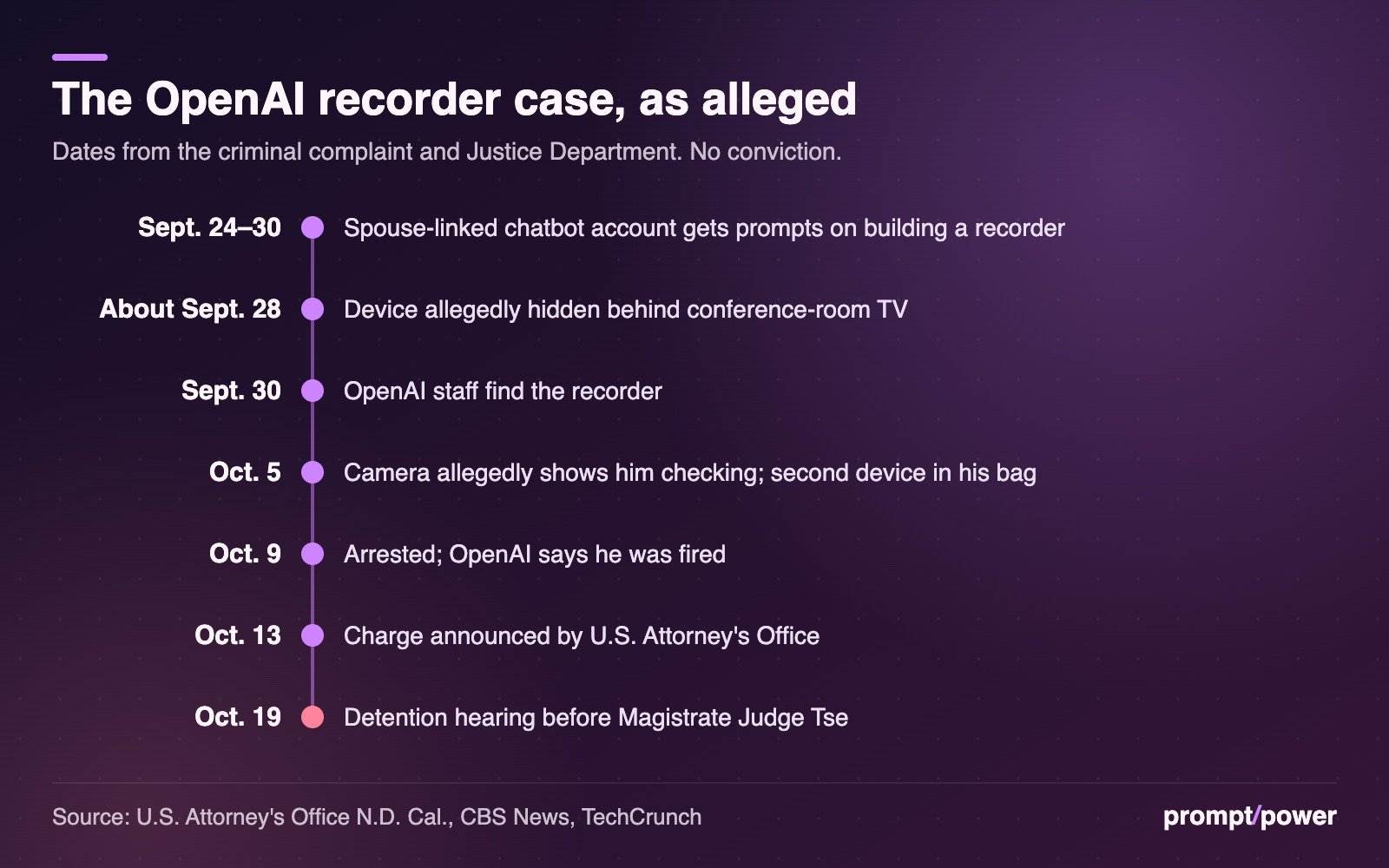
- Before late September: Alfozan allegedly used a workplace productivity tool to look up OpenAI building addresses, meeting rooms, room capacities, calendars and where “leadership and exec” and outside-partner meetings took place. Prosecutors say closed-circuit footage placed him near the executive conference room on several dates, although he had no authorisation to use it.
- Sept. 24 to 30: A chatbot account associated with his spouse, which prosecutors say shared identifiers with his own, allegedly received prompts about building, installing, testing, concealing and remotely accessing a continuous audio recorder. Prompts on Sept. 27 and 28 allegedly referred to the specific device, including its MAC address, The Hacker News reported.
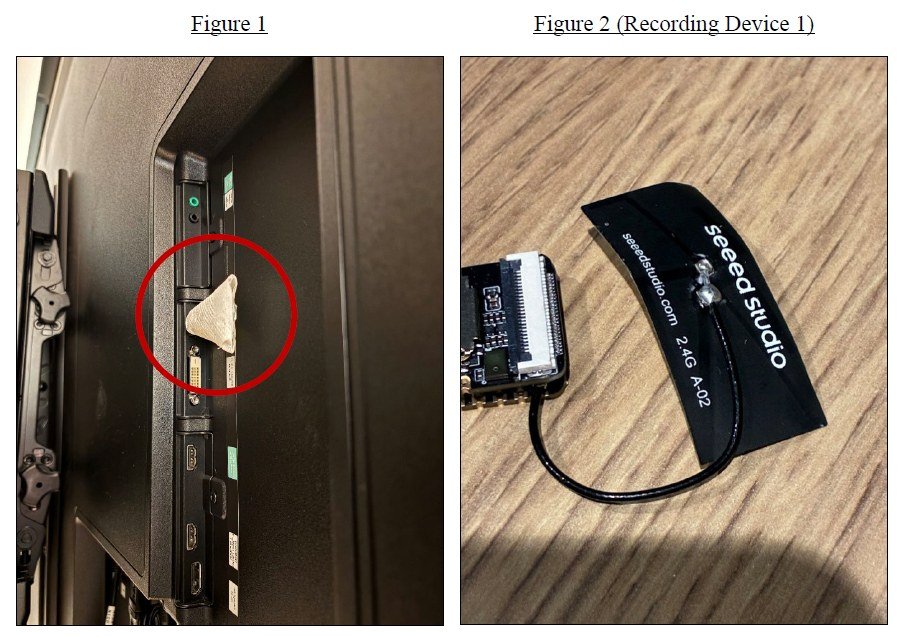
- About Sept. 28: The recorder was allegedly plugged into a USB port on the back of the room’s television, wrapped in toilet paper. Its contents were encrypted, according to the Justice Department.
- Sept. 30: OpenAI staff found it.
- Oct. 5: A camera OpenAI had since installed allegedly recorded Alfozan entering the room and checking behind the television. The same day, security staff allegedly found a second, similar recorder in a bag he had left unattended in another room, along with his wallet and ID.
- Oct. 9: Arrest. OpenAI says it has fired him.
Prosecutors say the room was regularly used for confidential discussions of research, product plans and business development. The complaint, as reported, does not say what Alfozan intended to do with any recordings, and no court document or official cited in coverage so far alleges that he acted for a foreign government. ABC News in Australia reported that officials have not said what the purpose was.
OpenAI says its own models traced the device
The company’s account adds a detail the government’s does not lead with. In a post on X, quoted by Engadget, OpenAI said: “We used our models to understand the device and where it had come from, identifying that a specific employee had planted it a few days earlier.” It then referred the matter to the FBI.
“At this time, we have no indications of this individual inappropriately accessing or exfiltrating model weights, source code, or customer data.”
OpenAI, on X
OpenAI also told TechCrunch the recorder had “advanced encryption, audio monitoring capabilities, and a mechanism for transferring data designed to evade monitoring.” TechCrunch noted it was unclear how different that makes it from other recording devices. OpenAI spokesperson Nate Evans confirmed to TechCrunch that Alfozan worked on the product team.
Our read: the government’s narrative rests on cameras, a bag search and chatbot prompts. OpenAI’s rests on its AI. Both can be true, and the complaint, not a press post, is what a court will weigh.
What officials and the defence are saying
U.S. Attorney Craig Missakian said in the release: “For us it is a matter of national security.” FBI Director Kash Patel said the device was meant to “secretly capture sensitive communications about the company’s superintelligence technology,” according to ABC News, and said the FBI views that mission as one of its “highest counterintelligence priorities.” In a statement quoted by TechCrunch, Patel also used the White House’s newer shorthand, “American SI innovation,” a label we examined when Washington started saying it.
Alfozan’s lawyer, William Pernik, said his client is presumed innocent, CBS News reported. He cautioned against “jumping to conclusions at this very early stage of the case when very little information is known,” and against efforts to “politicize” the prosecution on the basis of factors such as nationality.
Why the OpenAI recording device case matters for AI labs
Frontier labs have mostly framed insider risk as a data problem: who can touch model weights, code repositories and customer records. OpenAI’s statement is built around exactly those three categories. The allegations here concern something older and lower-tech, the conversations in a room where executives meet. A USB port on a television is not on most data-loss checklists.
It also lands on a company already arguing in public about who leaks what. OpenAI recently fired three safety researchers over alleged information sharing, a separate matter with no connection to this case. More of our coverage of the company sits in AI and machine learning.
The next date on the docket is Oct. 19, before U.S. Magistrate Judge Alex G. Tse, where the question is narrower than any of the above: whether Alfozan stays in custody until trial.

Cassandra Lee covers AI and machine learning for prompt/power: the labs, the model releases, the research and the safety fights that come with them. She reads model cards the way other people read horoscopes: skeptically, and mostly for what's left unsaid.
Keep reading



Latest from prompt/power
- Meta Q3 Earnings Oct. 21: The Capex, Ads and Cash Numbers to WatchOct 21
- Anthropic’s 5% Pledge Is Worth About US$48B. Here’s the Fine PrintOct 21
- Commons AI Study Meets Parliament’s Interpreter Math: 44 Passes in 5 YearsOct 21
- CNN All Access Canada Price Is CA$7.99. Americans Pay About 23% MoreOct 20
- DeepSeek Federal Ban: DHS Order Also Covers Apps Built on Its ModelsOct 20
Leave a Reply