
Meta Superintelligence Labs released Muse Wonder and Muse Wonder Full on Oct. 12, and for the first time a Meta model sits within two points of the top of the independent Artificial Analysis Intelligence Index. The catch is in the distribution. Only the weaker model, Muse Wonder, is sold through Meta’s API, at US$4 (about CA$5.56) per million input tokens and US$20 (about CA$28) per million output tokens. Wonder Full, the one that scored 56, lives only inside paid Muse Code subscriptions, and neither model’s weights are downloadable. Meta says a full safety report is coming “soon.”
Meta’s blog post frames the launch as a comeback. “Fourteen months ago, we began a ground-up overhaul of our artificial intelligence efforts,” it says, describing a path “from rebuilding our stack from first principles to pushing the frontier.” Mark Zuckerberg called the pair “a much larger and more advanced class of models” than the Muse Spark family in a post on X, VentureBeat reported. Investors bought the story, at least for a day: Meta shares were up about 4% in afternoon trading, Reuters reported.
Muse Wonder benchmarks: where Meta actually lands
Meta published a wall of its own numbers. Some of them come from tests Meta built, including a “Personal Superintelligence Index” whose formula, Decrypt noted, hasn’t been published. On that one, Wonder Full beats everyone. On Meta’s SWE-Marathon coding test it posts 57.5 against 46.3 for Claude Opus 5.5, a gap Meta itself says comes from a comparison that wasn’t controlled, with its own model running at maximum effort.
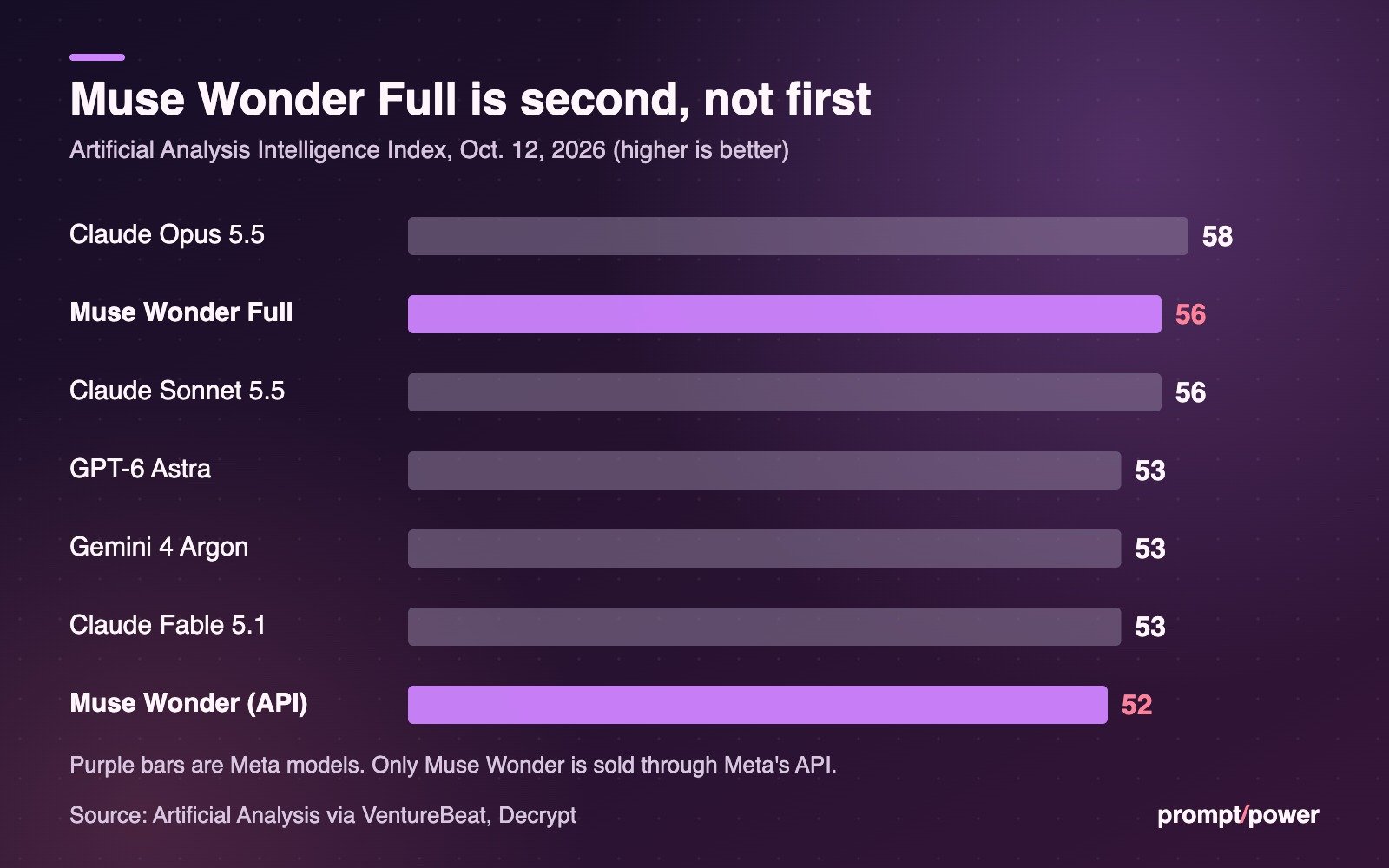
The more useful scoreboard is the outside one. Artificial Analysis, which runs the same 10 evaluations on every model, puts Claude Opus 5.5 first at 58. Wonder Full ties Claude Sonnet 5.5 at 56. GPT-6 Astra, Gemini 4 Argon and Claude Fable 5.1 sit at 53, and the API-available Wonder scores 52. That is a real result, and a ranking Meta could not claim before Oct. 12. It is also second place, behind Anthropic’s flagship and level with Anthropic’s mid-tier model.
The firm’s own breakdown adds a wrinkle. “Knowledge remains a relative weakness for both models, but this is mitigated by very low hallucination rates,” Artificial Analysis posted on X. On its AA-Omniscience test, Wonder Full scores 30, against 46 for Opus 5.5 and 43 for Astra, according to the same thread. Wonder Full ranks in the top three on six of the index’s 10 evaluations, and it places first on two of them, CritPt and GDP.pdf.
Muse Wonder API price vs Claude and GPT-6
Here is what a developer can actually buy on Oct. 13. The model ID is muse-wonder-1.0, with cached input at US$0.20 per million tokens and web search at US$2.50 per 1,000 queries. Those token rates match Claude Opus 5.5’s list price, which we laid out in our field guide to AI model names. So Meta is charging flagship money for the model that scores four points below its own flagship and six below Opus.
| Model | AA Intelligence Index | API input / output, per 1M tokens |
|---|---|---|
| Claude Opus 5.5 | 58 | US$4 / US$20 |
| Muse Wonder Full | 56 | Not sold by API |
| GPT-6 Astra | 53 | US$10 / US$50 |
| Muse Wonder | 52 | US$4 / US$20 |
Against OpenAI the math looks better. Astra costs US$10 and US$50 per million tokens and scores one point higher than Wonder. Artificial Analysis also measures cost per task, and puts Wonder at US$4.52 per index task, 2.8 times what Meta’s older Muse Spark 1.3 costs to run the same suite.
Wonder Full has no pay-as-you-go price at all. VentureBeat reports it comes with Muse Code’s Power Usage and Maximum Usage plans, at US$50 (about CA$70) and US$200 (about CA$278) a month. Meta’s own help page describes the US$50 tier as “Access to the most powerful Muse models” and promises “20x more usage than the Everyday Usage plan,” which costs US$5.
Contributor mode: the default that trains on your code
This is the part a working developer should read twice. “Muse Code subscriptions default to Contributor mode,” Meta says, which means the prompts, code, files and context you send, and the responses you get back, can be used to train future Meta models. You can switch it off at any time, but only content sent after that point is excluded. Contributor mode isn’t available to accounts with Zero Data Retention. VentureBeat adds that Meta’s terms bar users from submitting confidential, sensitive or personal information while it’s on.
Put those together. The only way to use Meta’s best model is through a subscription, and that subscription arrives switched to share. The API, by contrast, runs on a standard tier where, in Meta’s words, “your prompts and completions are not used to train Meta models.” Meta already sells a cheaper contributor tier for Muse Spark through the API, at US$0.10 in and US$0.20 out per million tokens, against US$1.25 and US$4.25 on standard pricing. Our read: Meta has put a price on developer data, and for Wonder Full it collects that data by default rather than buying it with a discount.
The only way to use Meta’s best model is through a subscription, and that subscription arrives switched to share.
Muse’s track record makes the default harder to wave off. Inc. columnist Jason Aten has said the Muse agent synced more than 187,000 rows of his private iMessages after he says he declined access, as Decrypt recounts, a claim Meta has denied, as we reported on Oct. 3.
No open weights from the Llama company
Neither Wonder model has downloadable weights. Meta’s smaller Muse Glimmer model was released under the Apache 2.0 licence, but the flagship tier stays closed. For a company whose Llama models made it the default name in open AI, that is a clear change of posture, and Meta’s blog post doesn’t mention weights at all. If you want frontier-adjacent models you can run yourself, the options now come mostly from elsewhere, as our guide to open-weight models shows.
On safety, Meta calls Wonder “our most aligned model to date” in its announcement. Its model card reports a 0% harmful-action rate on an Agentic Misalignment test and lists a 1M-token context window, with text, image, video and audio in and text out. The fuller safety evaluation “will be available soon,” Meta says, with no date.
What it means for you
- Developers on the API get Wonder, not Wonder Full, at Opus prices. Benchmark it on your own workload before switching; on Artificial Analysis it trails Astra by a point.
- Muse Code subscribers should check the Contributor setting before pasting in client or company code. Turning it off doesn’t pull back anything already sent. Our guide to training opt-outs covers Meta AI’s consumer settings.
- Muse app users will see Wonder later. Meta says it “will soon power experiences in Muse” and roll out first to subscribers. Free users have no date.
The stock reaction may owe something to more than the model. On Oct. 12, Yahoo Finance’s markets blog called the Muse agent “the main driver of the stock price at the moment”, citing Sensor Tower data that 73% of new Muse users come back the day after installing. Meta shares rose as much as 4.7% intraday, The Motley Fool reported. A 56 on someone else’s index, and a default switch most subscribers will never touch: that was the day’s trade. More from our AI and machine learning coverage.

Cassandra Lee covers AI and machine learning for prompt/power: the labs, the model releases, the research and the safety fights that come with them. She reads model cards the way other people read horoscopes: skeptically, and mostly for what's left unsaid.
Keep reading

Latest from prompt/power
- Meta Q3 Earnings Oct. 21: The Capex, Ads and Cash Numbers to WatchOct 21
- Anthropic’s 5% Pledge Is Worth About US$48B. Here’s the Fine PrintOct 21
- Commons AI Study Meets Parliament’s Interpreter Math: 44 Passes in 5 YearsOct 21
- CNN All Access Canada Price Is CA$7.99. Americans Pay About 23% MoreOct 20
- DeepSeek Federal Ban: DHS Order Also Covers Apps Built on Its ModelsOct 20
Leave a Reply