
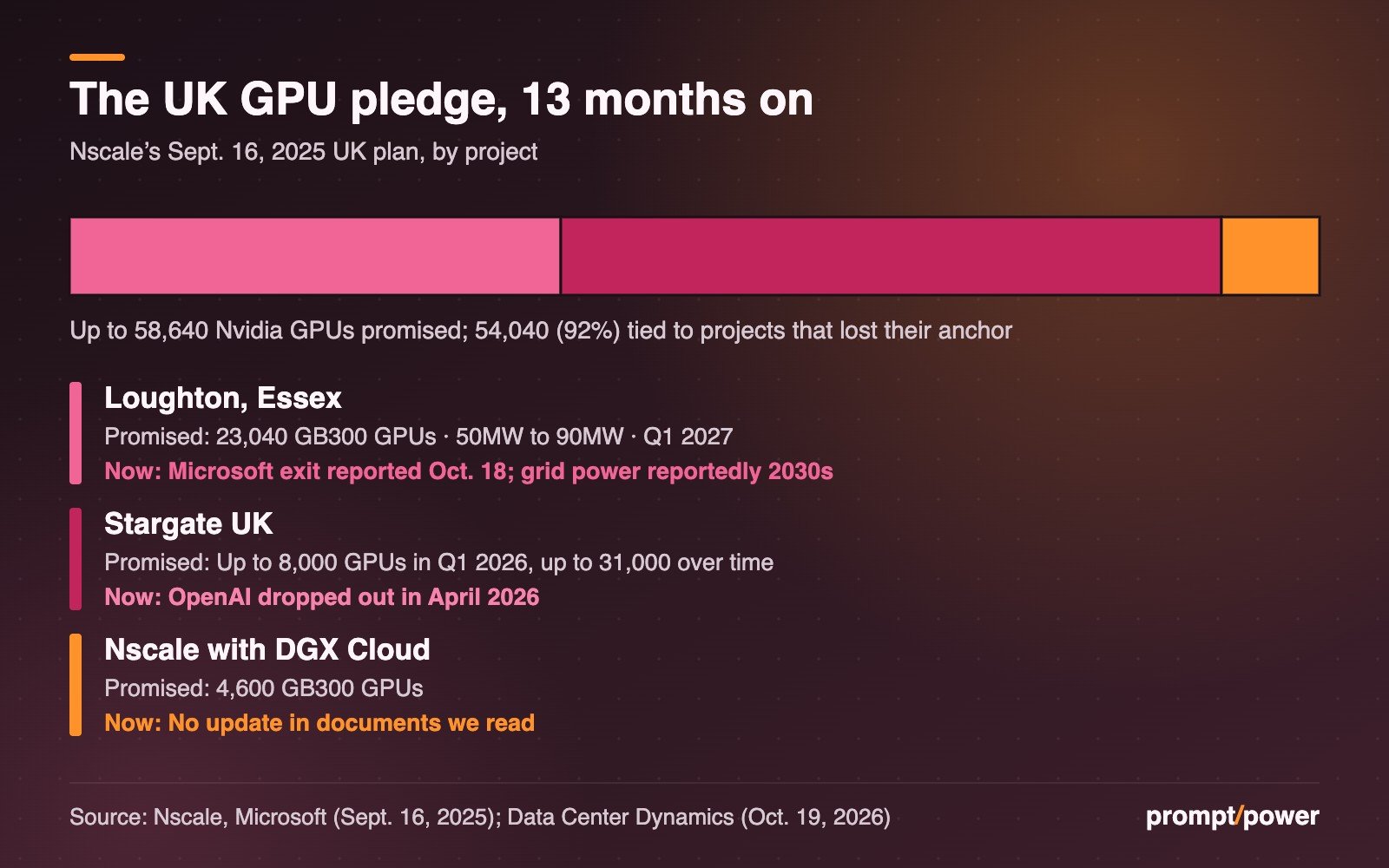
On Sept. 16, 2025, Nscale set out a plan for up to 58,640 Nvidia GPUs across Britain. Two projects made up 54,040 of them: a Microsoft supercomputer at Loughton in Essex and OpenAI’s Stargate UK. By our count, both have now lost the anchor customer they were announced with. That is 92% of the GPU headline, on paper at least, with no named tenant.
The latest blow landed on Oct. 18, when The Telegraph reported that Microsoft had walked away from Loughton, according to Data Center Dynamics. The site is now not expected to receive grid power until the 2030s, DCD reported. Nscale told The Telegraph it was “exploring alternative power sources for the site.” DCD’s report carries no statement from Microsoft, and we have not seen the company confirm the withdrawal.
Microsoft Loughton supercomputer: what was promised
The Loughton campus was the centrepiece of Microsoft’s own pledge. In a Sept. 16, 2025 blog post, Microsoft vice chair and president Brad Smith announced about £22.6bn (US$30bn) of spending in the UK “during the four years from 2025 through 2028,” including about £11.3bn (US$15bn) in capital expenditure on cloud and AI infrastructure. The post said the money would “enable us to build the country’s largest supercomputer — with more than 23,000 NVIDIA GPUs — in partnership with Nscale.”
Nscale’s release the same day put specifics on it: 23,040 Nvidia GB300 GPUs at its Loughton AI Campus, 50MW of capacity “expandable to 90MW,” delivered in the first quarter of 2027, to support Microsoft’s Azure services in the UK. Chief executive Josh Payne called the package “the most significant provision of AI infrastructure in the UK yet deployed.”
Two dates now sit uneasily together. Nscale promised GPUs in early 2027. Grid power, on the reported timeline, arrives sometime in the 2030s.
The UK AI pledge tracker
We set each item in Nscale’s and Microsoft’s September 2025 announcements against what has since been reported. Status lines rely on DCD’s reporting unless stated.
| Pledge (Sept. 16, 2025) | What was promised | Status as of Oct. 22, 2026 |
|---|---|---|
| Microsoft UK investment | About £22.6bn (US$30bn), 2025 to 2028, incl. about £11.3bn (US$15bn) capex | No revised figure from Microsoft that we have seen |
| Loughton supercomputer (Microsoft, Nscale) | 23,040 GB300 GPUs, 50MW to 90MW, Q1 2027 | Microsoft exit reported Oct. 18; grid power reportedly not until the 2030s |
| Stargate UK (OpenAI, Nscale) | Up to 8,000 GPUs in Q1 2026, up to 31,000 over time; sites incl. Cobalt Park, North East AI Growth Zone | OpenAI dropped out in April 2026 |
| Nscale with Nvidia DGX Cloud | 4,600 GB300 GPUs | No update in the documents we read |
On Stargate UK, DCD says OpenAI pointed to energy infrastructure, though the lab itself cited regulation and energy costs. The difference matters for ministers. One is a grid problem the state can fix over years. The other is a pricing problem it can only fix with money.
Our read: the pledges were never really about the headline sums. Microsoft decides how its own money is spent, and a reported cancellation at one site does not by itself shrink a £22.6bn figure measured over four years. The GPU counts were different. They were physical, site-specific and dated, which is why they are now the easiest promises to check.
“We are exploring alternative power sources for the site.” Nscale, to The Telegraph, via DCD
What Nscale’s US prospectus says about power
Nscale is preparing to list in the US, and its preliminary S-1 prospectus, filed with the US Securities and Exchange Commission on Sept. 18, 2026, is the most detailed public document the company has produced. Exactly one month later came the Loughton report. We read the filing for anything on the Essex site.
It does not name Loughton in the sections we were able to read. The United Kingdom appears in a risk factor headed “Our current pipeline and future growth rely on significant continued expansion of our data center footprint,” in a list of countries alongside the United States, Norway, Iceland, Portugal and Indonesia. The same risk factor warns that difficulties “obtaining reliable power with sufficient capacity and on acceptable terms, will limit the growth of our revenues.” Elsewhere, the filing lists “utility readiness” among the causes of possible failures or delays in bringing capacity live.
That is boilerplate in most data centre prospectuses. At Loughton it describes exactly what went wrong. DCD reports that Microsoft accounts for about 40% of Nscale’s roughly US$103bn (about £77bn) in contracted revenue and calls Loughton a small share of that total; we could not find that customer breakdown in the S-1 text we read. Nscale told The Telegraph the “London-wide grid issue has no impact on our other contracts.”
Investors in the listing will want an amended filing that says so in writing. Whether one appears is the next thing to watch.
Loughton is not the only London-area data centre fight
In Charlton, the Royal Borough of Greenwich has come out against a 180MW data centre on the Thames. As we reported on Oct. 7, the real prize in that fight is a confirmed grid connection in a city short of them. Our explainer on AI’s electricity demand sets out why estimates of the load vary so widely. More UK coverage is on our policy page.
The pattern is consistent. Announcements arrive with GPU counts and quarter-by-quarter delivery dates. Connection dates arrive later, and they come from a different queue.
What to watch
- Microsoft’s own account. Whether it confirms the Loughton exit, and whether it says where the 23,000-GPU supercomputer it promised will now be built, if anywhere.
- Nscale’s filing. An amended S-1 that mentions Loughton, Microsoft or the grid delay.
- Alternative power. What “alternative power sources” means in practice at a site that was to draw up to 90MW.
Microsoft’s blog post still describes the Loughton machine as “the country’s largest supercomputer.” On the reported timeline, it will not have grid power this decade.

Felix Strauss covers tech policy and regulation for prompt/power, from Brussels and Ottawa to Washington and Sacramento. He reads the 400-page regulation so you don't have to, and highlights the one sentence that actually matters.
Keep reading

Latest from prompt/power
- OpenAI Is on Google Cloud Now. Where GPT-6 Actually Runs, Cloud by CloudOct 22
- Apple ‘Pro and Tell’ Oct. 28: What’s Confirmed and What’s Only RumouredOct 22
- Tesla Q3 Earnings: SpaceX Out-Earned It Nearly 4 to 1 as Merger Talks BeginOct 22
- Meta Q3 Earnings: A US$64.6B Beat, US$34.9B of Capex and Negative Cash FlowOct 22
- PHP2Shell: Ottawa Pulled Websites Offline. Here’s What to Patch NowOct 22
Leave a Reply