Is that Black Friday ‘regular price’ real? The rules in Canada, the U.S. and the U.K., and how to check
Canada, the U.S. and the U.K. all require a 'was' price to be real. What each country's rules say, and a three-minute check for any AI gadget deal.
Black Friday runs on one claim: the price you see is lower than the price it used to be. In Canada, the U.S. and the U.K., that “regular price” is supposed to be real, and each country has rules about what counts. Here’s what those rules say, and a three-minute way to check a deal on any AI gadget or subscription before you buy.
Canada: two tests
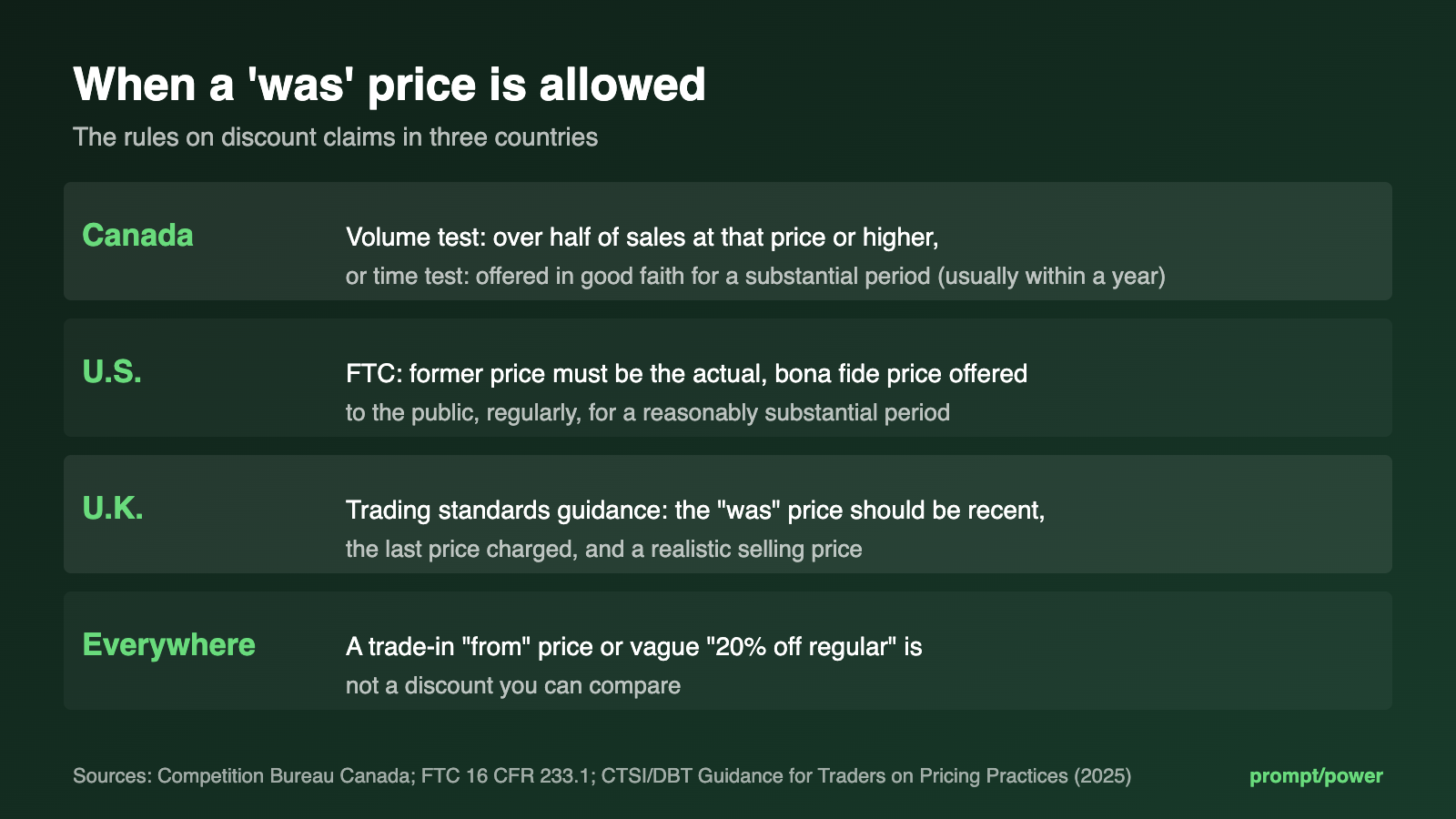
Canada’s Competition Bureau says a business can only compare against a regular price it can prove. That price has to pass one of two tests. Under the volume test, more than half of the product’s sales were at that price or higher within a reasonable period, usually a year before or after the promotion. Under the time test, the product was offered at that price or higher, in good faith, for a substantial period, usually within the year before or after.
If neither test is met, the discount claim can be misleading under the Competition Act. Last November the Bureau warned businesses that it had seen a surge in complaints about inflated regular prices, and that vague claims like “20% off our regular price!” should be avoided because they can’t be verified. Canadians can report suspected fake sales through the Bureau’s online complaint form.
U.S.: a “bona fide” former price
The Federal Trade Commission’s Guides Against Deceptive Pricing say a former price is a fair basis for comparison when it is “the actual, bona fide price at which the article was offered to the public,” offered regularly for a reasonably substantial period. A price that was inflated just so a markdown would look bigger makes the bargain false.
U.K.: recent, last and realistic
Guidance for traders from the Chartered Trading Standards Institute, produced with the Department for Business and Trade and updated in 2025, sets no fixed number of days. It says a “was” price should be recent, should be the last price charged with no prices in between, and should be a realistic selling price, ideally backed by significant sales. A recommended retail price must be clearly labelled as an RRP, not presented as the shop’s own previous price.
How to check a deal in three minutes
- Write down today’s price without trade-ins or bundles. On Google’s U.S. store, for example, the Pixel 11’s “from” price of US$389 assumes a trade-in; the list price is US$899.
- Compare with a dated baseline. Our Pixel baseline from Nov. 15 is one; your own screenshot from a week ago is another.
- Read what the “was” price refers to. The store’s own previous price, an RRP or a competitor’s price are three different claims.
- For subscriptions, check what happens after the first year. Introductory AI plan prices usually renew at the regular rate.
We’ll publish our Black Friday price check against the Nov. 15 baseline on Nov. 27.
This is general information, not legal advice.
More from prompt/power: Our Pixel Black Friday baseline · Annual vs monthly AI subscriptions · Pixel Tag prices in three countries
Researched and drafted with AI tools, fact-checked against primary sources and approved by a human editor before publishing. Prices and dates are as of publication. Our standards →

Alicia Loveday is a senior editor at prompt/power and a mom who works where fashion meets AI. She leads Tech & Your Money: what Canadians actually pay for phones, plans and gadgets, and the fine print that changes the bill. When the news needs her elsewhere, she goes. She believes every algorithm should come with a return policy.
All stories by Alicia →Keep reading




Latest from prompt/power
- An AI may be taking notes at your doctor’s appointment. What Ontario and the NHS require, and what to askNov 21
- How to read an IPO prospectus in 10 minutes, using Anthropic’s as the exampleNov 20
- ChatGPT Pro, Claude Max or Google AI Ultra? What CA$140 a month buysNov 20
- Anthropic’s first day, studied: who made money, what it left on the table, and what ANT is now worthNov 20
- Broadcom’s AI chip sales now outstrip its entire business from a year ago. What to watch on Dec. 9Nov 19