ChatGPT now lets brands claim a profile and run their own agent. What creators and publishers should know
OpenAI's Businesses in ChatGPT beta gives brands verified profiles, mention data and, for some U.S. firms, their own agents. Here's what's in it.

For two years, brands, publishers and creators have been guessing how ChatGPT talks about them. OpenAI now wants to sell them the answer, and a seat at the table.
On Nov. 10, OpenAI launched Businesses in ChatGPT, a beta that lets companies claim a profile inside ChatGPT, see aggregated data on how often the chatbot mentions them and, for some U.S. firms, put their own AI agent in front of ChatGPT’s users. The details below come from OpenAI’s announcement as reported by The Next Web; OpenAI’s own post was not reachable when we checked.
What you get
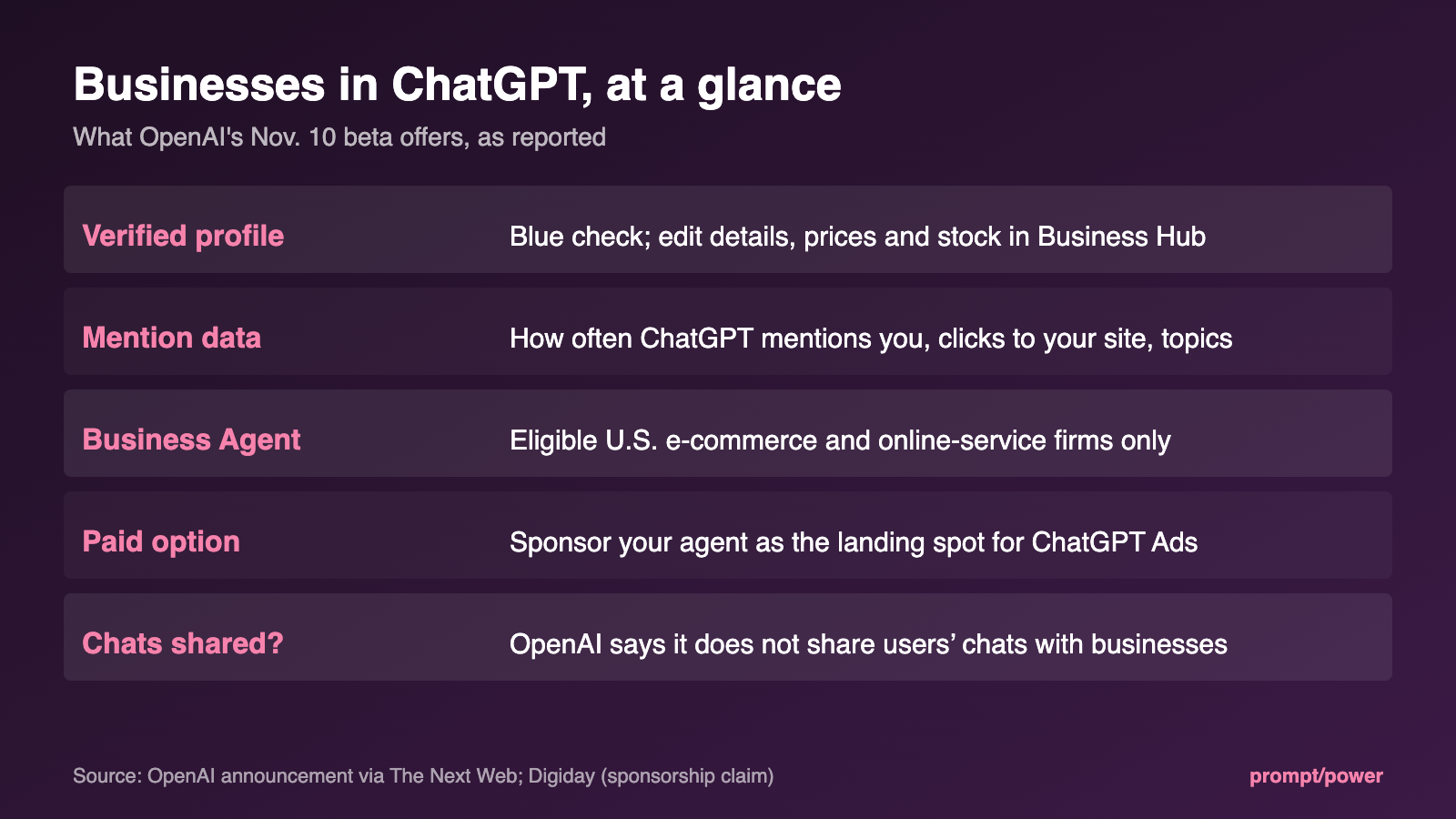
A verified profile. Through a tool called Business Hub, verified companies get a blue check and can update their details, prices and stock. OpenAI hasn’t spelled out publicly how verification works.
Mention data. Business Hub shows how often ChatGPT mentions a business, how many users click through to its website and the common topics in those conversations. OpenAI says it does not share users’ chats with businesses. It pitches the reach as the 1.2 billion people who use ChatGPT each week.
A Business Agent, if you qualify. Eligible U.S. e-commerce and online-service firms can launch an agent that answers questions using their own product details. When a business appears in a ChatGPT answer, users can open its profile and chat with that agent. Agent chats are labelled and kept separate from ChatGPT’s own answers, and purchases or sharing personal data need the user’s explicit approval. For now, buyers are sent to the brand’s own website to pay.
Where the money is
The one paid option OpenAI described is sponsorship: a business can make its agent the landing spot for a ChatGPT ad, building on the Sponsored Agents test that began in September. OpenAI told Digiday that paying doesn’t change how often ChatGPT recommends a business. That is the claim to watch, because it is exactly the line search engines have had to defend for 25 years.
What it means for creators and publishers
For independent shops and creators who sell products, the mention data is the immediately useful part: it is the first official view of whether ChatGPT is sending anyone your way. Expect it to squeeze the start-ups that sell estimates of “AI visibility.”
For publishers, the questions are sharper. A chatbot that now hosts brands’ own agents, with ads attached, is becoming a storefront as well as an answer engine. If ChatGPT’s answers lean on reporting and reviews while the click goes to a sponsored agent, the economics of review journalism shift again.
And for Canadian and U.K. businesses, the agent piece is off-limits for now: OpenAI limited Business Agents to U.S. firms, and it hasn’t said when other markets will follow.
More from prompt/power: Apple Creator Studio’s AI assistant · The AI training opt-out token · What GPT-6.1 Terra costs
Researched and drafted with AI tools, fact-checked against primary sources and approved by a human editor before publishing. Prices and dates are as of publication. Our standards →

Casie Stewart covers the creator economy, social platforms and wellness tech for prompt/power: who gets paid, who gets seen, and what the algorithm is really asking of the people who feed it. She has been publishing online since 2005, long before "creator" was a job title, and has spent most of that time on the other side of the platforms she now writes about. Based in Toronto. Her rule for any new app: if it promises to save you time, check how much of it you just spent reading the onboarding.
All stories by Casie →Keep reading




Latest from prompt/power
- GPT-6.2 Astra is OpenAI’s first released model rated ‘High’ for AI self-improvement. What that means, and what it costsNov 18
- OpenAI’s free CSAM classifier misses half the infant images in its own test set. What the model card showsNov 18
- Anthropic’s last filing before pricing: Nasdaq approval, a US$6.5-billion stock-pay bill and a redrawn lock-upNov 18
- AlphaGenome 2 predicts what a DNA change does in a specific cell. DeepMind says it doubles the hit rateNov 18
- Apple, the NSA and Chase: what each says broke in a week of outagesNov 18