An AI may be taking notes at your doctor’s appointment. What Ontario and the NHS require, and what to ask
Ambient AI scribes are spreading in clinics. Ontario has 20 approved vendors; NHS England requires clinician sign-off and transparency. Questions to ask.


More and more doctors’ appointments now have a third participant: an AI “scribe” that listens to the conversation and drafts the clinical note. The pitch is less typing and more eye contact. For patients, the questions are simpler: is it recording me, who sees it, and can I say no? Here’s what public bodies in Ontario and England have set out.
What an AI scribe does
Ambient scribes, which the NHS calls ambient voice technology, capture audio during a visit, transcribe it and, in most products, use generative AI to summarise it into a note or letter. That summarising step matters. NHS England’s guidance says a tool that only produces an easily checked transcript is likely not a medical device, while one that uses generative AI to summarise probably is.
Ontario: a vendor list, not a subsidy
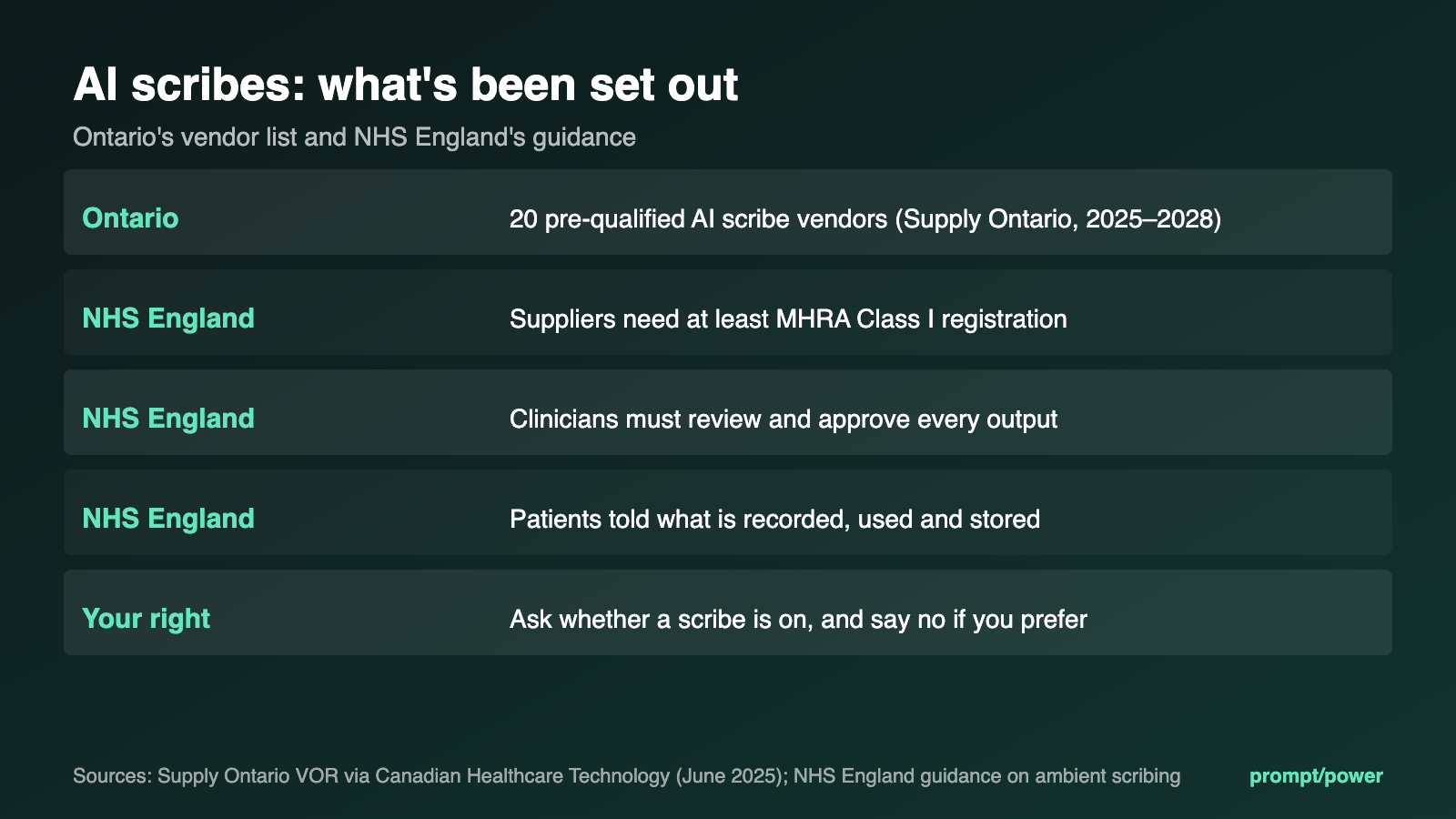
Ontario built its AI Scribe program with the Ministry of Health, Ontario Health and OntarioMD. In 2025, Supply Ontario set up a vendor-of-record arrangement running from April 27, 2025 to April 27, 2028, with 20 pre-qualified AI scribe vendors chosen through competitive bidding, according to Canadian Healthcare Technology. The list includes 3M’s Solventum and a long tail of Canadian start-ups. The arrangement gives clinics group-buying power, but the same report says no funding is available to buy from it, so doctors still pay for the tools themselves.
England: rules for the NHS
NHS England’s guidance on AI-enabled ambient scribing sets out the following:
- Suppliers on its ambient voice technology registry need at least MHRA Class I medical device registration, along with the NHS’s digital technology and data security checks.
- Clinicians must review and approve every output before anything else happens, and they stay responsible for its accuracy.
- Organisations must be open with patients before recording starts: what is recorded, what the output is, who uses it and how it’s stored, so that patients can object.
- Organisations need a data protection impact assessment and clear rules on how long audio, transcripts and notes are kept.
The guidance stops short of a blanket consent requirement, but it tells organisations to train staff to ask patients’ permission.
What to ask at your next appointment
- Is a scribe on right now? In England, the NHS guidance expects you to be told; anywhere, it’s a fair question.
- Is the audio kept, and for how long? Retention policies vary by vendor and clinic.
- Who checks the note? The answer should be your clinician.
- Can we turn it off? For sensitive conversations, asking is reasonable.
AI scribes can give clinicians time back, but they work only if what they write is right. Reading your visit summary in your patient portal, where you can, is the simplest check.
More from prompt/power: AI therapy chatbots: the rules · Google’s Gemini health coach · AlphaGenome 2, explained
Researched and drafted with AI tools, fact-checked against primary sources and approved by a human editor before publishing. Prices and dates are as of publication. Our standards →

Keep reading




Latest from prompt/power
- Canada’s CA$2-billion plan for AI computing power: where the money goes, and what’s actually openNov 21
- Is that Black Friday ‘regular price’ real? The rules in Canada, the U.S. and the U.K., and how to checkNov 21
- How to read an IPO prospectus in 10 minutes, using Anthropic’s as the exampleNov 20
- ChatGPT Pro, Claude Max or Google AI Ultra? What CA$140 a month buysNov 20
- Broadcom’s AI chip sales now outstrip its entire business from a year ago. What to watch on Dec. 9Nov 19