IBM, NVIDIA and Fermilab plan a quantum test bed. Here’s what each brings, and what’s still missing
IBM, NVIDIA and Fermilab announced plans for a quantum-classical codesign platform. Both releases skip the date and the site. What ships now, and what doesn't.


Quantum computers will need ordinary supercomputers sitting right beside them, and three of the biggest names in the field want to work out how that pairing should be built. On Nov. 16, IBM and NVIDIA each announced plans for a “codesign” platform with the U.S. Department of Energy’s Fermi National Accelerator Laboratory, near Chicago.
We read both releases side by side. They describe the same idea from two directions, and neither gives a start date or says where the finished platform will sit.
What the platform is for
Today’s quantum processors make constant errors. Fixing them in real time takes a lot of conventional computing: something has to read the measurements and work out, very fast, what went wrong. That job is called decoding, and it gets harder as machines grow from one processor to several linked ones, the “modular” design both companies expect future fault-tolerant machines to use.
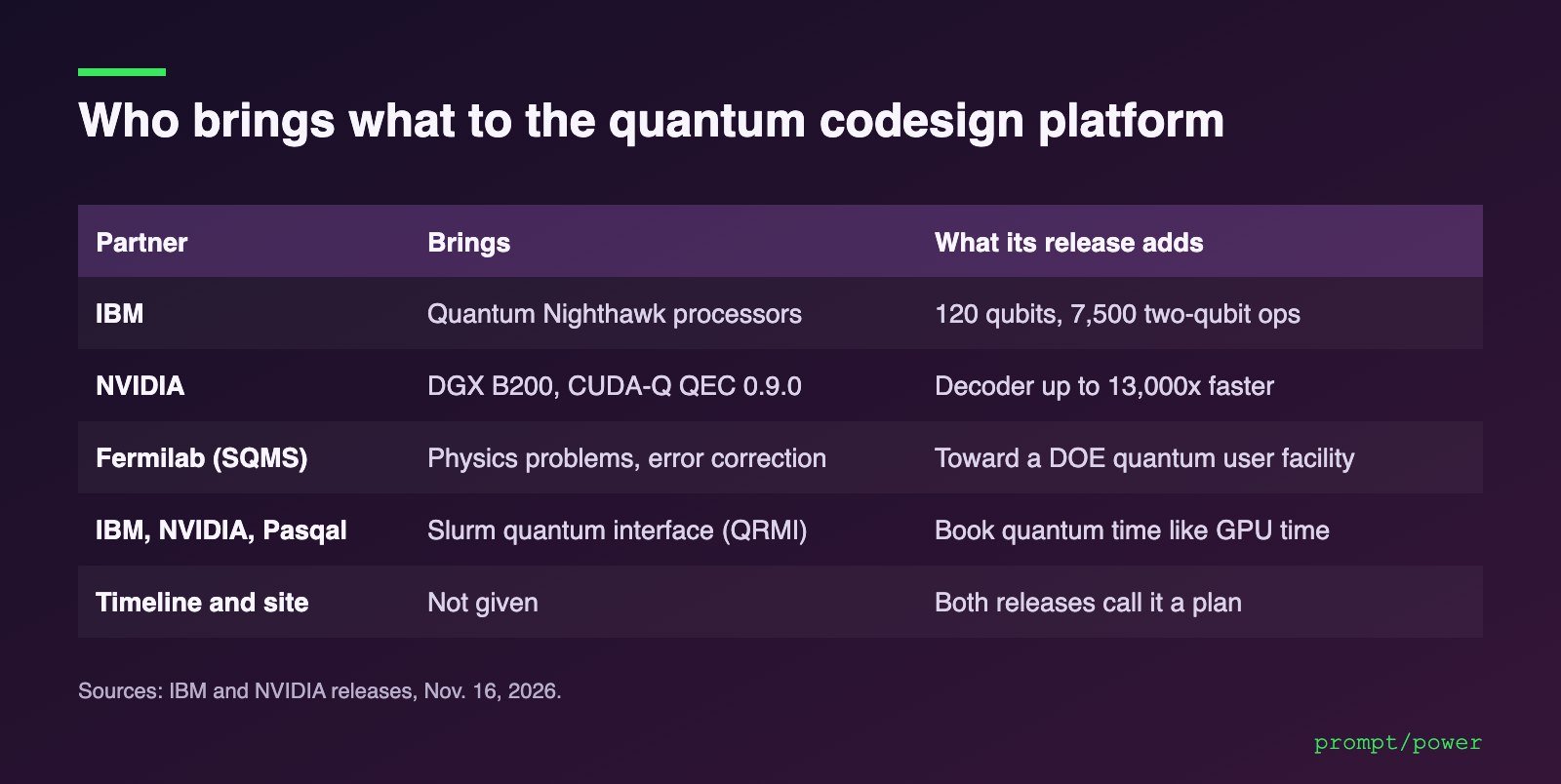
The plan puts NVIDIA DGX B200 systems next to IBM quantum computers, including IBM’s Quantum Nighthawk processor, which IBM describes as its most powerful yet: circuits of up to 7,500 two-qubit operations on 120 qubits. Fermilab’s Superconducting Quantum Materials and Systems (SQMS) Center would use the setup to test how multiple quantum processors work together and how much classical computing they need.
The physics Fermilab wants to try
IBM says Fermilab and IBM plan to study what hard problems in high-energy and nuclear physics would demand, naming lattice gauge theories, neutrino interactions and nuclear simulations. Anna Grassellino, Fermilab’s chief technology officer and director of SQMS, called it “an important step toward the capabilities and community needed for a future DOE quantum computing user facility.” That’s the long game: a national lab where outside scientists could book quantum time.
The part that ships now
Two pieces are more than plans. NVIDIA says a new decoding algorithm, TCBP-JOBS, speeds up the heaviest parts of error-correction research by up to 13,000 times and cuts the computing time to study a new quantum design from 12 weeks to 45 minutes. It says the algorithm is available now in its CUDA-Q QEC 0.9.0 library. Those are NVIDIA’s own figures, not independently tested.
The second is scheduling. IBM, NVIDIA and Pasqal worked with the open-source Slurm community on a Quantum Resource Management Interface, so a computing centre can book and bill quantum processor time inside a normal job, the same way it handles CPU and GPU time. That’s dull plumbing, and it’s what makes quantum hardware usable in a real research centre.
What’s missing
Neither release puts a dollar figure, a date or a site on the platform, and both call it planned or proposed. IBM’s release also points to separate results: with RIKEN and NVIDIA, it reports a 72-qubit study of an iron-sulfur cluster that came within 4.3 millihartree of a leading classical method. That’s a measure of accuracy in quantum chemistry, not a claim that the quantum machine beat the classical one.
For more on why error correction is the whole game, see our explainer on Google’s magic state cultivation.
More from prompt/power: Google’s magic state cultivation, explained · Nvidia’s earnings: the numbers to watch · Will AI win a Nobel again?
Sources: IBM press release, Nov. 16, 2026 (via CNW); NVIDIA press release, Nov. 16, 2026.
Researched and drafted with AI tools, fact-checked against primary sources and approved by a human editor before publishing. Prices and dates are as of publication. Our standards →
Sources- newswire.ca — IBM
- nvidianews.nvidia.com — NVIDIA

Keep reading



Latest from prompt/power
- GPT-6.2 Astra is OpenAI’s first released model rated ‘High’ for AI self-improvement. What that means, and what it costsNov 18
- OpenAI’s free CSAM classifier misses half the infant images in its own test set. What the model card showsNov 18
- Anthropic’s last filing before pricing: Nasdaq approval, a US$6.5-billion stock-pay bill and a redrawn lock-upNov 18
- Celestica, the Toronto company building AI’s racks, expects US$40 billion in revenue next yearNov 18
- ChatGPT now lets brands claim a profile and run their own agent. What creators and publishers should knowNov 18