
Google’s quantum team says it has shown, on real hardware, a cheaper way to make the “magic states” a fault-tolerant quantum computer burns through every time it runs a T gate. In a paper published in Science on Oct. 15, researchers ran a technique called magic state cultivation on the 105-qubit Willow processor and cut the error of the resulting state about 40-fold compared with preparing it the old, unprotected way, reaching a fidelity of 0.9999. The catch, in the paper’s own numbers: only about 8% of attempts survived, and the result is still roughly a million times noisier than what code-breaking algorithms would need. More experiments at larger scale come next.
Google announced the work in a post by research scientist Emma Rosenfeld and quantum software engineer Craig Gidney, which frames it as breaking open a bottleneck researchers have recognised since 2004. We read the underlying study instead, via its preprint on arXiv, posted in December 2025, because the interesting parts are in the figures and the caveats, not the headline multiplier.
What is a magic state in quantum computing?
Quantum error correction works by spreading one reliable “logical” qubit across many unreliable physical ones and checking them constantly for mistakes. Google showed that trick getting better with scale on Willow in 2024, which it describes in its post on making quantum error correction work.
The problem is that the operations easiest to protect inside an error-correcting code (the so-called Clifford gates) are not enough on their own. A computer limited to them can be simulated efficiently by an ordinary laptop. To get the power that makes quantum computing worth building, you need at least one extra ingredient, usually the T gate, and it does not fit neatly inside the code.
The standard workaround is to prepare a special resource, a T state or “magic state”, separately, then feed it into the computation, where it is used up. Every T gate eats one. Large algorithms need enormous numbers of them, and each must be extraordinarily clean, because one bad state can spoil the whole run.
That is why Google’s post says some estimates put up to 95% of a quantum computer’s capacity into manufacturing magic states. Treat the figure as a ceiling from older designs, not a measured fact about any machine.
Distillation vs cultivation: what changed
For two decades the default answer has been magic state distillation: make many noisy copies, then run a protocol that combines them into fewer, cleaner ones, repeating in rounds until the error is low enough. It works on paper. It is also a factory that eats qubits and time.
Cultivation, proposed in 2024 by Gidney, Noah Shutty and Cody Jones in a paper titled “Magic state cultivation: growing T states as cheap as CNOT gates”, takes a different route. Instead of refining a crowd of bad states, it nurses a single one. The state starts in a small error-correcting patch (a distance-3 colour code), gets checked repeatedly, and is thrown away the instant anything looks wrong. Survivors are then “grafted” into a larger surface code, the workhorse code the rest of the computer would use.
The 2024 simulations were bold. The authors wrote that cultivation “uses an order of magnitude fewer qubit-rounds” than earlier methods to reach a logical error rate of 2×10⁻⁹ at a physical noise level of one in a thousand, and 4×10⁻¹¹ if that noise is halved. They went further and suggested “further magic state distillation may never be needed in practice.”
Those were simulations. The new paper is the first test on physical hardware, and that is the whole point of it.
The Willow results, by the numbers
The study (we worked from the arXiv version), first-authored by Rosenfeld with Gidney and dozens of Google Research co-authors, used surprisingly little of the chip. The core cultivation experiments ran on 12 to 14 of Willow’s 105 transmon qubits. The grafting demonstration used 54.
- Without cultivation, simply injecting the state gave a logical error of about 4.4×10⁻³, roughly four failures per thousand, while keeping about 76% of attempts.
- With cultivation, the error fell to between 1×10⁻⁴ and 2×10⁻⁴, the 40-fold improvement Google is quoting, with a fidelity of 0.9999(1). Acceptance fell to about 8%.
- Remove the error-correction cycles from the circuit and the error gets about 100 times worse, the paper says, which is the evidence that the checking, not luck, does the work.
One line in the results section is worth sitting with. The cultivated state’s error “is well below the error of each of the 216 physical two-qubit gates in the circuit.” In plain terms, the team built something more reliable than any of the parts it was built from. That is the definition of error correction paying off.
The 8% figure is the honest cost. Cultivation buys quality by discarding: run the routine a dozen times and expect to keep one. The 2024 theory assumed exactly this trade, and argued the restarts are cheap because each attempt is small. Whether that holds on a large machine running in real time is not something this experiment tests.
There is also a measurement story. Checking an error rate near one in ten thousand with standard state tomography would take around 10⁸ shots, according to the paper. The team built a new method it calls kickback tomography, which uses cultivation to measure itself, needing about 10⁴. Google’s blog post describes Rosenfeld spending months chasing data that seemed to break physics before tracing it to a faulty assumption in the old benchmarking method, thrown off by drifting electronics and temperature changes.
What magic state cultivation has not solved yet
Read past the abstract and the paper is candid about the gaps.
“The high error per QEC cycle following cultivation engulfs any magic state fidelity improvements.” Rosenfeld et al., arXiv preprint, Section III
That sentence is about grafting, the step that hands the cultivated state to a bigger surface code. On Willow, the authors showed the handoff from a distance-3 colour code into a distance-5 surface code. But once the state is in the larger code, the ordinary error per correction cycle swamps the gain. The grafted logical error came out about seven times higher than simulation predicted, which the team attributes most likely to leakage, qubits slipping out of the two energy levels they are supposed to occupy. No leakage-removal hardware was used.
The paper lists further open items: grafting into larger code distances, running the T gates in real time instead of analysing results afterward, and better decoders, since “the grafted code is not matchable” by the standard decoding algorithms. Slow phase noise also produced nonsensical results in conventional tomography, one reason kickback tomography exists at all.
Google’s own post says larger demonstrations are still needed before the approach is practical. Nobody is claiming distillation is dead yet. The 2024 paper predicted it might be. This one shows the first step works.
Does this bring code-breaking closer?
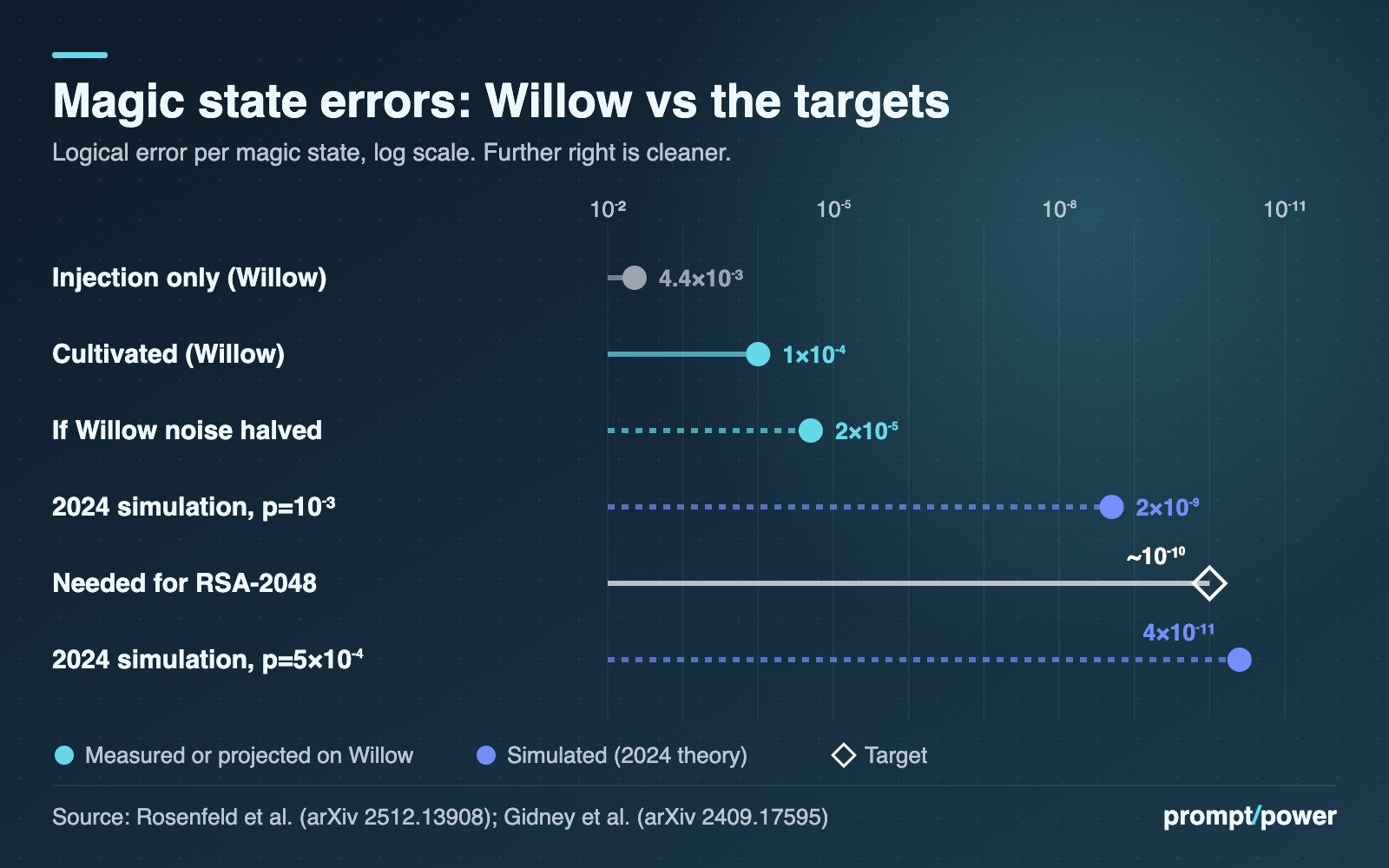
Expect this result to be dragged into the Bitcoin and encryption debate. The paper itself gives the yardstick: running Shor’s algorithm against RSA-2048 needs magic states with infidelity around 10⁻¹⁰, and useful chemistry or optimisation runs need 10⁻⁶ to 10⁻⁸. Willow’s best cultivated state sits at about 10⁻⁴.
Cultivation does matter to that timeline. Gidney’s May 2025 estimate that RSA-2048 could be factored with less than a million noisy qubits in less than a week leaned on cheap magic states of exactly this kind. Today’s result is evidence the ingredient behaves on real hardware, not that the machine exists. Our read: it removes one reason to doubt the low-qubit estimates, and leaves the engineering gap, about six orders of magnitude in state quality and nearly 10,000 times more qubits than Willow has, untouched.
The paper’s conclusion points to the next lever. Because cultivation’s infidelity should scale with the cube of physical noise, halving Willow’s noise would push the bound to about 2×10⁻⁵. That is how this line of work will be judged: chip by chip, against the noise, not against headlines. For more on how Google is spreading its compute bets, see our explainer on Project Suncatcher’s TPUs in orbit, and the rest of our hardware coverage.
What it means for you
Nothing changes on your phone, your bank or your crypto wallet this weekend. If you manage systems with long-lived secrets, the guidance is the same as before: plan the move to post-quantum cryptography now, because data harvested today can be decrypted later. The practical everyday steps are the same ones in our passkeys guide, which does more for most people’s security than any quantum timeline.
The number to watch is not 40. It is 8: the share of attempts Willow kept. A machine running billions of T gates will live or die on how cheaply it can afford to throw the other 92 away.

Priya Natarajan covers science and society for prompt/power: climate and energy tech, data centres, and the physical cost of the digital world. Every query has a water bill, and she would like to see the receipt.
Keep reading
Latest from prompt/power
- Meta Q3 Earnings Oct. 21: The Capex, Ads and Cash Numbers to WatchOct 21
- Anthropic’s 5% Pledge Is Worth About US$48B. Here’s the Fine PrintOct 21
- Commons AI Study Meets Parliament’s Interpreter Math: 44 Passes in 5 YearsOct 21
- CNN All Access Canada Price Is CA$7.99. Americans Pay About 23% MoreOct 20
- DeepSeek Federal Ban: DHS Order Also Covers Apps Built on Its ModelsOct 20
Leave a Reply