Can AI help catch breast cancer? What Sweden’s big trial found, and what the NHS is testing
Sweden's MASAI trial found more cancers with less reading work, and England's EDITH trial is testing AI-supported screening at scale.

Breast screening is one of medicine’s biggest routine reading jobs. Every mammogram has to be examined, and in many programs two specialists read each one. That makes it an obvious test for artificial intelligence, and two large public trials are now giving real answers about whether it helps.
What the Swedish trial found
The MASAI trial in Sweden randomly split about 106,000 women into two groups: one screened with AI support, one screened the standard way. Results published in The Lancet Digital Health in February 2025, and announced by Lund University, found the AI-supported group had 29% more cancers detected: 338 against 262.
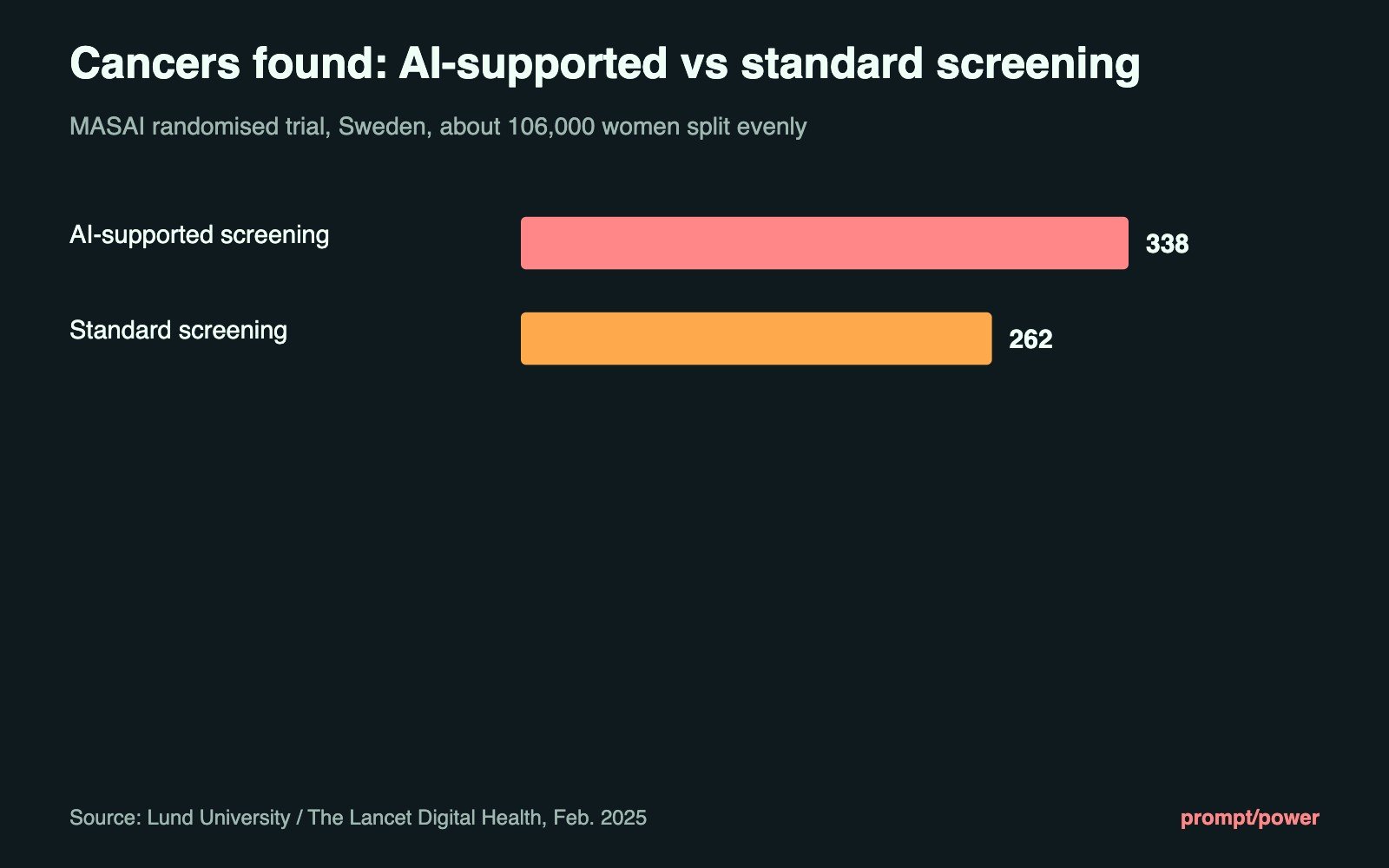
The extra cancers were mostly the ones screening is meant to catch early. Detection of early-stage invasive cancers rose 24%, from 217 to 270, and in situ cancers rose 51%, from 45 to 68. The cost in false alarms was small: seven more women in the AI group were recalled and found not to have cancer, a 1% increase. And the workload for radiologists reading screens fell by 44%.
Did it reduce the cancers screening misses?
Yes, according to the trial’s second set of results. The first results didn’t answer the most important question: interval cancers, the ones diagnosed between scheduled screenings, which are a key measure of what screening misses. Those results were published in The Lancet on Jan. 30, 2026, Lund University announced.
The AI-supported group had 82 interval cancers against 93 with standard double reading, 12% fewer. The drop was bigger for the cancers that matter most: 16% fewer invasive interval cancers, 19% fewer large ones and 27% fewer of aggressive subtypes. The university said AI support increased sensitivity without increasing false positives, and the 44% cut in reading workload held.
“Interval cancers are typically more aggressive and should be as low as possible,” said Kristina Lång, the Lund researcher who led the trial. “Now, enough time has passed for us to assess the cancers that we did not detect within screening.”
| MASAI result | AI-supported | Standard double reading | Change |
|---|---|---|---|
| Cancers detected at screening | 338 | 262 | +29% |
| Interval cancers (missed, found later) | 82 | 93 | −12% |
| Radiologist reading workload | — | −44% | |
What it doesn’t prove yet
The results come from one country’s screening program and one AI system. They show fewer cancers slipped through, not yet that fewer women died, which takes much longer to measure. And how well AI support works depends on how a program uses it, including which scans it routes to one reader or two. “It is a rather low bar to get started, in principle it is merely to integrate an AI software into existing IT systems,” Lång said, though other countries will want their own evidence.
What England is testing
England is running its own test at a much larger scale. The EDITH trial, announced by the U.K. government on Feb. 4, 2025, World Cancer Day, involves nearly 700,000 women at 30 sites, with £11 million from the National Institute for Health and Care Research. The AI analyses scans for changes in breast tissue that could indicate cancer and flags cases for further investigation. Today two specialists read each mammogram; the government says the technology could let one do it.
“This landmark trial could lead to a significant step forward in the early detection of breast cancer,” said Lucy Chappell, chief scientific adviser at the Department of Health and Social Care.
What it means for patients
For women invited to screening, nothing changes overnight. In England’s trial, the AI is described as assisting radiologists. The practical promise is twofold: catching more cancers early, and freeing scarce specialists to spend more time on the cases that need them.
Canadian provinces run their own screening programs, and any AI tool used in them would need Health Canada’s approval as a medical device. The Swedish and English results will be the evidence those decisions lean on.
Last checked Nov. 24, 2026. This is general information, not medical advice.
Sources
- Lund University, AI support in breast cancer screening: fewer missed cancer cases, Jan. 30, 2026 (The Lancet, doi:10.1016/S0140-6736(25)02464-X)
- Lund University and The Lancet Digital Health, MASAI screening-performance results, February 2025
- U.K. government, EDITH trial announcement, Feb. 4, 2025
More from prompt/power: NHS skin cancer AI can now discharge patients · How Health Canada reviews AI medical devices · AlphaGenome 2 predicts what a DNA change does
Researched and drafted with AI tools, fact-checked against primary sources and approved by a human editor before publishing. Prices and dates are as of publication. Our standards →
Sources- lunduniversity.lu.se — Lund University announced

Jessie Isberg is a Toronto psychotherapist and musician. She also writes for Not An Atlas and The Remote.
All stories by Jessie →