Giving a tech gift card? The expiry and fee rules in Ontario and the U.S.
Most Ontario retail gift cards can't expire. U.S. cards must last at least five years. The exceptions, the fees that are allowed, and what to check before you give one.

Gift cards are the safe choice when you don’t know which gadget, game or subscription someone wants. They’re also easy to lose track of. The good news is that in Ontario and across the U.S., the law limits how quickly a card can lose its value. The rules differ, and there are exceptions worth knowing before you buy one, or before you find one at the back of a drawer.
Ontario: most cards can’t expire
Ontario’s Consumer Protection Act bans expiry dates on most retail gift cards, according to the provincial government. That means a card from an electronics store or a game retailer can be used at full value at any time. Most businesses also can’t charge activation, service or dormancy fees that eat into a card’s balance. They can charge to customize a card or to replace one that’s lost or stolen.
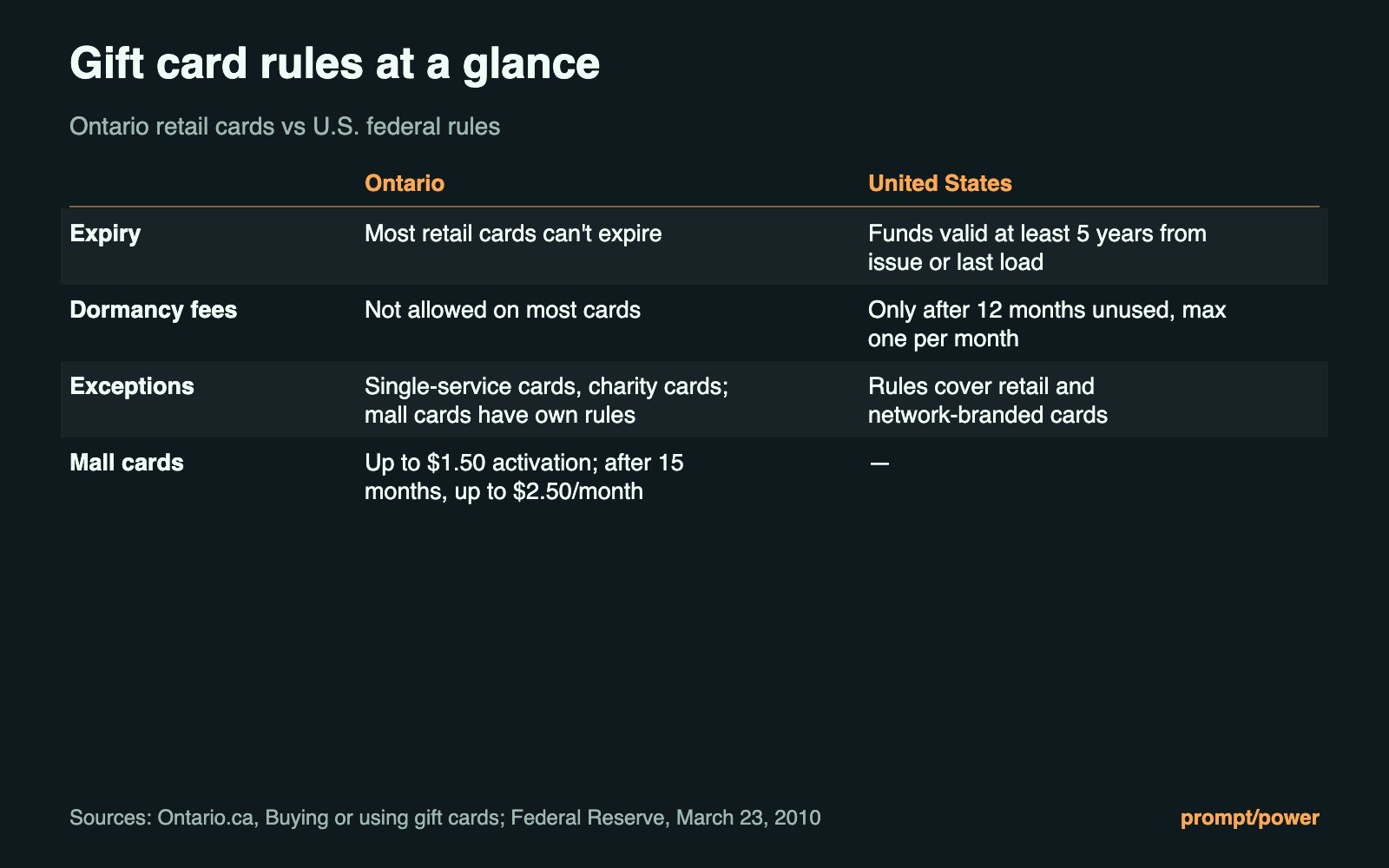
There are exceptions. Cards for a single specific service, such as a spa treatment, can expire, as can cards issued for charity. Loyalty cards and prepaid credit cards aren’t covered by the gift card rules at all.
Shopping-mall cards have their own regime. The mall can charge an activation fee of up to $1.50. The card keeps its full value for 15 months, after which the mall can charge a dormancy fee of up to $2.50 a month. You can ask for a three-month extension during the 15th month, and no dormancy fees can be charged during it.
If a store charges an illegal fee, ask it for a refund first. If that fails, you can file a complaint with the province through Ontario.ca. Other provinces have their own rules, so check locally.
The U.S.: at least five years
In the U.S., federal rules that took effect on Aug. 22, 2010, under the Credit CARD Act, require gift card funds to remain valid for at least five years from the date the card was issued or the last time money was loaded onto it. Dormancy, inactivity and service fees are banned unless the card has gone unused for at least 12 months, no more than one such fee is charged a month, and the fees are clearly disclosed. The rules cover both store gift cards and network-branded cards that work anywhere the brand is accepted.
What about the rest of Canada?
It depends on the province. “Provinces have their own regulations on gift cards,” the federal Financial Consumer Agency of Canada says, and “The territories don’t have specific regulations on gift cards.” In general, it says, “there are no fees to buy or use a gift card,” though some provinces let retailers charge to replace, customize or activate one, or to maintain a mall card after a set period. Cards for promotions, charity or a specific service may expire, depending on local rules.
One distinction catches people out. A card with a Visa, Mastercard or American Express logo isn’t a gift card in the legal sense, the agency says: “Cards with a Visa, Mastercard or American Express logo are prepaid cards.” Those follow different rules and are more likely to carry fees.
What about digital and app-store cards?
Treat them like cash. App-store, console and streaming cards are often sold as a code on a receipt or by email. Once the code is redeemed, the value usually sits in an account, governed by that platform’s terms rather than the card itself. The FCAC’s advice to “stay alert when buying a gift card online or checking your balance online” applies doubly: scammers favour these cards because the codes are easy to pass on and hard to trace. Anyone asking you to pay a bill or a fine with gift cards is running a scam.
What to check before you give one
Read the back. Restrictions must be disclosed, so look for any expiry date or fees before you buy.
Prefer the store’s own card. Prepaid credit cards and mall cards can carry fees that store cards can’t.
Check the country. If the recipient lives in another country, check the card’s terms to make sure it can be used there.
Keep the receipt. If a card doesn’t work, the receipt is your proof of purchase.
Last checked Nov. 24, 2026. This is general information, not legal advice.
Sources
- Government of Ontario, Buying or using gift cards
- Financial Consumer Agency of Canada, Gift cards
- Consumer Financial Protection Bureau and Federal Reserve, Credit CARD Act gift card rules (effective Aug. 22, 2010)
More from prompt/power: Is that Black Friday ‘regular price’ real? · Black Friday scams now look professional · Can you return a tech gift?
Researched and drafted with AI tools, fact-checked against primary sources and approved by a human editor before publishing. Prices and dates are as of publication. Our standards →
Sources- ontario.ca — provincial government
- canada.ca — Financial Consumer Agency of Canada

Alicia Loveday is a senior editor at prompt/power and a mom who works where fashion meets AI. She leads Tech & Your Money: what Canadians actually pay for phones, plans and gadgets, and the fine print that changes the bill. When the news needs her elsewhere, she goes. She believes every algorithm should come with a return policy. She also writes for Not An Atlas and The Remote.
All stories by Alicia →Keep reading




Latest from prompt/power
- Holiday tech scams to watch for in 2026: fake shops, delivery texts, marketplace buyers and gift card demandsNov 28
- Parental controls for ChatGPT, Gemini and Claude: what you can switch off, and what you can’t seeNov 28
- The EU AI Act’s next deadline is Dec. 2. Every date that applies now, after the delayNov 28
- Can AI help catch breast cancer? What Sweden’s big trial found, and what the NHS is testingNov 28
- Is that image AI-generated? How to check with Content Credentials, SynthID and OpenAI VerifyNov 27
[…] as gifts, check the packaging for tampering and avoid buying them on resale or auction sites. Our gift card rules guide covers expiry dates and […]