Google Play Store Class Action: £1.2bn UK Trial Over App Fees Begins
Consumer advocate Liz Coll says Google's commission of up to 30% was passed on to about 20 million UK Play Store buyers between 2015 and 2026. The seven-week Competition Appeal Tribunal trial is due to end on Nov. 20.
If you have bought a Duolingo subscription, a stack of Roblox currency or a Tinder upgrade on an Android phone in the UK since 2015, you are probably already a claimant in a lawsuit against Google. You did not sign anything. Under the UK’s opt-out collective action rules, about 20 million people are included automatically and pay nothing.
That case, brought by consumer advocate Liz Coll, went to trial at the Competition Appeal Tribunal in London on Oct. 6, Reuters reported. It is listed for seven weeks and is scheduled to end on Nov. 20. The claim is worth about £1.2bn (about US$1.6bn), according to the figure The Next Web took from Bloomberg; Reuters and PocketGamer.biz describe it as more than £1bn.
Google Play Store class action: what the claim says
The allegation is that Google abused a dominant position by charging developers commissions of up to 30% on apps, in-app purchases and subscriptions, and that developers passed the cost on to the people buying. The class covers UK Play Store purchases from Oct. 1, 2015, to July 31, 2026. PocketGamer.biz lists TikTok, Tinder, Strava, Candy Crush, Duolingo, Roblox and ChatGPT among the apps whose purchases can attract the fee. The action is funded by Vannin Capital and insured.
“For more than a decade, Google has taken a cut of up to 30% on almost everything we buy through the Play Store,” Coll said. “We say that charge was unfair and excessive, and that consumers paid for it.”
Her lawyers say Google “exploited its market strength to extract unfair prices,” according to The Next Web, and cited YouTube Premium, Google’s own subscription, as an example of the charge feeding through to prices.
Google’s defence: Apple, Android choice and low fees
Google denies it is dominant in facilitating digital content transactions between developers and consumers and has asked for the claim to be dismissed. A spokesperson said the case ignores the choice Android gives consumers and that Google charges “some of the lowest fees in the market,” Mobilegamer.biz reported, citing Reuters. Its lawyers argue the Play Store faces strong competition from Apple’s App Store.
That argument has a problem in Britain. The Competition and Markets Authority (CMA) has already found that Apple and Google run an effective duopoly in mobile platforms and has given both firms strategic market status under the new digital markets regime, The Next Web noted. Strategic market status is a different legal test from the dominance Coll has to prove, but Google is arguing against the grain of the regulator’s findings.
Where the CMA and the £260m developer deal fit in
Six weeks before the trial, Google settled a separate claim. Competition academic Barry Rodger, representing UK businesses that sold apps on Google Play between August 2018 and July 2026, agreed a £260m (about US$348m) deal that surfaced on Aug. 27. Of that, £160m goes to developers and £100m covers the costs of bringing and funding the case. Google admitted no wrongdoing; the agreement says it “believes it has strong defences.” That claim had been valued at just over £1bn, so developers settled for roughly a quarter.
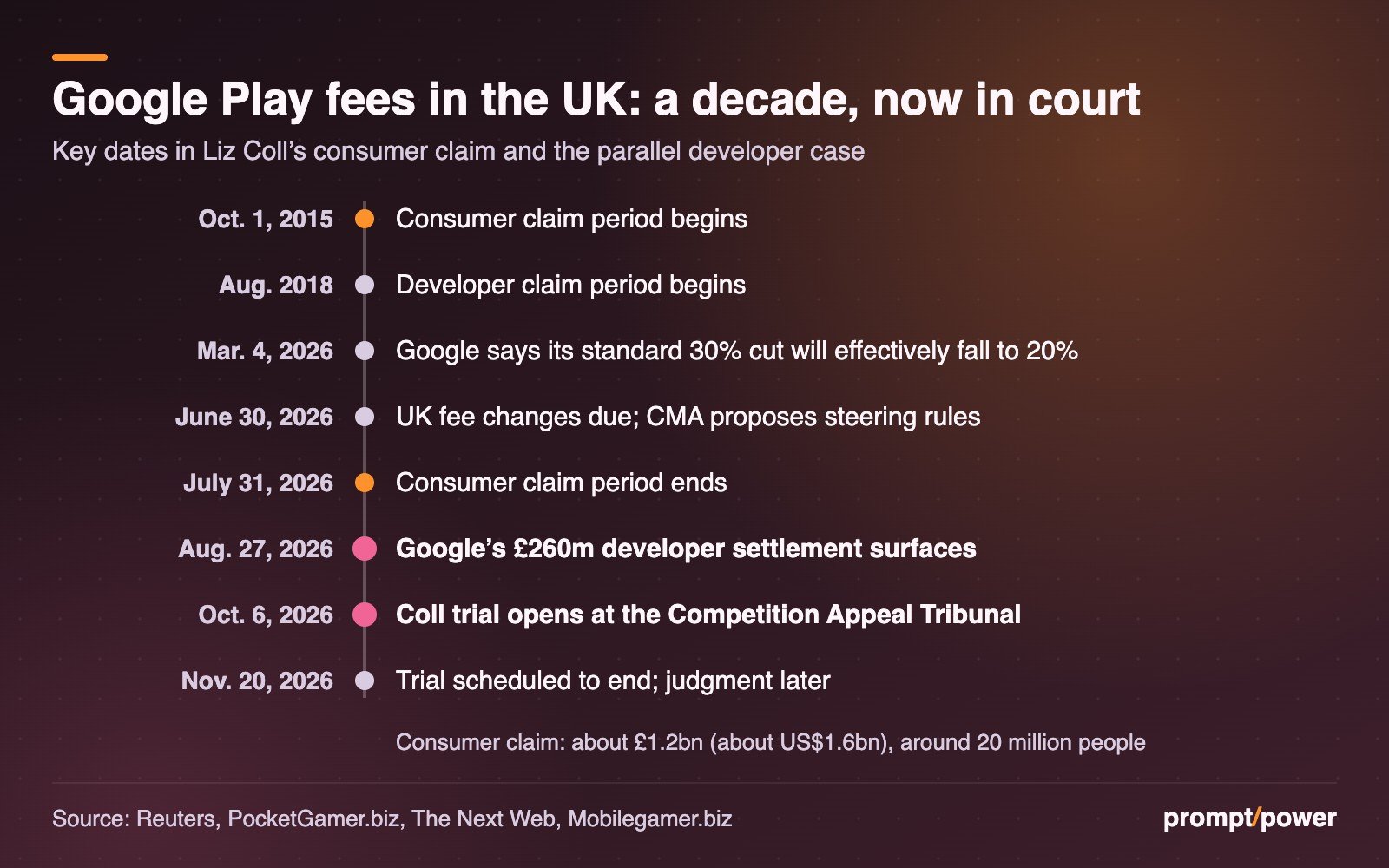
The fees themselves are already moving. In March, Google announced that its standard 30% cut would effectively fall to 20%, with an extra 5% for developers who use Google Play billing in the UK, EU and US, as part of ending its dispute with Epic Games. Those UK changes were due by June 30. On the same date the CMA proposed rules letting developers steer users to cheaper checkouts, with any fee for doing so required to be “fair and reasonable.” Google said its new Play terms already complied.
Our read: none of that reaches backwards. The trial is about roughly a decade of purchases made before the cuts, which is exactly the money a regulator cannot return. App store power is also behind the fight over who checks users’ ages, which we covered here.
What UK Play Store users could actually get
Divide £1.2bn by 20 million people and you get about £60 (about US$80) each. That is our arithmetic, not a forecast, and it assumes Coll wins every point. Real payouts depend on how much of the commission the tribunal decides was passed on, how much each person spent, and what is deducted for funding and costs, as the developer deal shows.
- You do not need to do anything now. UK residents who made qualifying purchases are in the class unless they opt out.
- Keep your Google Play order history. It sits in the Play Store app under Payments and subscriptions, and any distribution scheme could ask what you spent.
- Watch for Nov. 20. That is when the hearing is due to close. A judgment would follow later.
Meanwhile, in Brussels, the European Commission fined Google €890m (about US$1bn) on July 23, partly for stopping Play developers steering users to cheaper offers. None of it goes to the people who paid.
Researched and drafted with AI tools, fact-checked against primary sources and approved by a human editor before publishing. Prices and dates are as of publication. Our standards →
Sources- pocketgamer.biz — included automatically and pay nothing
- mobilegamer.biz — Reuters reported
- thenextweb.com — The Next Web took from Bloomberg
- thenextweb.com — surfaced on Aug. 27
- mobilegamer.biz — effectively fall to 20%
- thenextweb.com — proposed rules

Alicia Loveday is a senior editor at prompt/power and a mom who works where fashion meets AI. She leads Tech & Your Money: what Canadians actually pay for phones, plans and gadgets, and the fine print that changes the bill. When the news needs her elsewhere, she goes. She believes every algorithm should come with a return policy. She also writes for Not An Atlas and The Remote.
All stories by Alicia →Keep reading


Latest from prompt/power
- When will Anthropic join the Nasdaq-100 and the S&P 500? The rules, and ANT’s datesNov 25
- Dario and Daniela Amodei each sold about US$280 million of Anthropic stock in the IPO, filings showNov 25
- DXC is reselling Claude Mythos as a bug-hunting service. What it does and what the announcement leaves outNov 25
- Anthropic’s prospectus describes its AI models breaking into real computer systems. What it told investors about safetyNov 25
- One in five Canadian businesses now uses AI. Statistics Canada’s numbers, industry by industryNov 25