Meloni’s Voice Trademark, Explained: What It Can’t Stop, and the UK Gap
The recording lasts four seconds and contains four words: “Io sono Giorgia Meloni.” On Oct. 5, the Italian prime minister filed it with the European Union Intellectual Property Office (EUIPO) as an application for a sound trade mark, the Italian news agency ANSA reported, in a move first reported by La Repubblica and aimed at AI voice clones.
The phrase is a callback. It echoes a line from a 2019 rally speech and the title of her 2021 memoir, Io sono Giorgia, Reuters noted. The legal effect is narrower than the headlines suggest, and the gap between what a trade mark does and what deepfake victims need is the real story. It is also a gap that Britain, which has no general right over your own voice, has barely started to close.
What Meloni filed with the EUIPO
According to ANSA, the application was lodged through a Rome law firm and an intellectual property company from the Marche region, and its status is listed as “oggetto di esame,” or under examination. It covers three categories, including downloadable multimedia content, cultural activities and the organisation of political events. Il Sole 24 Ore gives the application number as 019431219 and names the Rome firm as MpmLegal. Italian outlet Open identifies the lawyer as Marco Mastracci.
The motive is not abstract. Meloni has repeatedly been the target of manipulated images, including sexually explicit deepfakes, and in 2024 she brought a civil case against a Sardinian man accused of making and sharing them; that case is still pending, Reuters reported. The agency also cited Italian media saying that registration “would not by itself prevent the use of her voice in AI-generated deepfakes, though it could create additional legal obstacles.”
Italy already has a criminal law aimed at harmful deepfakes. Its AI law, passed in September 2025, made spreading them without consent an offence carrying one to five years in prison, Open notes. The trade mark adds a civil, commercial tool on top.
Can you trademark your voice? Ferreri, Ward and McConaughey went first
Meloni is following a small queue. In February, the Italian voice actor Luca Ward filed a sound mark of his own voice through the same firm, MpmLegal, with Mastracci handling it, Milano Finanza reported. In May, the singer Giusy Ferreri applied at the EUIPO for a sound mark consisting of the phrase “Sono Giusy Ferreri,” application 019353063, in classes 9 and 41, The IPKat reported.
In the US, Matthew McConaughey holds eight registrations from the US Patent and Trademark Office, including a sound mark of him saying “Alright, alright, alright,” which Variety reported in January, according to a Mondaq analysis. Japan took a different route entirely: on Sept. 30 a Tokyo court recognised voice as a publicity right, though the anime actor who sued still lost his takedown bid, as we reported on Oct. 2.
Why a voice trade mark won’t stop most deepfakes
A trade mark protects a sign that tells consumers where goods or services come from. It does not protect a person. That creates three practical limits.
First, registration is not guaranteed. Writing about the Ferreri filing, Eleonora Rosati wrote on the IP blog The IPKat that “it is highly doubtful that the average consumer would consider Ferreri’s well-recognizable voice as actually functioning as a trade mark” for goods such as recordings.
Second, the mark is the recording. A clone that sounds like Meloni but says something else, which is what most political deepfakes do, is not obviously a copy of a four-second clip of her saying her own name.
Third, infringement generally requires use in the course of trade. A fake video pushed around social media to embarrass a politician is not selling anything. Il Sole 24 Ore notes that, if granted, the mark would let her seek the withdrawal of unlawful material, claim damages and bring criminal proceedings for counterfeiting. Those remedies bite hardest on commercial misuse.
“The narrative that these filings are the way to go to ‘be protected’ and resulting enforcement initiatives are bound to succeed is – and should be – simply incorrect.” Eleonora Rosati, The IPKat
UK personality rights: no general right over your voice yet
Britain has less to offer than Italy. “English law does not recognise a standalone right to control the commercial use of one’s name, image, likeness, or voice,” the law firm Reed Smith wrote on Sept. 30. The main fallback is passing off, which requires goodwill, misrepresentation and damage, and which the firm says “offers little protection where a replica is used in a way that implies no endorsement.” Data protection law gives “some leverage,” but no clear basis to stop a replica being made.
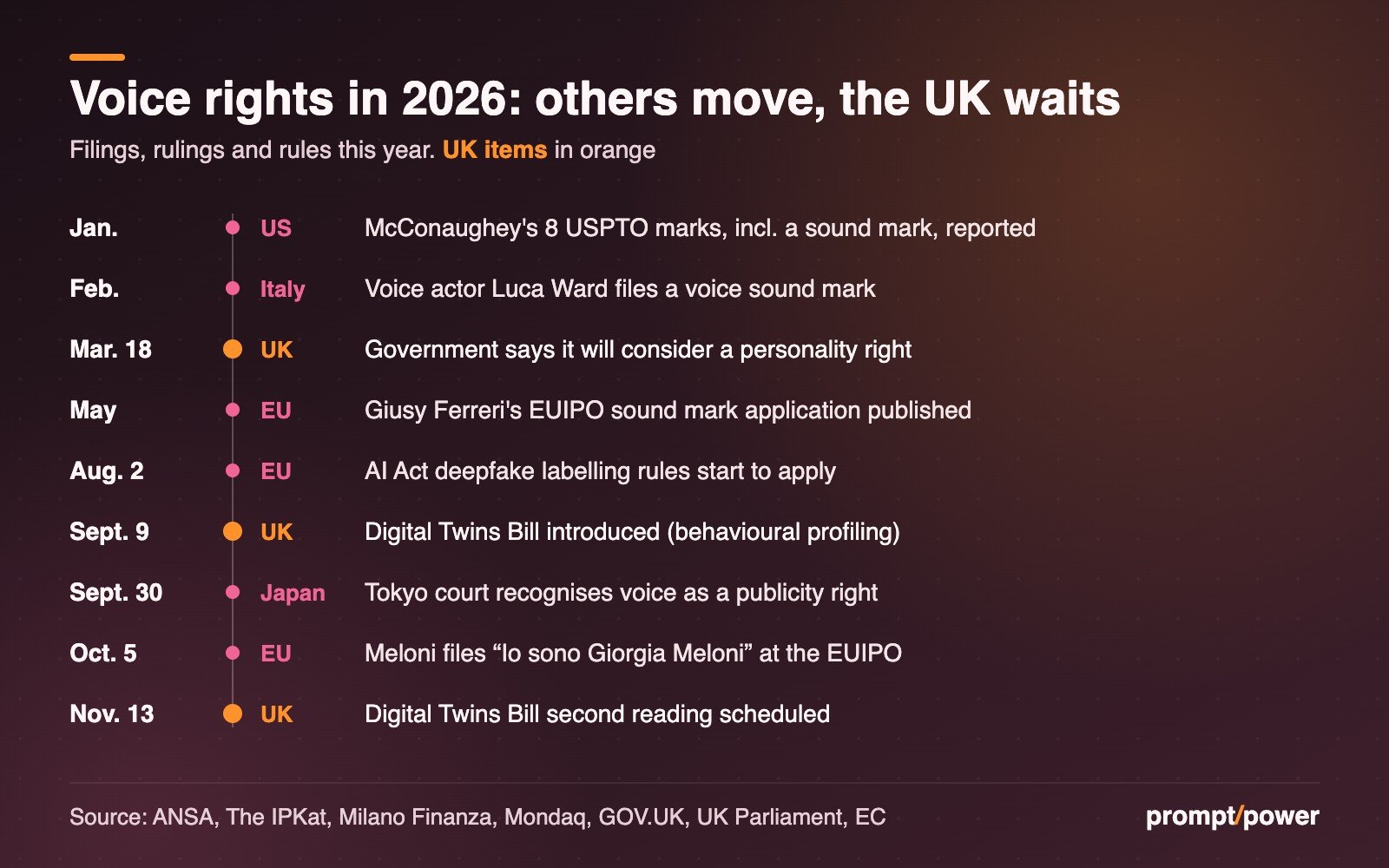
The government knows. In its Report on Copyright and Artificial Intelligence, published on March 18 by the Department for Science, Innovation and Technology, the Department for Culture, Media and Sport and the Intellectual Property Office, ministers said the exploration of options “will include consideration of whether it would be beneficial to introduce a new digital replica or personality right.” That was a promise to think, with no timetable.
Then there is Dame Chi Onwurah’s Personal Data (Digital Twins) Bill, introduced under the Ten Minute Rule on Sept. 9. It is often filed alongside the deepfake debate, but read the long title: it would regulate “software or algorithms which use or hold personal data for the purpose of modelling the preferences or behaviours of a person.” Its target is the behavioural model a platform builds of you, not a cloned voice. Onwurah, the Labour MP who chairs the Commons Science, Innovation and Technology Committee, said in comments quoted by Computer Weekly that colleagues were backing her bill to ban tech companies from “turning our constituents into an algorithm, without their permission.” Reed Smith lists its second reading for Nov. 13. Our read: as a backbench bill without government support, its odds of becoming law are long, and even if it passed, it would not give anyone a right over their voice.
Denmark’s draft and the EU AI Act’s deepfake labels
The most ambitious European model is still on paper. Denmark proposed amending its copyright law to give every person a right against realistic digital imitations of their voice and appearance, lasting 50 years after death, with exceptions for satire, parody and social criticism, Dennemeyer explains. It was expected to take effect on March 31, but a snap election clouded the timetable, and as of Oct. 2 the Afterlife deepfake-law tracker still listed it as a bill.
What is in force is labelling. Under Article 50 of the EU AI Act, deployers must disclose deepfakes, and providers must mark synthetic content in a machine-readable way, from Aug. 2, 2026, according to the European Commission. Generative systems already on the market before that date have a grace period on marking until December 2026. Labels tell you a clip is synthetic, when they are applied; for the checks that still work without them, see our guide to spotting AI images. Labels do not give the person being imitated a right to stop it, and they reach British companies only when they serve the EU market.
What to do if your voice is cloned in the UK
- Report it to the platform first. Impersonation and synthetic media policies are usually faster than any court.
- If it is used in an advert, complain to the Advertising Standards Authority, which Reed Smith notes can act on false endorsement under the CAP Code.
- If it is used to scam you or someone you know, report it to Report Fraud, which replaced Action Fraud in England, Wales and Northern Ireland, at reportfraud.police.uk or 0300 123 2040.
- If you earn a living from your voice, take legal advice on passing off and data protection claims, and on whether a sound mark makes sense for your commercial work.
Meloni’s four seconds follow Ferreri’s application, published in May. If Ferreri’s mark clears examination, Meloni’s lawyers will have a precedent. Either way, the most Italy’s prime minister can win is the exclusive commercial right to a recording of herself saying her own name.

Felix Strauss covers tech policy and regulation for prompt/power, from Brussels and Ottawa to Washington and Sacramento. He reads the 400-page regulation so you don't have to, and highlights the one sentence that actually matters.
Keep reading



Latest from prompt/power
- DeepSeek V4.1 Flash Cut the US AI Lead to 3%. What LiveBench MeasuresOct 6
- Ben Affleck Calls AI Job Fears ‘Propaganda.’ He Sold an AI Firm to NetflixOct 6
- Cohere’s North 2 Puts AI Agents on a Budget. Toronto Bets on BoringOct 6
- How to Stop ChatGPT, Claude, Gemini and Meta AI From Training on Your ChatsOct 6
- Musk Is a Trillionaire Again After SpaceX Stock Jumps 7.6%Oct 6
Leave a Reply