
Trump’s Super Intelligence Force: Who Runs It and What It Can Actually Do
Six days after he ordered the federal government to stop saying “artificial intelligence,” Donald Trump gave the new vocabulary a team. In a Truth Social post on Sunday, Oct. 4, the president announced a “Super Intelligence Force,” and the same day Elon Musk agreed to rename his AI company to match.
The post, as quoted by ABC News, said the force “is tasked with coordinating the effort of the Federal Government to ensure that America continues to lead the World in Super Intelligence, which many say is bigger than the Industrial Revolution, and the Internet, and will protect the interests, and improve the lives, of all Americans.”
Read that closely and the operative verb is coordinating. Nothing published so far gives the force a budget, a staff, or the power to make anyone do anything.
Super Intelligence Force members: who’s in charge
Four officials run it. TechCrunch reports that Director of National Intelligence Jay Clayton chairs the group, with three vice chairs:
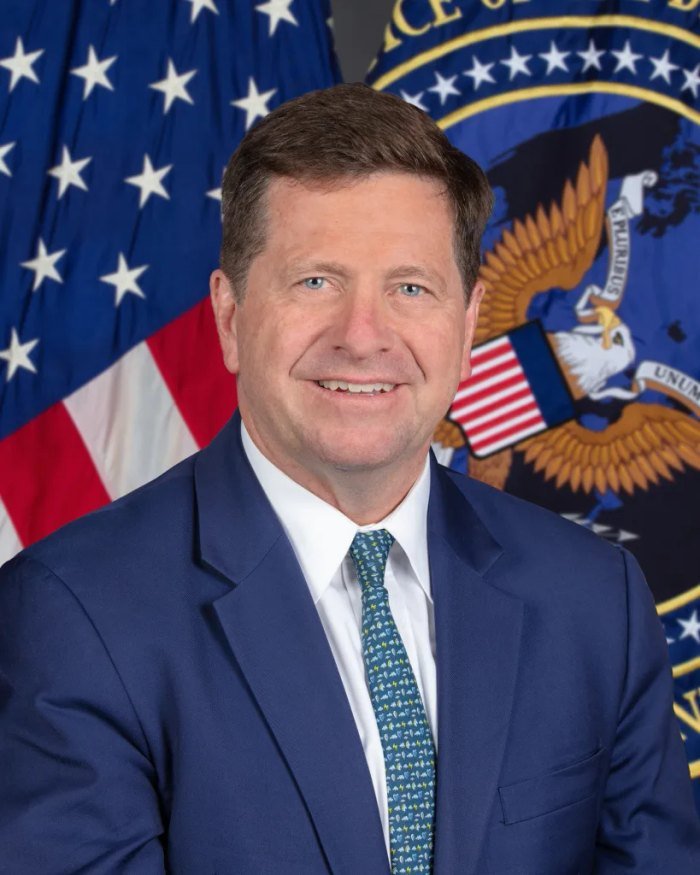
- Jay Clayton, Director of National Intelligence, the former SEC chairman and Manhattan U.S. attorney who was sworn in as the ninth DNI on Aug. 3. ABC describes him as the administration’s new AI czar.
- Andrew Ferguson, chairman of the Federal Trade Commission.
- Emil Michael, the Pentagon’s under secretary for research and engineering. TechCrunch uses the administration’s “Under Secretary of War” styling; ABC and others say Defense. It is the same job.
- Scott Kupor, director of the Office of Personnel Management.
Outlets disagree on who else sits around the table. Straight Arrow News lists Vice President JD Vance, Defense Secretary Pete Hegseth, Treasury Secretary Scott Bessent and Chief of Staff Susie Wiles as members; the Daily Caller names a partly different roster that includes outside advisers. We could not find an official membership list, so we are not treating either as settled.
The mix is the tell. An intelligence chief, a competition regulator, a defence technologist and the person in charge of hiring federal workers. Among the four leaders, there is no one from the Commerce Department, which runs chip export controls, or anyone whose day job is consumer safety outside the FTC.
What the task force can actually do
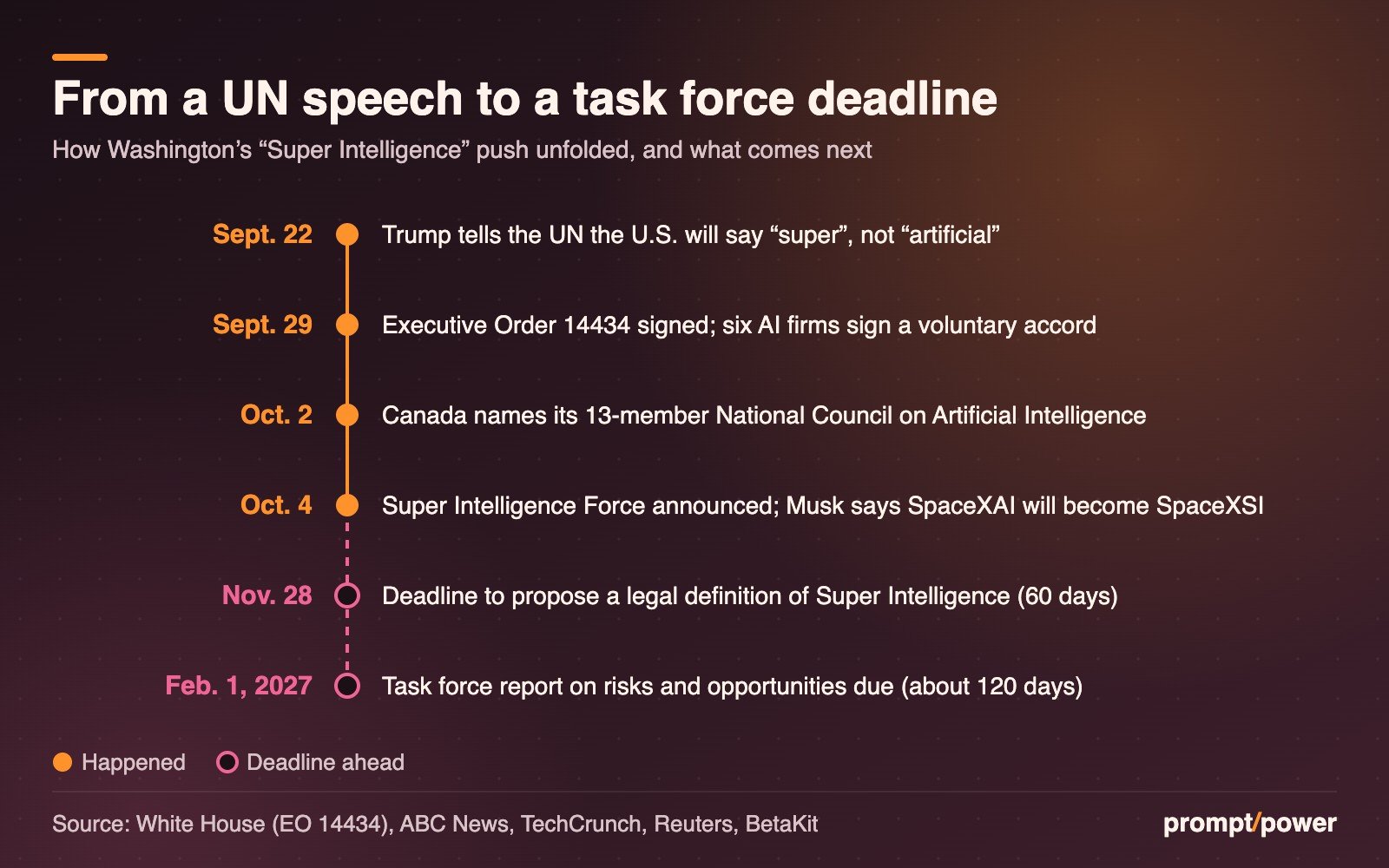
The Truth Social post lists who the force will talk to: it “will coordinate the Federal Government’s engagement with Consumers, Public Interest Groups, Religious Organizations, Critical Infrastructure Providers, and Super Intelligence Companies,” per ABC. Its one concrete deliverable is a report on the technology’s risks and opportunities within 120 days, which Clayton described to The Wall Street Journal, according to TechCrunch. Counting from Oct. 4, that lands around Feb. 1, 2027.
The Journal also reported on the force’s charter, which TechCrunch summarizes as calling for plans to respond to “SI-enabled threats” while “preventing overregulation and regulatory capture that would stifle innovation.” The second half reads as a promise not to lean on the first.
Clayton’s own framing leans hard on the race with China. “The risk of not being first is high,” he told the Journal, as quoted by ABC News. On oversight, he offered: “I expect there will be mechanisms developed in dialogue, just like there are in other industries.”
What we could not find: the legal instrument. As of midday Oct. 5, the White House’s presidential actions page listed nothing on the force; its most recent AI item was still the Sept. 29 order. Until a charter or order is published, the force’s authority is whatever its members already hold in their own agencies. In Ferguson’s case that is real enforcement power. For the force as a body, it is advice.
The ‘AI constitution’ and Lina Khan’s response
Trump’s post opened by tying the force to what he called the “Historic White House Accord on Super Intelligence,” according to The Statesman. That accord was signed on Sept. 29, the same day as Executive Order 14434, the order directing agencies to use “Super Intelligence” and “SI” and declaring that the executive branch “will not acknowledge the usage of ‘Artificial Intelligence’ and ‘AI’ in any applicable setting.” (We covered the order’s definitions section when it landed; legally, SI is still AI.)
Nextgov/FCW reports that executives from Google, Anthropic, Meta, OpenAI, xAI and Nvidia signed the accord. It asks companies to run internal monitoring, oversight teams, independent external auditors and committees to review the audits. Trump called it a “constitution.” Asked whether it was binding, he said it was “morally” binding, ABC News reported, and House Speaker Mike Johnson described it as “a statement of principles” with commitments “that are voluntary on behalf of the industry.” Elon Musk’s summary, per Nextgov: “We agreed to joint monitoring, board special committees, generally grading each other’s homework.”
“Self-regulation efforts by big tech have been a proven failure.”
Lina Khan, former FTC chair, on ABC’s This Week, Oct. 4
Former FTC chair Lina Khan, Ferguson’s predecessor, went on ABC’s This Week on Oct. 4, the day the force was announced, and dismissed the pledge. “We need to remember what happened a decade ago, where you had big tech companies, social media companies, similarly suggest that existing laws and regulations no longer apply to their new technologies, and that they were going to try instead to self-police,” she said. Her remedy was blunt: “Congress needs to legislate.”
She also took aim at the FTC itself under her successor, now a vice chair of the new force. “The chair of the FTC has said very plainly that it is President Trump and only President Trump that calls all the shots about what that agency will and will not do,” Khan said.
Why Musk is renaming SpaceXAI to SpaceXSI
On Oct. 4, asked on X whether SpaceXAI would become SpaceXSI, Musk replied: “Yes, we will make that change,” Reuters reported. Earlier posts that day read “No more AI / SI / It’s better” and “SpaceX is a super intelligence company,” according to BeInCrypto. He gave no date, and SpaceXAI’s X account still carried the old name when Reuters published.
SpaceXAI is the unit behind Grok. It was xAI until SpaceX acquired it in February and adopted the SpaceXAI name on July 6, The Next Web notes, so SpaceXSI would be its third name in roughly a year. Nothing obliges him: the order binds only executive agencies.
The rename traces to Trump’s Sept. 22 speech at the UN General Assembly, where, per Reuters, he said: “From this point forward, all of United States documents, and hopefully the world’s will be changed to use the much more accurate term ‘super’ as opposed to artificial.”
What it means for Canada
The world has not followed. Two days before Trump’s post, Prime Minister Mark Carney named 13 people to Canada’s new National Council on Artificial Intelligence, and “artificial” survived intact. Both bodies are advisory. Ottawa’s skews toward researchers and investors; Washington’s is led by an intelligence chief whose stated priority is winning.
Our read: the practical friction for Canadian companies will not be vocabulary. Federal contractors and anyone answering U.S. procurement documents should expect “SI” in solicitations, but the statutory definition underneath is unchanged. The bigger watch item is what the Super Intelligence Force recommends on threats and regulation by early February, because a White House that treats AI as a race tends to lean on allies’ chip, data-centre and export rules too.
One more date is already on the calendar. The executive order gave the president’s science and technology adviser 60 days to propose a legal definition of Super Intelligence to Congress. That clock runs out on Nov. 28, two months before the task force is due to report on what the thing it is named after can actually do.

Jeff Cameron writes about the business and policy side of AI for prompt/power. A chief operating officer by trade, he also writes for Not An Atlas.
Keep reading




Latest from prompt/power
- DeepSeek V4.1 Flash Cut the US AI Lead to 3%. What LiveBench MeasuresOct 6
- Ben Affleck Calls AI Job Fears ‘Propaganda.’ He Sold an AI Firm to NetflixOct 6
- Cohere’s North 2 Puts AI Agents on a Budget. Toronto Bets on BoringOct 6
- How to Stop ChatGPT, Claude, Gemini and Meta AI From Training on Your ChatsOct 6
- Musk Is a Trillionaire Again After SpaceX Stock Jumps 7.6%Oct 6
Leave a Reply