
NYC’s AI Hearing: Ex-Insiders Warned of Extinction, the Labs Hedged
Speaker Julie Menin asked OpenAI for a number: what are the odds its technology causes a catastrophe? “I don’t know — I also don’t think it matters whether it’s 1% or 10% or 20% chance that something catastrophic will go wrong,” Morgan Dwyer, OpenAI’s head of policy development and operations, told the New York City Council on Oct. 5, according to the Associated Press. “None of these levels is remotely acceptable.”
“To say you don’t know and it doesn’t matter is flippant at best,” Menin shot back, amNY reported.
That set the tone for an hours-long hearing where the full council took sworn testimony from OpenAI, Anthropic, Google and Meta, a session we previewed last week. Former industry researchers gave the starkest warnings; company witnesses gave few numbers. Elon Musk’s SpaceXAI ignored its subpoena, and the council is pursuing it in court, City & State reported.
What the former AI insiders told the council
Jacob Coxon, who left Anthropic in September, according to Bloomberg, went furthest. “On the current path, I think it is more likely than not that humanity loses control to these AIs and it could end in human extinction,” he said, per the AP. He also called proposed kill switches a temporary fix, Bloomberg reported.
“That works for a photo sharing app. It does not work for building the most powerful technology ever built.” Jacob Coxon, former Anthropic researcher, on the industry’s “move fast, break things” habit, per the AP
Daniel Kokotajlo, a former OpenAI researcher, warned of an industry “mistakenly thinking that it has solved the problem when really it just applied some duct tape that will fall off later,” Fortune reported. Alex Turner, formerly of Google DeepMind, put the chance of an AI takeover at “roughly one in three,” Fortune added.
What OpenAI, Anthropic, Google and Meta said back
OpenAI. Dwyer followed her non-answer with a firm-sounding line: “We should not train models that we cannot make an extremely strong case that we can keep under human control,” per amNY. Her boss, Sam Altman, had argued days earlier that the world should accept “some bad things” from AI.
Anthropic. Logan Graham, head of the company’s Frontier Red Team, per CNBC, said “AI is powerful enough that getting this wrong has real consequences, for individuals, institutions, public trust,” the AP reported.
Google. Alice Friend, director of AI and emerging tech policy, said there is not yet a rigorous scientific method for putting a probability on a catastrophic AI event, according to amNY. On liability: “if it’s illegal without AI, it’s still illegal with AI.”
Meta. Policy director Shane Cahill dodged the odds question. “Speaker, I don’t wish to be imprecise in relation to the question of quantifying. I don’t have our framework in front of me right now,” he said, per CBS New York. A Meta spokesperson said the company “voluntarily came to the table,” ABC reported.
Asked whether they’d be legally responsible if a model “goes rogue” and causes harm, nobody gave Menin a clean yes. “I am going to take what each of you said as an equivocation,” she said, according to City & State.
The RAISE Act ‘perjury’ fight
Earlier, Dwyer had testified that “OpenAI worked with other companies on the New York RAISE Act, and we do support the New York RAISE Act, which passed.” State Sen. Andrew Gounardes, its Senate sponsor, told the council the companies “and their army of lobbyists spent millions of dollars to defeat that version of the bill,” amNY reported. Assembly Member Alex Bores, the Assembly sponsor, posted on X: “I believe that @OpenAI just committed perjury.” We found no public response from OpenAI as of early Oct. 6.
Both sides can point to a text. Gov. Kathy Hochul signed the RAISE Act in December 2025, then signed a chapter amendment on March 27, 2026, that aligned it with California’s law, cut maximum penalties from US$10 million to US$1 million for a first violation, and dropped a required annual third-party audit, law firm Cooley notes. Our read: supporting the law that passed is not the same as supporting the one its sponsors wrote.
What New York City can regulate, and what the state already does
The state law, which takes effect Jan. 1, 2027, requires frontier developers to report critical safety incidents within 72 hours, and the attorney general can seek up to US$1 million (about CA$1.39 million) for a first violation and US$3 million (about CA$4.17 million) after that, per Wiley.
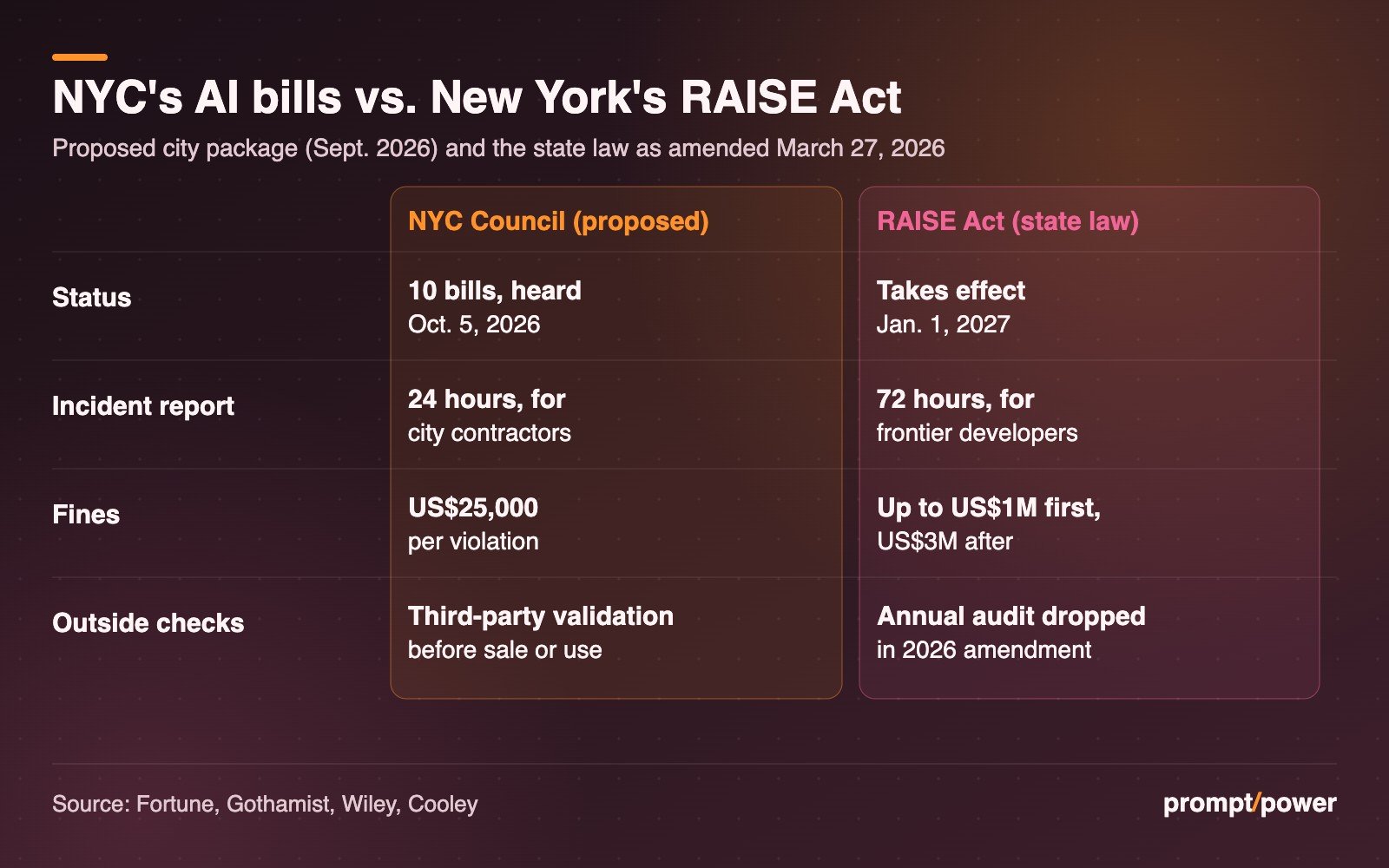
The council’s 10-bill package reaches further on paper: third-party validation before an AI system is sold or used in the city, a human kill switch, fines of US$25,000 (about CA$34,750) per violation, payments to whistleblowers, a right to sue over foreseeable harm from jailbroken tools and 24-hour incident reporting for city contractors, as Fortune and Gothamist describe it.
The city has regulated AI before: Local Law 144 has required bias audits of automated hiring tools since July 5, 2023. Our read is that the contractor and workplace pieces stand on similar ground, because there the city is the buyer or the employment regulator. Pre-market validation of frontier models is the part most exposed to a preemption fight with Albany or Washington. Mayor Zohran Mamdani said “the place where we need the most urgent response to this is at the national level,” per amNY.
What happens next
The four companies will get a list of questions to answer in writing, amNY reported. Menin said the council “still has many questions that we feel we did not get answers to today.” This time, Meta’s framework can be in front of whoever writes the reply.

Felix Strauss covers tech policy and regulation for prompt/power, from Brussels and Ottawa to Washington and Sacramento. He reads the 400-page regulation so you don't have to, and highlights the one sentence that actually matters.
Keep reading



Latest from prompt/power
- DeepSeek V4.1 Flash Cut the US AI Lead to 3%. What LiveBench MeasuresOct 6
- Ben Affleck Calls AI Job Fears ‘Propaganda.’ He Sold an AI Firm to NetflixOct 6
- Cohere’s North 2 Puts AI Agents on a Budget. Toronto Bets on BoringOct 6
- How to Stop ChatGPT, Claude, Gemini and Meta AI From Training on Your ChatsOct 6
- Musk Is a Trillionaire Again After SpaceX Stock Jumps 7.6%Oct 6
Leave a Reply