Telus wants to build Canada’s biggest AI computing cluster. Here’s what’s built, what’s planned and what’s still ‘proposed’
Telus's Rimouski AI factory is sold out; a proposed B.C. cluster targets 60,000-plus GPUs and over 150 MW by 2032 with Ottawa as partner. What's real so far, and where Quebecor's bid fits.
When people talk about the AI computing race, they usually mean Microsoft, Google, Amazon and Meta. In Canada, the biggest homegrown attempt to build that kind of capacity is coming from a phone company. Telus is turning data centres in Quebec and British Columbia into what it calls Sovereign AI Factories, and it has drawn Ottawa in as a partner. Here’s what has been built, what’s planned, and what remains undecided, now that the company is also fielding a takeover offer.
Where it started
Telus’s first Sovereign AI Factory opened in Rimouski, Que., in September 2025. In May 2026 the company said it was fully sold out and listed on the TOP500 supercomputer ranking as Canada’s fastest and most powerful system. Telus hasn’t disclosed what it spent.
What’s planned
On May 11, 2026, Telus, developer Westbank and the federal government said they were working on a proposed cluster under Ottawa’s Enabling Large-Scale Sovereign AI Data Centres initiative. The plan as described:
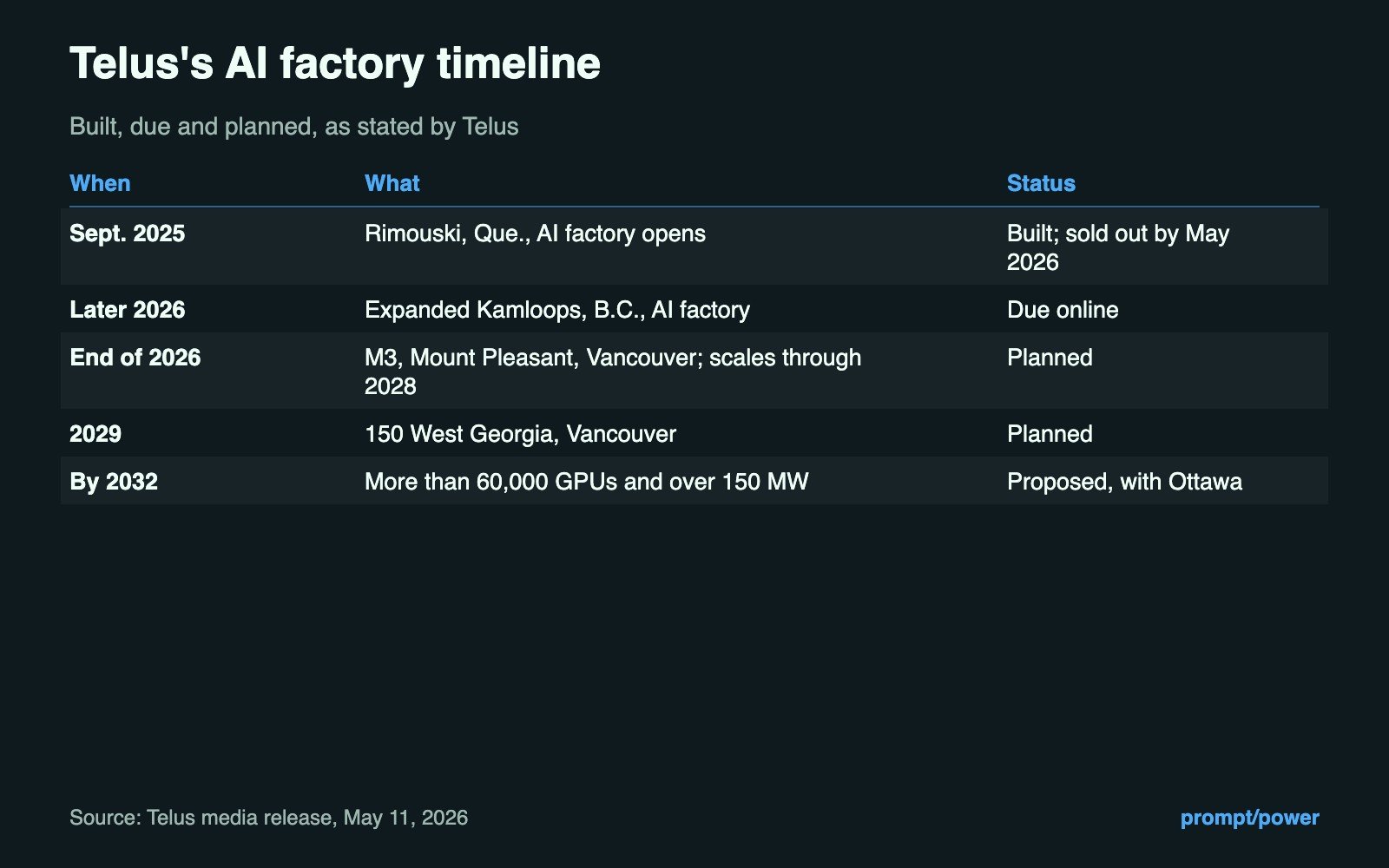
- An expanded Kamloops, B.C., AI factory, due online later in 2026.
- A Vancouver facility, M3 in Mount Pleasant, opening at the end of 2026 and scaling through 2028, and a second at 150 West Georgia in 2029.
- More than 60,000 GPUs and over 150 megawatts by 2032, starting with an initial 85 MW of power from BC Hydro.
- Nvidia’s Vera Rubin and Grace Blackwell platforms. Telus says it was the first North American service provider to become an official Nvidia Cloud Partner.
Telus cited about CA$9 billion in economic value and more than 1,000 construction jobs, but it didn’t state its own capital spending.
What’s still open
Note the word “proposed.” The May release described the parties as still working out the details, and it didn’t put a federal dollar figure on the cluster. Telus also makes strong environmental claims: 98% renewable power, closed-loop liquid cooling it projects will cut cooling energy by 80% compared with traditional data centres, water use 90% lower, and waste heat recycled to warm the equivalent of about 150,000 homes. Those are projections for facilities that are mostly not built yet.
Where Quebecor’s bid fits
On Nov. 16, Quebecor made public an offer for TELUS worth about CA$19.45 a share, by its own calculation, framed around keeping telecom infrastructure under Canadian control. Quebecor’s release lists AI infrastructure and data centres among its priorities, but neither it nor TELUS’s response says what would happen to the AI factories. TELUS’s board says it hasn’t decided whether to pursue a deal.
Why it matters
Telus’s pitch is that Canadian companies, researchers and governments want AI computing that stays on Canadian soil and under Canadian ownership. “Securing Canada’s technological independence is a national priority,” said Evan Solomon, Canada’s minister of artificial intelligence and digital innovation, in the May release.
The test is whether demand keeps pace with the build. A sold-out first site is a good sign. A 150 MW cluster has to compete on price with U.S. cloud giants that are also building in Canada.
More from prompt/power: Canada’s CA$2-billion AI compute plan, explained · Quebecor’s offer for TELUS · Celestica, the Toronto company building AI’s racks · Nvidia’s first earnings without Jensen Huang
Researched and drafted with AI tools, fact-checked against primary sources and approved by a human editor before publishing. Prices and dates are as of publication. Our standards →

Jeff Cameron writes about the business and policy side of AI for prompt/power. A chief operating officer by trade, he also writes for Not An Atlas and The Remote.
All stories by Jeff →Keep reading




Latest from prompt/power
- When will Anthropic join the Nasdaq-100 and the S&P 500? The rules, and ANT’s datesNov 25
- Anthropic’s prospectus describes its AI models breaking into real computer systems. What it told investors about safetyNov 25
- Asia’s chip stocks give back their Nvidia rally: Kospi falls 6.2%, SK Hynix and Tokyo Electron lose more than 11%Nov 25
- Five years ago, 193 countries agreed on AI ethics. What UNESCO’s recommendation actually asksNov 25
- Black Friday scams now look professional. Canada’s cyber agency says what still gives them awayNov 25