Canada’s CA$2-billion plan for AI computing power: where the money goes, and what’s actually open
Ottawa's Sovereign AI Compute Strategy splits CA$2 billion three ways. The Access Fund that start-ups ask about is closed; here's the rest.

Canada’s federal government has promised CA$2 billion to make sure Canadian AI companies and researchers aren’t entirely dependent on foreign computing power. It’s one of the largest AI line items Ottawa has. Two years after it was announced, it’s worth asking where that money is meant to go, and which parts are actually open to companies.
The CA$2 billion, in three parts
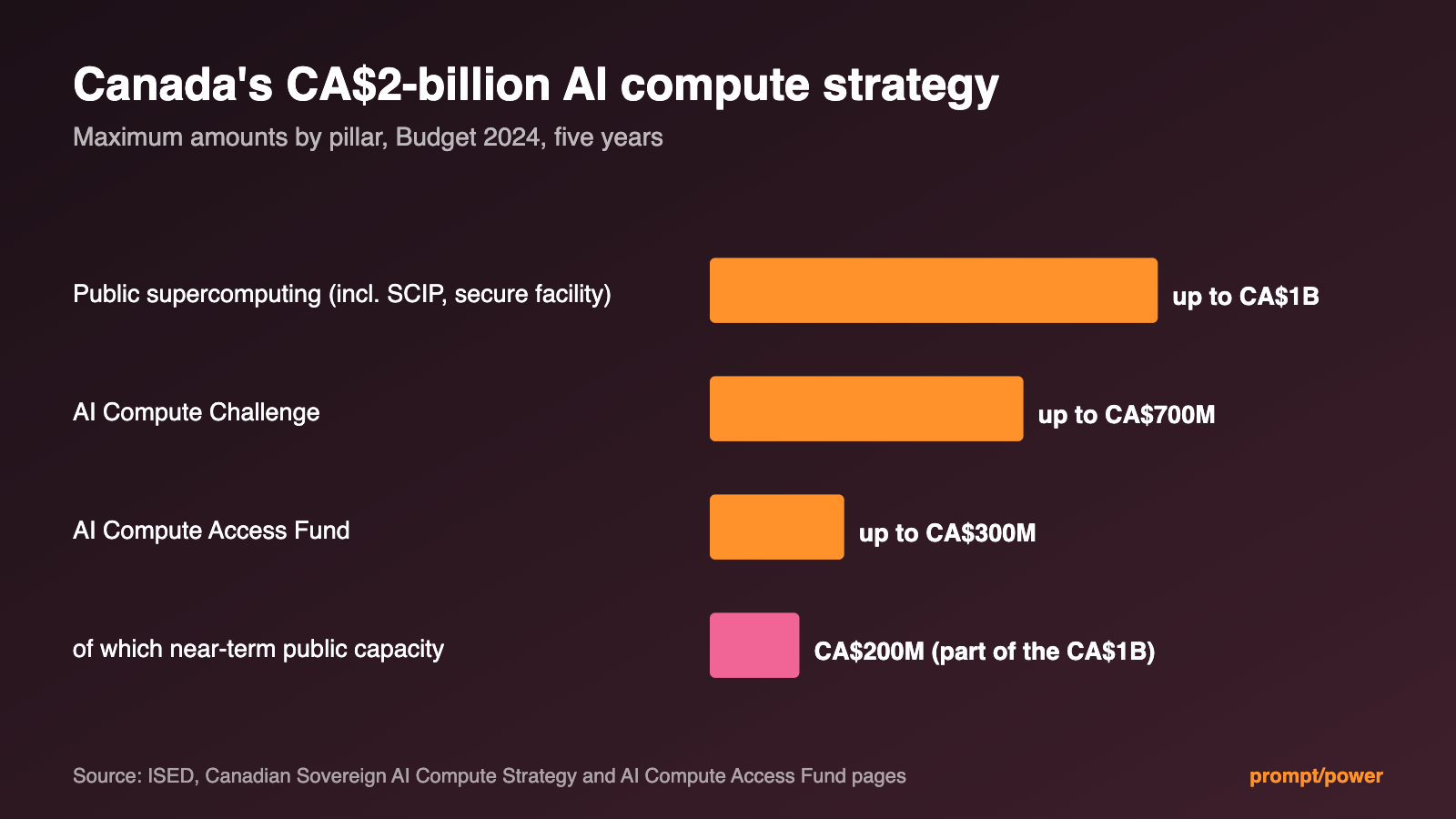
The Canadian Sovereign AI Compute Strategy draws on CA$2 billion over five years from Budget 2024, starting in 2024-25. Innovation, Science and Economic Development Canada (ISED) splits it three ways.
- Up to CA$1 billion for public supercomputing. This covers a new Canadian-owned AI supercomputer under the AI Sovereign Compute Infrastructure Program (SCIP), a secure computing facility led by Shared Services Canada and the National Research Council for government and industry research including national security, and CA$200 million to expand existing public capacity in the near term.
- Up to CA$700 million for the AI Compute Challenge, meant to draw private investment into commercial AI data centres in Canada built by companies, consortiums and academic-industry partnerships.
- Up to CA$300 million for the AI Compute Access Fund, which helps Canadian companies pay for compute.
What’s open, and what isn’t
ISED’s strategy page, last updated in June 2026, said SCIP applications were open. It gave no application window for the Compute Challenge and described the secure facility as something that “will also be established.”
The Access Fund, the part most start-ups ask about, is closed. Its last call ended July 31, 2025, and ISED’s page gives no date for another. Under that call, eligible companies were Canadian-registered, for-profit AI developers with fewer than 500 employees, revenue or at least Series A financing, and a Canadian R&D team. The fund covered compute costs of CA$100,000 to CA$5 million per project over up to three years.
The detail that shows the policy
The Access Fund paid more for Canadian compute: two-thirds of eligible costs for Canadian cloud AI services, against half for non-Canadian ones. That gap is the strategy in miniature. Ottawa wants the spending, and the data, to stay in Canada where it can.
What to watch
Three things will show whether the strategy delivers: named SCIP and Compute Challenge recipients, a new Access Fund intake, and how much of the CA$2 billion is actually committed before the five-year window closes. ISED’s page named no recipients when we checked. Canada’s Budget 2026 also added AI spending lines, which we broke down separately.
Amounts are in Canadian dollars and are maximums (“up to”) as stated by ISED.
More from prompt/power: Canada’s Budget 2026 AI spending · Celestica’s US$40 billion target · Bill C-22, explained
Researched and drafted with AI tools, fact-checked against primary sources and approved by a human editor before publishing. Prices and dates are as of publication. Our standards →

Jeff Cameron writes about the business and policy side of AI for prompt/power. A chief operating officer by trade, he also writes for Not An Atlas.
All stories by Jeff →Keep reading



Latest from prompt/power
- OpenAI opens 50,000 free ChatGPT grants for researchers on Nov. 23. Who can apply, and what its ‘1.9x faster’ study measuredNov 21
- An AI may be taking notes at your doctor’s appointment. What Ontario and the NHS require, and what to askNov 21
- Is that Black Friday ‘regular price’ real? The rules in Canada, the U.S. and the U.K., and how to checkNov 21
- How to read an IPO prospectus in 10 minutes, using Anthropic’s as the exampleNov 20
- ChatGPT Pro, Claude Max or Google AI Ultra? What CA$140 a month buysNov 20