
Amazon is in talks to buy Decart, a three-year-old AI startup, for about US$7 billion (about CA$9.7 billion), The Wall Street Journal reported on Oct. 11, citing people familiar with the matter. The Journal said a deal could come soon if the talks hold. Amazon declined to comment outside regular business hours and Decart did not respond to requests for comment, Reuters reported. A day earlier, on Oct. 10, the Financial Times reported that Nvidia is in early talks to buy Reflection AI, the American open-weight model lab, or to invest more in it. Neither deal has been agreed, and either could still collapse.
Two reported deals, one weekend, pointing in opposite directions. Decart sells software that makes it easier to run AI on chips that are not Nvidia’s. Reflection trains its models on Nvidia hardware and is the lab Washington hopes will answer DeepSeek. One buyer wants leaving Nvidia to get cheaper. The other buyer is Nvidia.
What Amazon would get for US$7 billion in Decart
Decart was founded in 2023 by chief executive Dean Leitersdorf, chief technology officer Orian Leitersdorf and chief product officer Moshe Shalev, and is based in San Francisco with teams in New York and Tel Aviv, according to Tech Funding News. Its public face is two models. Lucy edits live video in real time; Oasis generates simulated worlds used to train and test robots and self-driving systems, Reuters reported.
The part Amazon is more likely paying for is less glamorous. Decart’s DOS, short for Decart Optimization Stack, lets developers run the same AI workload on Nvidia GPUs, Google TPUs or Amazon’s Trainium chips without rebuilding it for each, and SiliconANGLE reported it can cut model-tuning time from months to a couple of weeks, Tech Funding News reported.
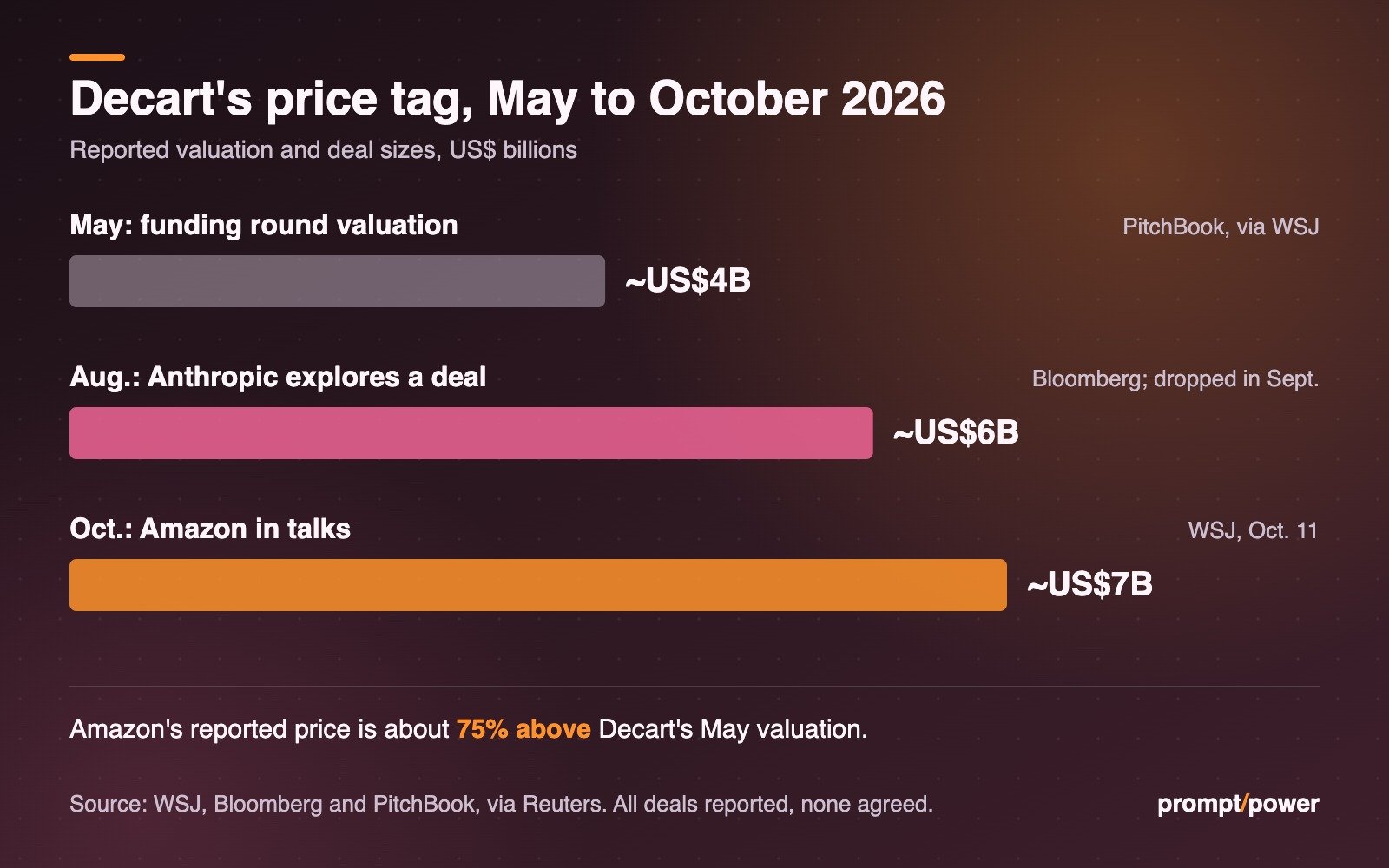
The price is steep. Decart was valued at nearly US$4 billion in May, according to PitchBook data cited by the Journal, when it raised US$300 million in a round led by Radical Ventures, with Nvidia joining as a new investor. US$7 billion is roughly a 75% markup on that five months later.
Amazon is not a stranger to the company. AWS gave Decart early access to Trainium3 in 2025, and at AWS re:Invent that December, Leitersdorf claimed up to four times faster frame generation at half the cost of GPUs. In May, Amazon became a strategic customer under a commercial agreement, Tech Funding News reported. The same outlet notes that Dealroom has described Decart’s headline 8x speed-up and 100x cost-efficiency claims as self-reported and hard to verify.
Why Decart’s DOS is a Trainium sales pitch
Amazon’s chip business started with an acquisition too. It bought Israeli chip designer Annapurna Labs in 2015 for a reported US$350 million, a figure Amazon never confirmed. Annapurna’s work became Trainium. The silicon has never been the hardest part of selling it. The hard part is that most AI code is written for Nvidia’s CUDA software, and moving it costs engineers and months, the same lock-in DeepSeek and Huawei are trying to break from the Chinese side.
Our read: a tool that shrinks that migration from months to weeks is worth more to the company selling the alternative chip than to anyone else. Bought by Amazon, DOS stops being a neutral adapter and becomes an on-ramp to AWS. Whether it keeps supporting Google’s TPUs with the same enthusiasm is the open question Tech Funding News raised, and nobody has answered it.
Anthropic and Nvidia both looked at Decart first
Amazon is at least the third reported suitor. Bloomberg reported that Anthropic explored a deal worth about US$6 billion in August and decided in September, after due diligence, not to pursue it, according to Reuters. No one has publicly explained why Anthropic walked away.
Nvidia came even closer, by one account. Israel’s Calcalist reported that Nvidia, already a Decart shareholder, was in advanced talks to buy the company before higher bids arrived, Tech Funding News reported.
The awkward detail is the relationship between the last two bidders. Amazon is one of Anthropic’s biggest backers: Tech Funding News counts a US$5 billion Amazon commitment to Anthropic in 2026, with up to US$20 billion more tied to milestones. So whatever Anthropic’s team saw in diligence, its largest investor now appears willing to pay about a billion dollars more than Anthropic considered.
Nvidia’s Reflection AI talks: buy it, or hire it
The FT, citing people with direct knowledge, said Nvidia’s talks with Reflection are at an early stage and could fall apart, though the sides could reach an agreement in the coming weeks, The Next Web reported. A deal could take several forms. One is an acqui-hire, in which Nvidia hires Reflection’s staff and licenses its technology instead of buying the company, a structure the FT said could avoid a lengthy regulatory review. Others include supplying more chips or raising Nvidia’s stake, which already stands at US$800 million. Bloomberg separately reported on Oct. 10 that Nvidia is discussing a bigger investment or computing power, and that no terms have been agreed. Neither company had commented publicly in the coverage we reviewed.
Reflection was founded in 2024 by former Google DeepMind researchers Misha Laskin and Ioannis Antonoglou. On Oct. 5 it released Beam, which it calls a sparse mixture-of-experts model with 501 billion total parameters and 23 billion active. As we explained when Beam launched, Reflection says it pretrained the model on 6,144 Nvidia GB300 GPUs. According to the FT, the Trump administration hopes Reflection will rival cheap Chinese open models such as DeepSeek, per The Next Web.
Our read: that makes Reflection an unusual target, a political project as much as a startup, and one already built on Nvidia silicon. Buying it keeps the flagship of American open-weight AI inside Nvidia’s house just as Amazon shops for the software that helps customers move out of it.
The Groq precedent hanging over an acqui-hire
Nvidia has been buying at pace. In September it agreed to buy Hugging Face for US$12.93 billion. Earlier, in December, it took a non-exclusive licence to chip startup Groq’s technology and hired executives including founder Jonathan Ross, without buying the company. The New York Times reported in September that the Justice Department is investigating whether that deal was structured to avoid antitrust review, according to The Next Web. An Nvidia spokesman defended it to the Times:
“The Groq story is a prime example of the American system working as designed to promote innovation.”
An acqui-hire of Reflection would be the Groq template again, proposed while the Justice Department is still examining the first one. The FT’s sources pitched that structure as the fast lane. It may also be the lane regulators are now watching most closely.
What to watch next
- Signed terms. Both deals are reported talks. Watch for an announcement from Amazon or Decart, and for which of the FT’s three options Nvidia picks for Reflection.
- DOS support lists. If Amazon closes, check whether Decart keeps shipping TPU and Nvidia support at the same cadence as Trainium.
- Beam’s licence and hosting. Reflection’s open weights are free to download today. An Nvidia-owned Reflection would decide where the next version runs best.
More deal coverage lives in our business and startups section. For now, DOS still promises to run one workload on Nvidia, Google or Amazon silicon. If the Journal’s sources are right, one of those three companies is about to own it.

Marcia Okonkwo covers the business of technology for prompt/power: venture capital, startups, IPOs and earnings. She treats a valuation as a mood rather than a number until the S-1 says otherwise.
Keep reading

Anthropic’s 5% Pledge Is Worth About US$48B. Here’s the Fine Print

Bumble Buyout: Ithaca Holdings Pays US$6.05 a Share, a 138% Premium
Cohere Opens an Ottawa Office as Its AI Agents Head to Navy Ships
Arena, the Leaderboard That Ranks AI Models, Is Now Worth US$3.1 Billion
Latest from prompt/power
- Meta Q3 Earnings Oct. 21: The Capex, Ads and Cash Numbers to WatchOct 21
- Commons AI Study Meets Parliament’s Interpreter Math: 44 Passes in 5 YearsOct 21
- CNN All Access Canada Price Is CA$7.99. Americans Pay About 23% MoreOct 20
- DeepSeek Federal Ban: DHS Order Also Covers Apps Built on Its ModelsOct 20
- Google Magic State Cultivation Explained: What Willow Fixed, What It Didn’tOct 20
Leave a Reply