The AI Data-Center Debt Map: Who Owes Whom After Oracle’s Jupiter Notice
OpenAI's promises become Oracle's leases, and Oracle's leases become bank loans inside project companies. New Mexico's Project Jupiter shows where that chain strains first.

Updated Oct. 19, 2026: This explainer, first published Sept. 26, has been rebuilt from primary documents. New since then: a New Mexico hearing officer has set the Project Jupiter air-permit hearing for Dec. 7, and the emissions numbers behind that permit have changed twice. Oracle’s fiscal first-quarter release, which shows US$664 billion in contracted backlog against negative free cash flow, now anchors the numbers below.
Oracle is the anchor tenant on a 2.45-gigawatt AI campus in New Mexico that is being built by a developer, not by Oracle. On Sept. 24, Bloomberg reported, and TechCrunch followed, that Oracle had sent the developer of that campus, Project Jupiter, a force majeure notice, a contract clause that would let it delay payments if the site misses its 2028 target to come online. The next hard date is Dec. 7, when a state hearing officer opens the hearing on the air permit for the fuel cells meant to power it. If anyone waits for money, our read is that the first in line are the banks that lent against the project, not Oracle’s bondholders.
That is the shape of the whole AI buildout. Labs sign long promises, cloud companies turn those promises into leases, and the leases get financed inside separate project companies whose debt never appears as a loan on the sponsor’s books. Here is the map.
Oracle’s own numbers: US$664 billion promised, US$5 billion short
Start with the company holding the most promises. In its Q1 fiscal 2027 results released Sept. 10, Oracle reported remaining performance obligations, the revenue customers have contracted for but Oracle has not yet earned, of US$664 billion, up US$209 billion from a year earlier. Cloud infrastructure revenue rose 121% to US$7.4 billion.
The same release says operating cash flow hit a record US$23 billion and that free cash flow was negative US$5 billion for the quarter. Free cash flow is operating cash minus capital spending, so by our arithmetic Oracle spent roughly US$28 billion on capital equipment in three months. The release does not state capex directly and gives no full-year capex guidance.
That gap is the whole story in miniature: the backlog is a promise of future cash, while the spending to serve it is happening now. Oracle files its detailed lease and debt disclosures with the SEC each quarter, and our guide to the numbers that matter in an AI company’s S-1 works for reading those 10-Qs too.
How a promise becomes a loan
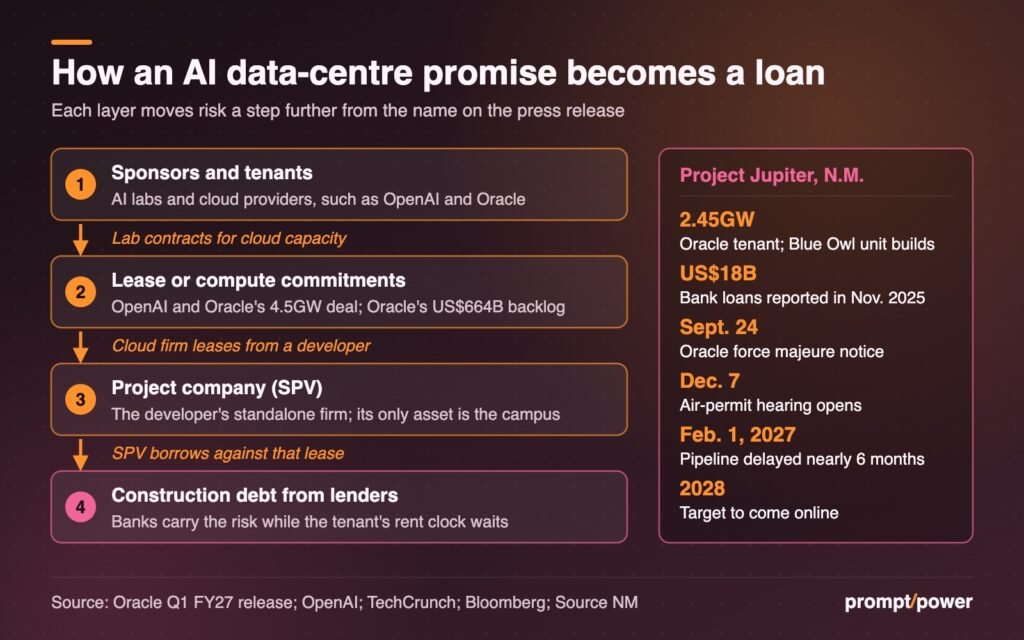
The structure has three layers, and each one moves risk a step further from the name on the press release.
First, an AI lab signs a multi-year capacity contract with a cloud provider. OpenAI’s deals with Oracle are the largest example: the companies announced a 4.5-gigawatt Stargate partnership, and those contracts sit inside Oracle’s backlog.
Second, the cloud provider signs a long lease with a developer rather than building on its own balance sheet. At Jupiter, the notice went to a unit of Blue Owl Capital, TechCrunch reported. Oracle is the tenant.
Third, the developer parks the campus in a special purpose vehicle, a standalone company whose only asset is the project, and that SPV borrows construction money secured against the tenant’s lease. In November 2025, Bloomberg reported that banks were lending US$18 billion for the Oracle-tied New Mexico data centre.
Meta has used outside capital for its own campus. It announced a joint venture with funds managed by Blue Owl Capital to develop its Hyperion data centre, a deal Data Center Dynamics described as a US$27 billion joint venture to fund a gigawatt-scale campus in Louisiana. The same name, Blue Owl, turns up on both sides of the map.
Our read: the SPV does not make the debt disappear. It relocates it to lenders, and it concentrates everyone’s exposure in one variable, the tenant’s ability and willingness to keep paying.
Circular financing: where the money comes back around
The second feature of the map is that suppliers are also financiers. Several of OpenAI’s biggest compute deals route money or equity back to the company buying the chips.
Nvidia and OpenAI announced a strategic partnership to deploy 10 gigawatts of Nvidia systems, which Engadget reported as Nvidia investing up to US$100 billion in OpenAI. OpenAI then spends on Nvidia systems. AMD and OpenAI announced a partnership to deploy 6 gigawatts of AMD GPUs in October 2025, under which, as Gigazine summarized it, OpenAI could acquire up to 10% of AMD’s shares. Buy the chips, earn the stock.
Then there is rented capacity. AWS and OpenAI announced a multi-year strategic partnership that Hargreaves Lansdown reported at US$38 billion.
Who owes whom, per the documents and the reporting linked here:
| Deal | Parties | Headline value | Structure | Start | Source |
|---|---|---|---|---|---|
| Stargate expansion | OpenAI, Oracle, SoftBank | Five new data centre sites | Partner-built campuses | Stargate launched early in Trump’s second term | OpenAI |
| Oracle capacity | OpenAI and Oracle | 4.5GW | Multi-year cloud contract | Not stated | OpenAI |
| Nvidia systems | Nvidia and OpenAI | 10GW; up to US$100B investment (reported) | Equity investment plus chip purchases | Announced 2025 | Nvidia, Engadget |
| AMD GPUs | AMD and OpenAI | 6GW; up to 10% of AMD shares (reported) | Supply deal plus equity rights | Announced October 2025 | StorageNewsletter, Gigazine |
| AWS capacity | OpenAI and AWS | US$38B (reported) | Multi-year cloud contract | Not stated | OpenAI, Hargreaves Lansdown |
| Project Jupiter | Oracle (tenant); Blue Owl unit (developer); bank lenders | 2.45GW; US$18B in bank loans | Lease plus project construction debt | Online target 2028 | TechCrunch, Bloomberg |
| Hyperion | Meta and Blue Owl funds | US$27B (reported) | Joint venture | Announced October 2025 | Meta, DCD |
| CoreWeave-tied campus | CoreWeave-linked project borrower | US$1.1B (reported) | Project high-yield bonds | September 2026 | Bloomberg, Dealroom |
That last row matters. On Sept. 21, Bloomberg reported that a CoreWeave-tied data centre project had kicked off a junk-bond offering, which Dealroom reported landed US$1.1 billion. Our read: lenders are starting to price individual campuses rather than lend on a famous name.
Project Jupiter, the first real stress test
Jupiter is one of the flagship Stargate sites, according to TechCrunch, and trade publication Capacity has put a US$165 billion price tag on the project.
Two things went wrong at once. The Energy Transfer pipeline meant to bring gas to the site has been pushed back nearly six months, to Feb. 1, 2027, after regulators repeatedly denied permits, according to TechCrunch’s account of Bloomberg’s reporting. And the separate air permit for the Bloom Energy fuel cells that would turn that gas into power has been stuck. The New Mexico Supreme Court put the air proceeding on hold in August, New Mexico Political Report reported, and KRWG reported on Sept. 18 that the court had lifted the stay.
Since our original story, the permit case has moved again. On Oct. 16, Hearing Officer James Browning, a retired federal judge, filed a schedule to the Environment Department docket setting the hearing for 9 a.m. on Dec. 7 at the Sunland Park Multi-Generational Center, Source New Mexico reported. Newly released department documents showed modelling in which the power system could emit a much higher concentration of pollutants than first forecast. Oracle has since proposed lower emissions; trade site mgrid reported that Oracle says a fuel cell redesign cuts emissions 35%. An Oct. 26 hearing will consider dismissing the case over the new figures, and an Oct. 29 hearing will take up discovery.
The calendar is the problem. TechCrunch reported a Nov. 23 deadline for the state to decide on the permit. The hearing now starts two weeks after that date.
Oracle told CNBC that “Project Jupiter remains on our planned schedule” and that it is “fully committed to New Mexico,” according to TechCrunch. Blue Owl, whose unit received the notice, put it this way.
“This notice does not change the financial commitments to this multi-year project.”
Lenders had already flinched. On Sept. 19, five days before the notice became public, The Star carried a report, citing the Financial Times, that Oracle’s US$18 billion of data centre debt was under pressure.
What it means
A force majeure notice is not a default. Oracle is not walking away, and the notice, per Bloomberg’s sources, preserves its right to pay later rather than not at all. But it shows where the pain lands first in an off-balance-sheet buildout: on the project company and its banks, which carry construction interest while the tenant’s rent clock waits for gas and a permit.
It also shows the physical limits under the financial ones. Power is the bottleneck, as our breakdown of AI’s electricity numbers lays out, and debt markets are starting to price it campus by campus. The same turn toward borrowing is reaching other capital-hungry AI businesses: Waymo took its first loan, US$5 billion, to fund robotaxi expansion. More coverage of the money behind AI lives in our business and startups section.
Watch three dates. Oct. 26, when a hearing officer decides whether the permit case survives. Dec. 7, when it is heard. And Feb. 1, 2027, the day gas is now due to reach a campus whose banks have already lent US$18 billion against power it doesn’t yet have.
Researched and drafted with AI tools, fact-checked against primary sources and approved by a human editor before publishing. Prices and dates are as of publication. Our standards →
Sources- techcrunch.com — Bloomberg reported, and TechCrunch followed
- sourcenm.com — opens the hearing on the air permit
- oracle.com — Q1 fiscal 2027 results released Sept. 10
- openai.com — 4.5-gigawatt Stargate partnership
- bloomberg.com — banks were lending US$18 billion for the Oracle-tied New Mexico data centre
- about.fb.com — announced a joint venture with funds managed by Blue Owl Capital

Marcia Okonkwo covers the business of technology for prompt/power: venture capital, startups, IPOs and earnings. She treats a valuation as a mood rather than a number until the S-1 says otherwise.
All stories by Marcia →Keep reading



Latest from prompt/power
- GPT-6.2 Astra is OpenAI’s first released model rated ‘High’ for AI self-improvement. What that means, and what it costsNov 18
- OpenAI’s free CSAM classifier misses half the infant images in its own test set. What the model card showsNov 18
- Anthropic’s last filing before pricing: Nasdaq approval, a US$6.5-billion stock-pay bill and a redrawn lock-upNov 18
- Celestica, the Toronto company building AI’s racks, expects US$40 billion in revenue next yearNov 18
- ChatGPT now lets brands claim a profile and run their own agent. What creators and publishers should knowNov 18