
Charlton Data Centre: Greenwich Wants 8,000 Homes, Not 180MW of Servers
The Royal Borough of Greenwich has decided it does not want a data centre in Charlton, and it made that decision before anyone had formally applied to build one.
The scheme, called Charlton Gateway, is being promoted by Greater London Industrial (GLI), a joint venture between the real-assets firm Patrizia and Kingston Space Property. DatacenterDynamics reported in August that it would be a 180MW campus on the former Stone Foundries site at 669A Woolwich Road and the neighbouring VIP Industrial Estate, with about 100,000 sq m of floorspace. So far GLI has only asked council officers whether an environmental impact assessment is needed. A full application is expected “in the coming months”, according to The Greenwich Wire.
The council did not wait. At a council meeting on Sept. 23, Labour councillor Jo van den Broek, who represents Charlton Village and Riverside, asked about the proposal, and the cabinet member for planning, Tom Creswell, answered without hedging, The Greenwich Wire reported. BBC News took the dispute to a national audience on Oct. 4.
“Let me be unequivocal on this. This Labour administration does not support the data centre proposal in Charlton. No ifs, no buts.” Tom Creswell, Royal Borough of Greenwich
What the Charlton data centre would displace
Creswell went on: “We want to deliver thousands of new homes and 1,000 new jobs in Charlton Riverside. We don’t think a data centre does that. We think it will take up too much space.”
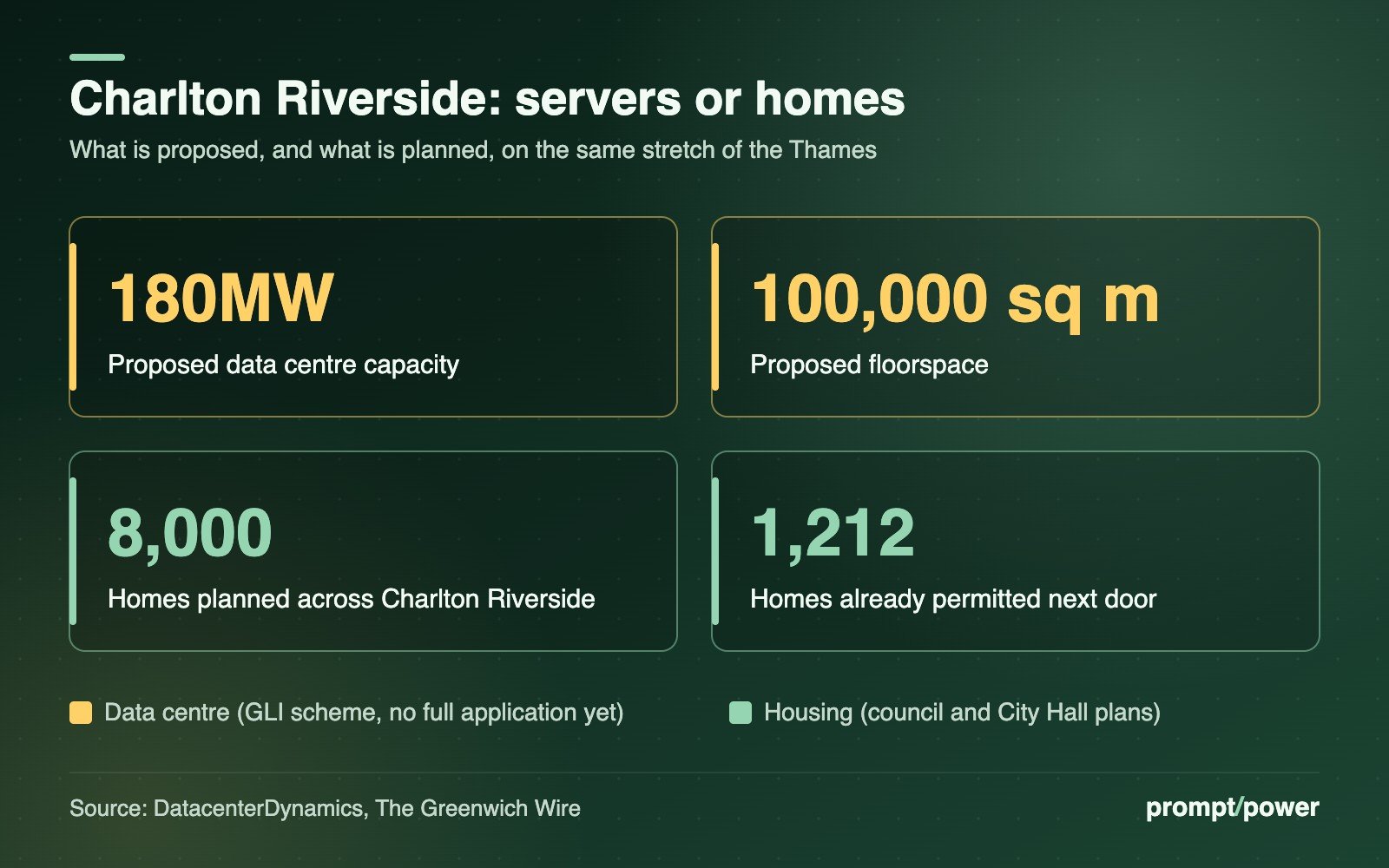
The council and City Hall want around 8,000 homes across the wider Charlton Riverside area, which the Evening Standard described as a 20-year ambition. Next door, the housing association Hyde’s Herringham Quarter has permission for 1,212 homes: 718 in full and 494 more in outline.
The local blog From the Murky Depths, which went through the scoping documents, found the site boundary running up against that approved housing, generators placed where a planned east-west public transport route should go, and a substation close to existing homes on Anchor and Hope Lane. The Greenwich Wire reported that two locally listed Stone Foundries buildings, the art deco-style “Odeon building” and the laboratory, would be demolished. Work could start in 2028 and finish by 2033.
London’s grid is the real prize
GLI’s own pitch explains why it wants this plot. Its planning documents, quoted by DCD, describe a site with “a confirmed power connection, high-speed fiber infrastructure and proximity to financial markets.”
In London, a confirmed power connection is scarce. The London Assembly’s Planning and Regeneration Committee reported on Dec. 1, 2025 that the grid in parts of west London, notably Hillingdon, Hounslow and Ealing, had reached full capacity since 2022, temporarily halting housing schemes. Short-term fixes connected more than 12,000 homes by early 2025. “London is at a critical moment, with energy capacity becoming a real constraint on both housing delivery and wider economic growth,” said the committee’s chair, James Small-Edwards AM. The committee asked the government for a separate planning use class for data centres and asked City Hall for a dedicated policy in the next London Plan.
Our read: Charlton’s fight is about electricity as much as land. Capacity committed to 180MW of servers is capacity that 8,000 future households will have to find somewhere else. For a sense of how fast that demand is growing, see our breakdown of AI’s electricity bill in six numbers.
Water is the other worry residents raised. GLI says it will use a “dry” cooling system that reuses water rather than drawing continually from the mains. A government spokesperson told the BBC that data centres account for about 0.2 per cent of non-household water use in England, according to Resultsense’s summary of that report.
Critical National Infrastructure status won’t settle it
The developer’s side has a national card to play. A Charlton Gateway spokesperson told the BBC that regeneration in the area had made “limited” progress and pointed to data centres’ status as Critical National Infrastructure, Resultsense reported.
That status dates to Sept. 12, 2024, when the then technology secretary, Peter Kyle, announced the designation, saying: “Data centres are the engines of modern life, they power the digital economy and keep our most personal information safe.” The release is about security: a dedicated government team to monitor threats and faster access to the National Cyber Security Centre. It does not grant planning permission.
Planning reform is where the decisive changes are. Law firm Burges Salmon notes that 2025 regulations let data centres enter the Nationally Significant Infrastructure Project regime, where ministers rather than councils decide. A National Planning Policy Framework consultation published on Dec. 16, 2025 would make local plans prioritise AI Growth Zones and allocate sites for data centres. The AI Growth Zones the firm lists are in Oxfordshire, North Wales, South Wales and the North East, none of them in London, and the government is putting £4.5m (about US$6m) into a national team of data centre planning experts to advise councils.
What happens next in Charlton
Greenwich’s draft local plan has yet to say what this site is for, Resultsense noted. That document, and whether it names the Stone Foundries land for housing, is the council’s strongest defence when GLI’s full application arrives. If the scheme were steered into the national regime instead, Greenwich’s “no ifs, no buts” would become one consultation response among many.
Creswell’s objection rested on people who are not there yet. The data centre, he said, “will be a nuisance for existing residents and also the residents who we hope to move in in these new homes.” Those homes are still a masterplan. GLI’s power connection, by its own account, is already confirmed.

Priya Natarajan covers science and society for prompt/power: climate and energy tech, data centres, and the physical cost of the digital world. Every query has a water bill, and she would like to see the receipt.
Keep reading




Latest from prompt/power
- Cohere Opens an Ottawa Office as Its AI Agents Head to Navy ShipsOct 11
- Beijing Warns Officials Off ‘Blind Investment’ in AI and High TechOct 11
- TSMC Q3 Revenue Beat Its Forecast: What to Watch in ASML and TSMC EarningsOct 11
- China Gave AI Influencer Yuri an Official ID. What It Unlocks for CreatorsOct 11
- Double Counter Discord Breach: What to Do If Your IP Address LeakedOct 11
Leave a Reply