
Cohere Opens an Ottawa Office as Its AI Agents Head to Navy Ships
Ottawa already has a building with Cohere’s name on it. The Toronto AI company bought the naming rights to the city’s Capital Exhibition Centre, now the Cohere Centre, BetaKit notes. On Oct. 8 it announced it would also have people there: a third Canadian office, beside Lansdowne Park in the Glebe, for the nearly 30 employees it already has in the Ottawa region.
Two days earlier, on Oct. 6, Thales Canada and Cohere said Cohere’s agentic AI is going into the maintenance and support of Royal Canadian Navy ships, in what they called “the first integration of agentic AI” into that work.
Put the two announcements side by side and a pattern shows. Canada’s AI champion is spending more and more of its public energy on a particular kind of customer: selling to the federal government and its defence contractors. Neither announcement came with a dollar figure.
Cohere’s Ottawa office: what was announced
The Ottawa staff work in go-to-market, engineering, infrastructure and security, according to BetaKit. Cohere gave no hiring target. A spokesperson said only that the company will “tap into Ottawa’s strong talent pool as it expands its footprint.” Public job postings are more specific: Cohere is advertising for forward-deployed engineers, the people who sit with a customer and wire its models into their systems, who can be based in Ottawa.
That job title is the tell. A forward-deployed engineer in Ottawa is most useful next to customers in Ottawa, and the biggest customer in Ottawa is the Government of Canada. Our read, not Cohere’s.
Cohere has more than 800 employees across North America, Europe and Asia, with offices in Toronto, Montréal, New York, London and San Francisco, BetaKit reports. Yasir Naqvi, the Liberal MP for Ottawa Centre, said the office would “reaffirm Ottawa’s role as a point of collaboration.”
Cohere AI agents on Royal Canadian Navy ships
The Navy work is a new task under the in-service support contract Thales holds for the Arctic and Offshore Patrol Vessels and the Joint Support Ships, known as AJISS, Naval Today reports. Agentic AI will automate specific support functions with human oversight kept in place, backed by Thales’s cortAIx AI accelerator. Neither company has said which functions. Cohere says the system can run securely in disconnected environments, with Navy personnel in control.
“Canada has an opportunity to lead in the responsible use of secure, enterprise-grade AI,” Cohere co-founder Ivan Zhang said in the announcement.
The partnership itself is not new. Thales and Cohere first announced it on Dec. 8, 2025, on the sidelines of a G7 industry and digital ministers’ meeting in Montreal, The Logic reported. Thales maintains more than 100 Canadian Armed Forces vessels, from Arctic patrol ships to tugboats. The Navy wants help with scheduling preventive maintenance, moving parts from storage to where they are needed, and training workers to fix critical systems.
The Logic also caught a detail that explains part of Thales’s interest. Federal defence sales come with obligations to spend in Canada, and by the government’s latest estimate Thales still owed about CA$21.3 million in industrial and technological benefits. A Thales spokesperson said it planned to use the Cohere contract to help meet them. Our read: a deal with a Canadian AI company is a tidy way to pay down that bill.
“With no data leaving the ship, the crew can now talk to the ship.” Cohere co-founder Ivan Zhang, describing a customer’s plan, as reported by The Logic
Cohere and Ottawa: from AI startup to government supplier
Line up Cohere’s Ottawa ties and they add up quickly:
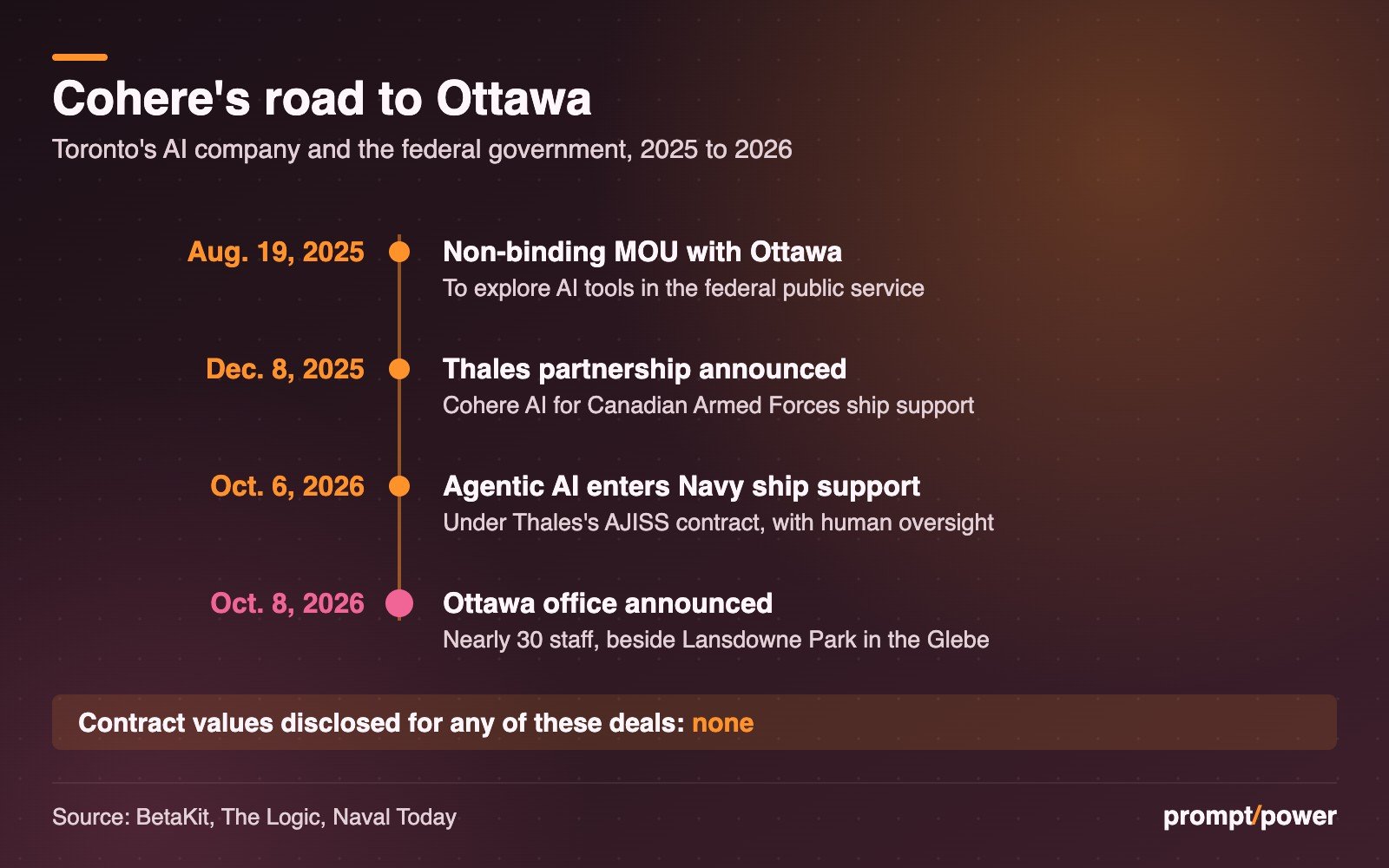
- Aug. 19, 2025: a non-binding memorandum of understanding with the federal government to explore AI tools in the public service, signed by AI Minister Evan Solomon and Joël Lightbound, per BetaKit. Cohere said at the time that no contracts had been awarded under it.
- A Communications Security Establishment contract, first reported by The Logic. No value has been made public.
- Dec. 8, 2025: the Thales partnership for naval support.
- A Toronto cybersecurity team building “agentic capabilities for cybersecurity,” whose members must be Canadian citizens and ideally hold top-secret clearance, per The Logic.
- Oct. 6 and Oct. 8, 2026: the Navy milestone and the Ottawa office.
This is the same company that, on Oct. 5, launched North 2, an agent platform sold on spending caps, audit logs and air-gapped deployment, which we read as a bet on boring. Government buyers are the customers who care most about all three.
The risk in betting on Ottawa as a customer
There is a sound commercial logic here. Governments and militaries want AI that runs on their own hardware and keeps data inside the country. Cohere can offer that with a Canadian head office, which matters when Ottawa has said it wants to buy more dual-use technology such as AI from domestic firms under its defence industrial strategy, as The Logic noted.
The risks are just as concrete. Government buyers move slowly, and a non-binding MOU is not revenue. None of the deals listed above has a public value, so there is no way for an outsider to tell whether Ottawa is a meaningful slice of Cohere’s sales or mostly a reference customer. Defence work also brings security clearances, citizenship requirements and scrutiny that a startup selling to banks never faces.
Policy is the other variable. Ottawa still has no law governing AI systems themselves, and Solomon has promised not to revive the old high-impact AI bill, The Logic reported in June. The rules for selling agentic AI to the Navy are being written contract by contract. Meanwhile the investors who back Cohere sit close to the policy table: Radical Ventures co-founder Jordan Jacobs is on Prime Minister Mark Carney’s new National Council on Artificial Intelligence.
Our read: Cohere is not abandoning enterprise customers like banks and telecoms. It is betting that being the government’s default Canadian supplier is a moat no American lab can cross. Whether that moat holds depends on numbers Cohere and Ottawa have not published.
What it means for Canadian tech
For Canadian tech workers, the Ottawa office is good news in a plain way: AI jobs outside Toronto and Montréal, in a city where public-sector tech has long been the main employer. For taxpayers, the question is the one every announcement so far has skipped: how much. The figure worth waiting for is the first one with a dollar sign.
Zhang sketched one version of the end state last year: a customer weighing a Cohere server on board a ship, processing sensor data on parts that may need replacing, with nothing sent ashore. He did not name the customer.

Felix Strauss covers tech policy and regulation for prompt/power, from Brussels and Ottawa to Washington and Sacramento. He reads the 400-page regulation so you don't have to, and highlights the one sentence that actually matters.
Keep reading

Canada’s Instant-Payment Rail Is Coming. Big Six Banks Might Not Be on It

Uber and Pony.ai Robotaxis Head for London Tests. Here’s What’s Approved

Manus Raises More Than US$500 Million After China Blocked Meta’s Deal

Microsoft’s H-1B Green Card Freeze Puts Canada’s Promise to the Test
Latest from prompt/power
- Beijing Warns Officials Off ‘Blind Investment’ in AI and High TechOct 11
- TSMC Q3 Revenue Beat Its Forecast: What to Watch in ASML and TSMC EarningsOct 11
- China Gave AI Influencer Yuri an Official ID. What It Unlocks for CreatorsOct 11
- Double Counter Discord Breach: What to Do If Your IP Address LeakedOct 11
- Fired OpenAI Safety Researchers Deny Leaking, Warn of a ‘Chilling’ CultureOct 11
Leave a Reply