
Beijing Warns Officials Off ‘Blind Investment’ in AI and High Tech
The phrase in the Chinese text is 一哄而上: a crowd surging in all at once. Reuters rendered it as “swarm-like.” On Oct. 9, China’s Communist Party and its cabinet, the State Council, put that crowd on notice in a policy document meant to speed up the country’s high-tech push, including artificial intelligence.
According to Reuters, the guidelines say “officials responsible for major losses caused by blind investment would be held accountable.” The full Chinese text published by Xinhua goes further, promising to “seriously pursue responsibility” where herd rushes or blind investment cause major losses (our translation).
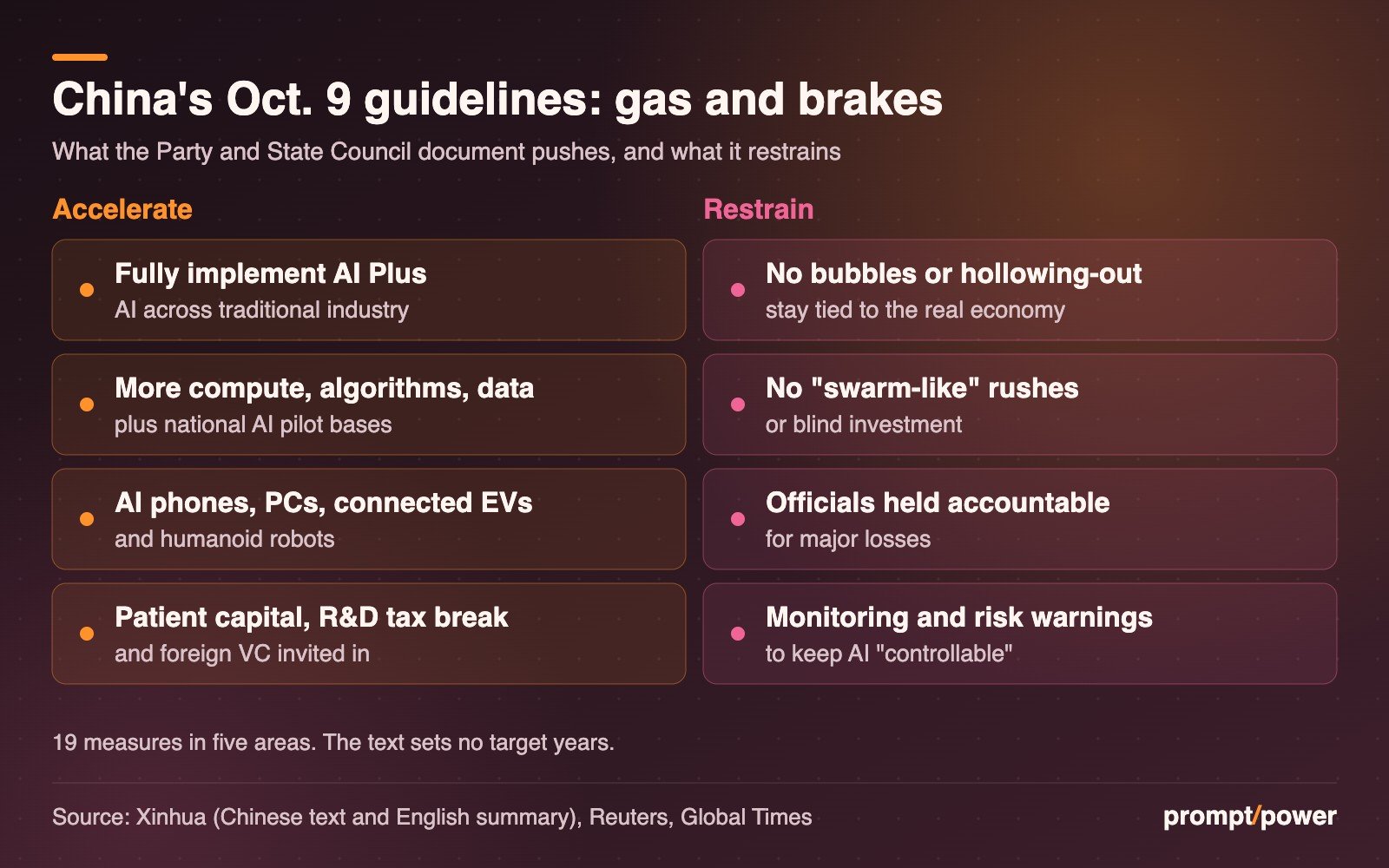
That warning sits inside a document that otherwise reads as an accelerator. It orders a full rollout of AI across traditional industry, more computing power and a pipeline of AI phones, PCs and humanoid robots. Beijing wants the boom. It does not want to pay for the wreckage.
What Beijing published on Oct. 9
The document is formally titled the Opinions of the CPC Central Committee and the State Council on Developing New Quality Productive Forces. State news agency Xinhua summarized it in English as 19 measures across five areas: science and technology innovation, linking research to industry, new development approaches, institutional reform, and talent.
“New productive forces” is a slogan President Xi Jinping introduced in 2023 for growth driven by research, technology and industrial upgrading, Reuters noted. The guidelines call developing them “an inherent requirement and an important focus for promoting high-quality development,” Reuters reported, citing Xinhua.
The text sets no target years for any of it. It is a statement of direction, and in China’s system that matters, because local governments and state-backed funds read these documents as instructions.
What the guidelines say about AI
The AI section, as published by Xinhua, opens with an order to “全面实施’人工智能+’行动”, to fully implement the AI Plus initiative. According to Reuters and Chinese crypto and finance outlet PANews, it calls for:
- breakthroughs in basic AI theory and core technologies, and a stronger supply of computing power, algorithms and data;
- national pilot bases for industrial AI applications and high-value use cases, matched to local conditions;
- faster rollout of “intelligent terminals,” including connected new-energy vehicles, AI phones and computers, and humanoid robots;
- systems for technology monitoring, risk warning and emergency response, to keep AI “safe, reliable and controllable.”
AI Plus is not new. The State Council’s August 2025 AI Plus opinions set targets for intelligent devices and AI agents to exceed 70 per cent penetration by 2027 and 90 per cent by 2030, according to a translation by Georgetown University’s Center for Security and Emerging Technology. The Oct. 9 document folds that campaign into the broader economic playbook. It also lists future industries for “forward-looking” bets, including quantum technology, brain-computer interfaces, embodied intelligence and 6G, PANews reported.
The brakes: bubbles, hollowing-out and blame
The restraint is written plainly. The Chinese text says regions must not “搞泡沫化,” create bubbles, or allow “产业空心化,” industrial hollowing-out. It warns against drifting from the real economy and “blindly pursuing novelty” (our translations).
State-run tabloid Global Times rendered the targets as “speculative expansion, industrial hollowing-out and blindly pursuing new industries,” and said the guidelines require “serious accountability” when “investment stampedes or blind investment cause major losses.” Reuters adds a ban on what it translated as “the illegal or improper abuse of policies in the name of developing new productive forces.” In other words, no more relabelling an ordinary factory subsidy as a frontier-tech project.
Beijing has been edging toward this for a while. In November 2025, Li Chao of the National Development and Reform Commission (NDRC), the state planner, said more than 150 Chinese companies were making humanoid robots, AFP reported. “‘Speed’ and ‘bubble’ have always been issues that need grasping and balance in the development of frontier industries,” she said.
What changes for Chinese AI money
Our read: the brake is aimed at officials, not founders. The accountability clause falls on the people who steer local government funds and state-linked capital into whatever sector is fashionable. Private investors get carrots instead. The guidelines promise a higher R&D super-deduction for tech-focused small firms, more “patient capital” that invests early and in hard tech, and a risk-sharing mechanism for future industries, according to the Chinese text and Global Times. They also encourage foreign venture capital firms to set up in China.
That last line deserves a footnote. The NDRC’s foreign investment security review office ordered Meta’s purchase of AI agent startup Manus cancelled in April, and Manus has since raised more than US$500 million (about CA$695 million) as an independent company, as we reported in our story on its new round. Foreign money is welcome. The state still decides where it can land.
For investors outside China, the document is a signal more than a rule change. Our analysis: Beijing is betting it can keep capital pouring into AI chips, models and robots while stopping local governments from building duplicate projects that never earn back their cost. Pakistan’s The News read the document chiefly as a warning against overexpansion and speculative bubbles. Whether officials hear “slow down” or “don’t get caught” will show up in local funding data over the next year, not in the text.
The document sets no target year for AI. The nearest thing to a hard number in it belongs to farming: a new campaign to raise grain capacity by 100 billion jin, about 50 million tonnes. For AI, Beijing wrote down a consequence instead of a figure.

Jeff Cameron writes about the business and policy side of AI for prompt/power. A chief operating officer by trade, he also writes for Not An Atlas.
Keep reading




Latest from prompt/power
- Cohere Opens an Ottawa Office as Its AI Agents Head to Navy ShipsOct 11
- TSMC Q3 Revenue Beat Its Forecast: What to Watch in ASML and TSMC EarningsOct 11
- China Gave AI Influencer Yuri an Official ID. What It Unlocks for CreatorsOct 11
- Double Counter Discord Breach: What to Do If Your IP Address LeakedOct 11
- Fired OpenAI Safety Researchers Deny Leaking, Warn of a ‘Chilling’ CultureOct 11
Leave a Reply