TSMC Q3 Revenue Beat Its Forecast: What to Watch in ASML and TSMC Earnings
TSMC's September sales of NT$511.86 billion pushed Q3 to about US$46.7 billion, above its own guidance. ASML reports Oct. 14 and TSMC Oct. 15. Here's what to watch.

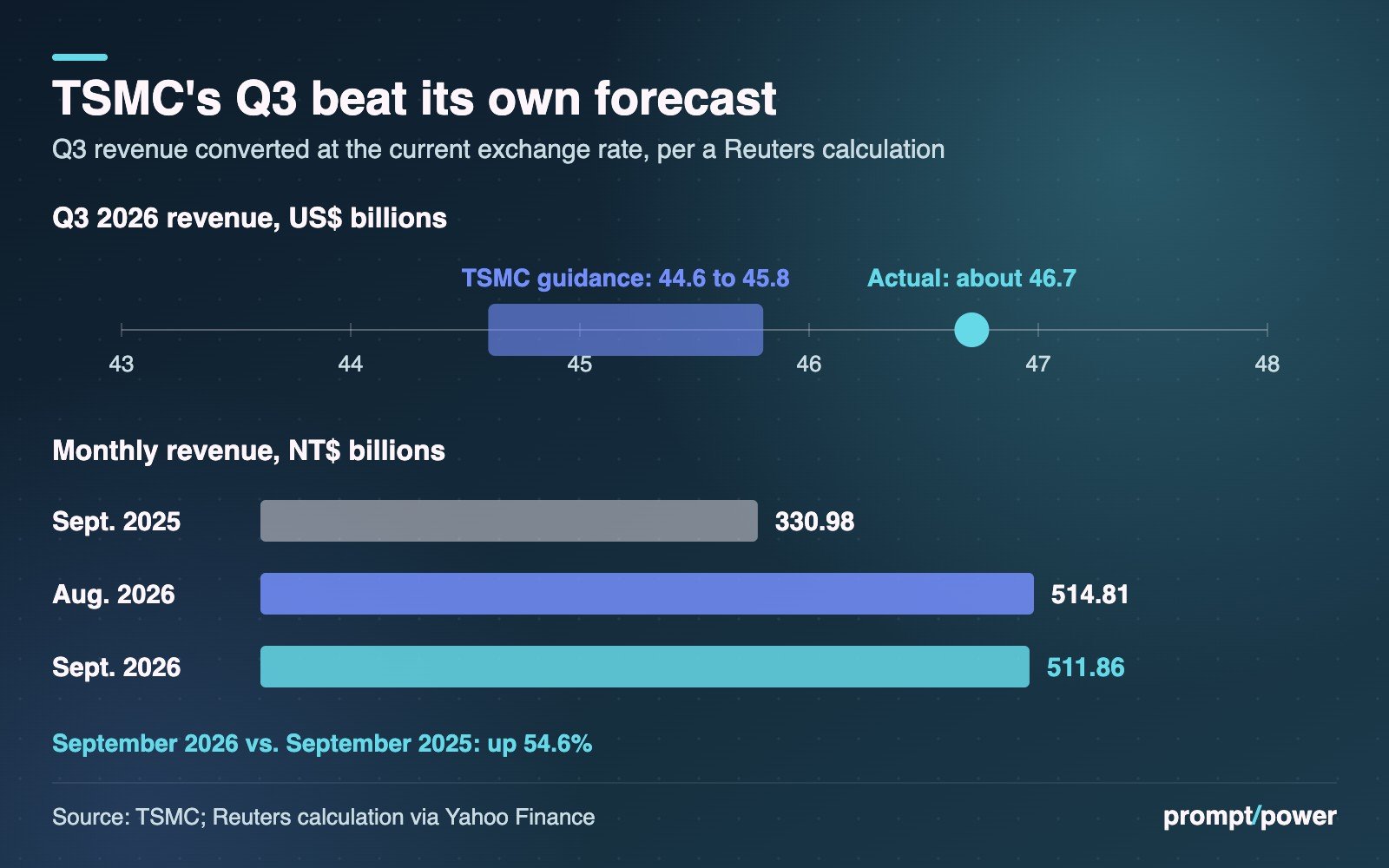
TSMC sold NT$511.86 billion worth of chips in September. That is 54.6% more than a year earlier, and it is the last piece of a quarter that came in above the company’s own forecast. The world’s largest contract chipmaker posted the figure on Oct. 8, along with a nine-month total of NT$3.90 trillion, up 41.1%.
Revenue reports from Taiwan don’t usually travel far. This one matters because it lands a week before the two earnings reports that set the tone for the AI chip trade every quarter: ASML on Oct. 14 and TSMC itself on Oct. 15. Here is what the September number does and does not tell you, and what to look for in each report.
What ‘beat’ means in TSMC’s Q3 numbers
TSMC publishes revenue monthly, so its quarterly sales are known before its earnings. Add July, August and September and Q3 comes to a record of about NT$1.49 trillion, up roughly 50% from a year earlier, by a Reuters calculation reported in a BeInCrypto story syndicated on Yahoo Finance. At the current exchange rate that is about US$46.71 billion (about CA$64.9 billion).
There are two bars that number cleared:
- TSMC’s own guidance. In July the company forecast Q3 revenue of US$44.6 billion to US$45.8 billion. The quarter landed about US$0.9 billion above the top of that range.
- Analysts’ estimates. The LSEG SmartEstimate, drawn from 19 analysts, was NT$1.46 trillion. Actual revenue beat it by about NT$30 billion, or roughly 2%.
Two percent is not a blowout, and the currency matters. TSMC guides in U.S. dollars but reports in New Taiwan dollars, so a move in the exchange rate can widen or narrow the apparent beat without a single extra wafer shipped. The cleaner signal is in the monthly table. TSMC’s September report shows revenue of NT$514.81 billion in August and NT$511.86 billion in September, a dip of 0.6%. Demand held at a record level for two straight months rather than accelerating.
Investors were braced for something. TSMC’s Taiwan-listed shares closed 1.35% lower at NT$2,550 on Oct. 8, before the figures came out, still up about 61% this year, according to the same report. The U.S.-listed shares closed at US$472.20 (about CA$656) on Oct. 7. Taiwan’s market was shut for the National Day holiday after the release and reopens on Oct. 12, so Monday is the first chance for local investors to react.
Why ASML and TSMC earnings set the mood for AI chips
Almost every advanced AI chip, whether it carries an Nvidia, AMD, Google or Apple logo, is manufactured by TSMC. Almost every leading-edge chip factory, TSMC’s included, depends on extreme ultraviolet lithography machines that only ASML, a Dutch company, makes. One sells the chips. The other sells the machines that make the chips.
That makes the pair a readout at two different points in time. TSMC’s results describe demand today, because they reflect wafers already shipped. ASML’s describe what chipmakers expect years out, because nobody buys a lithography machine for next month. When both point the same way, the market tends to believe it. When they diverge, that’s the story.
The two companies are also tied more closely than usual right now. On Sept. 8 they announced a joint initiative to move the industry to large-format photomasks for High NA EUV, ASML’s newest generation of machines.
ASML earnings on Oct. 14: what to watch
ASML is expected to report third-quarter results on Wednesday, Oct. 14, before U.S. markets open, according to MarketBeat. Its consensus, compiled from analysts who cover the U.S.-listed shares, is earnings of US$12.07 per share on revenue of about US$13.16 billion (about CA$18.3 billion). ASML reports in euros, so expect translation differences between headlines.
Three things to watch:
- Revenue against that US$13.16 billion line. A beat or miss of a few percent will move the stock. It says less about AI than what follows.
- The outlook for next year. Management’s comments on 2027 demand are the closest thing the industry has to an advance order book.
- High NA EUV. Any update on how quickly customers are adopting the newest machines, given the photomask work with TSMC.
TSMC earnings on Oct. 15: the numbers that matter
TSMC holds its earnings conference on Thursday, Oct. 15, from 2 p.m. to 3:30 p.m. Taipei time, according to its investor calendar. That is 2 a.m. to 3:30 a.m. in Toronto, so the numbers will be out before North American markets open.
Revenue is already known. The questions are about profit and the future:
- Net profit. Analysts expect it to rise 64% to NT$740.8 billion, per the LSEG SmartEstimate. For comparison, Q2 net income rose 77.4% to NT$706.56 billion.
- The full-year forecast. TSMC has said 2026 revenue will grow slightly above 40%. Nine-month revenue is already up 41.1%, so watch whether that guidance moves.
- Fourth-quarter guidance and any change to spending plans, which feed straight back into ASML’s order outlook.
One more piece of context arrived on Oct. 8. GlobalFoundries signed a five-year deal to make silicon interposers for TSMC at its fab in Malta, New York, with production expected to ramp in the first half of 2028, Reuters reported, as summarised by Tech Startups. Interposers are the layer that sits under a processor and its stacked high-bandwidth memory in advanced packaging. TSMC paying a rival to make some of them is a sign that packaging, not just chipmaking, is where capacity is tight. No value was disclosed.
What it means for Canadian investors
Most Canadians who own TSMC or ASML don’t know it. Both trade in New York as well as at home, and they are among the largest chip companies in the world, so global equity and technology ETFs tend to hold them. We could not verify specific Canadian fund or pension holdings for this story, so here is how to check your own: open your ETF provider’s fund page and read the top holdings list. If TSMC or ASML is near the top, these two reports will show up in your balance next week.
The other place you feel this is at the checkout. Chip and memory costs have already pushed up the price of phones and laptops in Canada, as we covered in our buyer’s guide and in Samsung’s record Q3. A strong TSMC quarter means that demand for AI hardware is still pulling capacity away from everything else.
The number to carry into Oct. 15 is NT$740.8 billion, the profit analysts expect TSMC to book in a single quarter. In September 2025, the company’s entire monthly revenue was NT$330.98 billion.
Researched and drafted with AI tools, fact-checked against primary sources and approved by a human editor before publishing. Prices and dates are as of publication. Our standards →
Sources- pr.tsmc.com — posted the figure on Oct. 8
- finance.yahoo.com — BeInCrypto story syndicated on Yahoo Finance
- pr.tsmc.com — TSMC's September report
- pr.tsmc.com — a joint initiative
- marketbeat.com — MarketBeat
- investor.tsmc.com — investor calendar

Andrew Lovesey is the editor-in-chief of prompt/power and the founder of Loveseyland, a Toronto studio that builds worlds and the companies inside them. Before that he spent 12 years at Canadian Geographic and the Royal Canadian Geographical Society, finishing as Director of Digital and Video, and later led the digital practice at Navigator. He is a Fellow of the RCGS and received its Quest Medal for his part in the expedition that located the wreck of Shackleton's Quest. At prompt/power he covers Apple and writes the big-picture analysis. He has helped find a ship lost for more than a century, and still can't reliably find a phone charger that works. He is also Editor-in-Chief of Not An Atlas and The Remote.
All stories by Andrew →Keep reading




Latest from prompt/power
- How to turn off AI features on your iPhone, Android phone, Windows PC and in Google and Meta appsNov 26
- TSMC’s US$165-billion Arizona plan: what’s running and what’s still promisedNov 26
- The WHO’s 40-plus rules for AI in health care, and why they matter nowNov 26
- Can you return a tech gift? Your rights in Canada, the U.S. and the U.K. are not the sameNov 26
- When will Anthropic join the Nasdaq-100 and the S&P 500? The rules, and ANT’s datesNov 25
[…] ASML is the only company that sells the extreme ultraviolet (EUV) lithography machines needed to print the most advanced chips, including the AI accelerators TSMC makes for Nvidia, AMD and Google. When ASML says it can’t build enough of them, it is putting a ceiling on how fast the AI chip supply can grow. We laid out why the two companies move together in our ASML and TSMC earnings preview. […]
[…] customers. Google and Amazon already run their own chips, and OpenAI has built one with Broadcom. Demand for Nvidia hardware is not shrinking, but its biggest buyers are building somewhere else to put the next workload. For background on why […]