
SpaceX Wants US$40B in Debt for Nvidia Chips, and Its Credit Is Flinching
Nvidia closed at a record US$239.24 a share on Oct. 6, a market value of roughly US$5.77 trillion (about CA$8 trillion) by Nasdaq’s count. That evening, the Financial Times reported that its biggest single-company fan wants to borrow to keep buying. SpaceX, the Elon Musk company that absorbed xAI in February and listed on Nasdaq in June, is seeking about US$40 billion (about CA$56 billion) in financing led by Apollo Global Management, mainly to pay for Nvidia AI chips.
The stock market shrugged. The credit market did not.
What the SpaceX Nvidia chip financing looks like
According to the FT, as relayed by Benzinga, the package would combine roughly US$10 billion (about CA$14 billion) in bank loans with about US$30 billion (about CA$42 billion) in investment-grade debt. Apollo is expected to lead and help place the bonds with a broad range of investors, and bond giant Pimco is among a small group of lenders in talks. The FT says the deal is expected to close in 2027.
On Oct. 7, Reuters confirmed the size and split through two sources, one of whom said SpaceX is talking to Pimco directly. Apollo and Pimco declined to comment to Reuters; SpaceX and Nvidia did not respond. Bloomberg, which followed the FT the same day, described the talks as early-stage and said they could still fall apart, so treat the number as a reported plan rather than a signed deal.
Where the chips go is not a mystery. Musk said in August that SpaceX would build its data centres on Nvidia hardware exclusively, and in September that the Colossus 2 site in Memphis could more than double its Nvidia chip count by December. Those machines also earn rent: CFO Bret Johnsen said last month the company believes it is on track for US$100 billion (about CA$139 billion) in annual recurring revenue, according to Yahoo Finance.
Nvidia’s record came before the news
One correction to the way this story has been passed around. Nvidia’s record was not a reaction to the SpaceX report. The record close came during regular trading on Oct. 6, and wire coverage of the FT scoop spread that night. The report itself moved Nvidia about 0.5 per cent, after hours on Oct. 6 and again in early trading on Oct. 7, per The Next Web and Reuters. Calcalist Tech put the record valuation at US$5.65 trillion, a little below Nasdaq’s share-count math; either way, the shares are up about 27 per cent this year, according to Quartz.
SpaceX shares fell about 2 per cent in early trading on Oct. 7, to around US$168. Small move. The bigger signal was a few floors down the capital structure.
SpaceX’s credit market is already flinching
The cost of insuring SpaceX debt against default hit a record on Oct. 7. The five-year credit default swap spread reached 194 basis points, up from about 110 when the contracts started trading in June, the FT reported, according to Benzinga. In plain terms, protecting US$1 million of SpaceX bonds now costs about US$19,400 (about CA$27,000) a year. Reuters Breakingviews noted, per the same report, that the company carries a BBB rating, the lowest rung of investment grade, and that wider spreads signal more perceived risk rather than any imminent default.
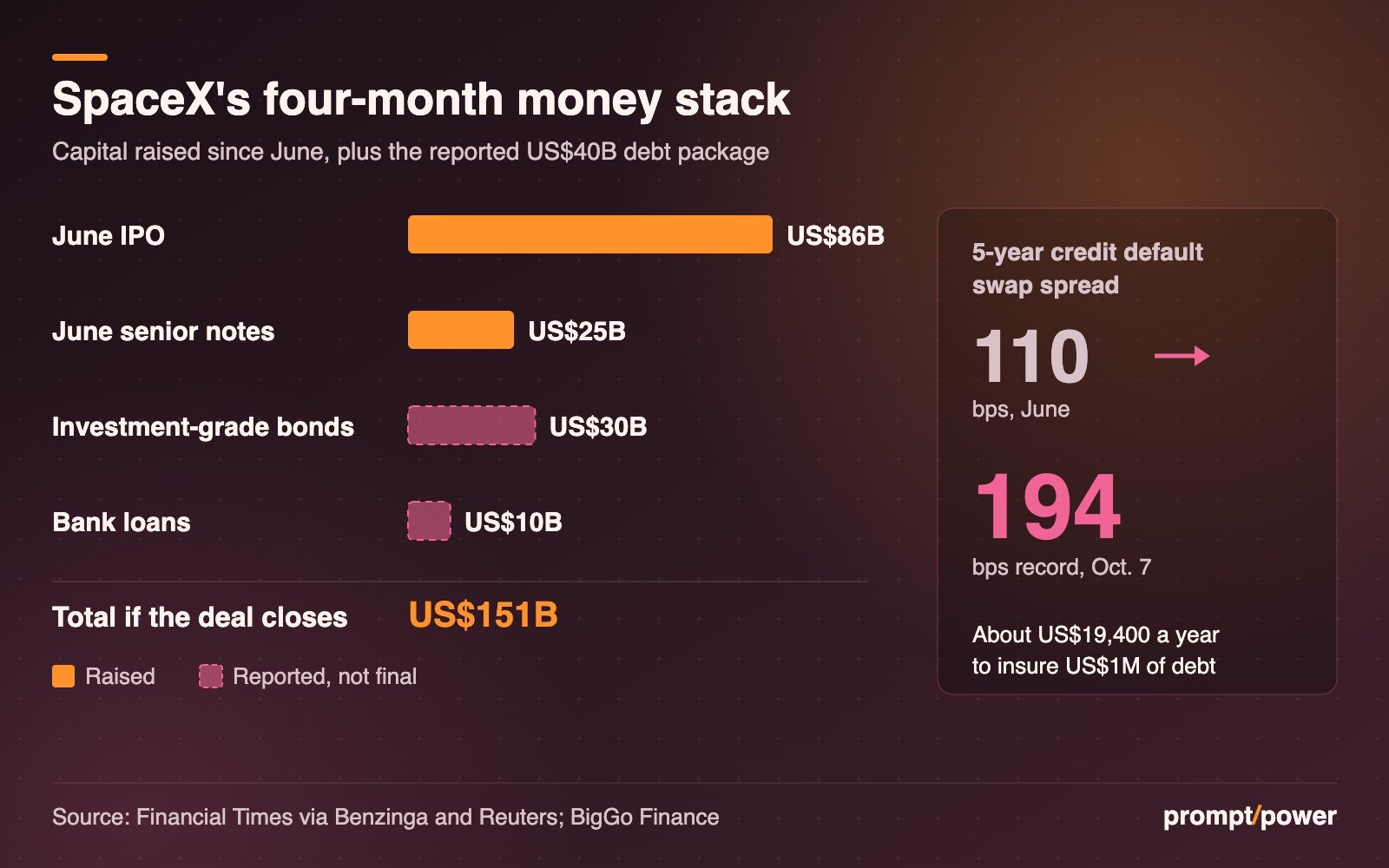
The worry is pace. SpaceX raised about US$86 billion (about CA$120 billion) in its June IPO, then sold US$25 billion (about CA$35 billion) of senior notes later that month with coupons from 5.35 to 6.65 per cent. Benzinga reports its debt rose from US$22 billion at the end of 2025 to US$38.4 billion by June 30. Add the new package and SpaceX would have raised more than US$150 billion in about four months, BigGo Finance calculated.
Morgan Stanley’s Adam Jonas, who calls the stock cheap, had already flagged in a late-August note that SpaceX might need to issue about US$80 billion in debt a year through 2035. He also described asking a room of 40 clients who owned the shares: “not a single hand went up,” he wrote, as quoted by Benzinga. (For how SpaceX’s stock run reshaped Musk’s own fortune, see our earlier piece on the Morgan Stanley trillionaire math.)
Lambda’s US$4 billion round and the Anthropic backlog
SpaceX was not the only Nvidia customer shopping for capital on Oct. 6. Lambda, the Nvidia-backed GPU cloud, is raising up to US$4 billion (about CA$5.6 billion) at a US$14.5 billion (about CA$20 billion) pre-money valuation, led by Blackstone and Coatue, the Wall Street Journal reported, according to Stocktwits. A letter to investors described it as the last private round before an IPO targeted for 2027.
The pitch rests on backlog: US$15 billion in June, US$50 billion in September. Most of that jump is a roughly US$35 billion (about CA$49 billion) cloud agreement with Anthropic, first reported by the WSJ on Aug. 31 and confirmed to Reuters by a person familiar with it. Neither company has announced it. The capacity sits in a Hut 8 data centre in Nueces County, Texas, where Lambda holds the lease and deploys Nvidia chips while Nvidia separately secured the capacity from Hut 8. Nvidia is also a Lambda investor. That puts it at three points in a transaction it is not formally party to, as The Next Web put it. The deal reportedly runs six years and covers about 350 megawatts, Tech Funding News reported, citing Bisnow.
Why AI data centre debt is the real story
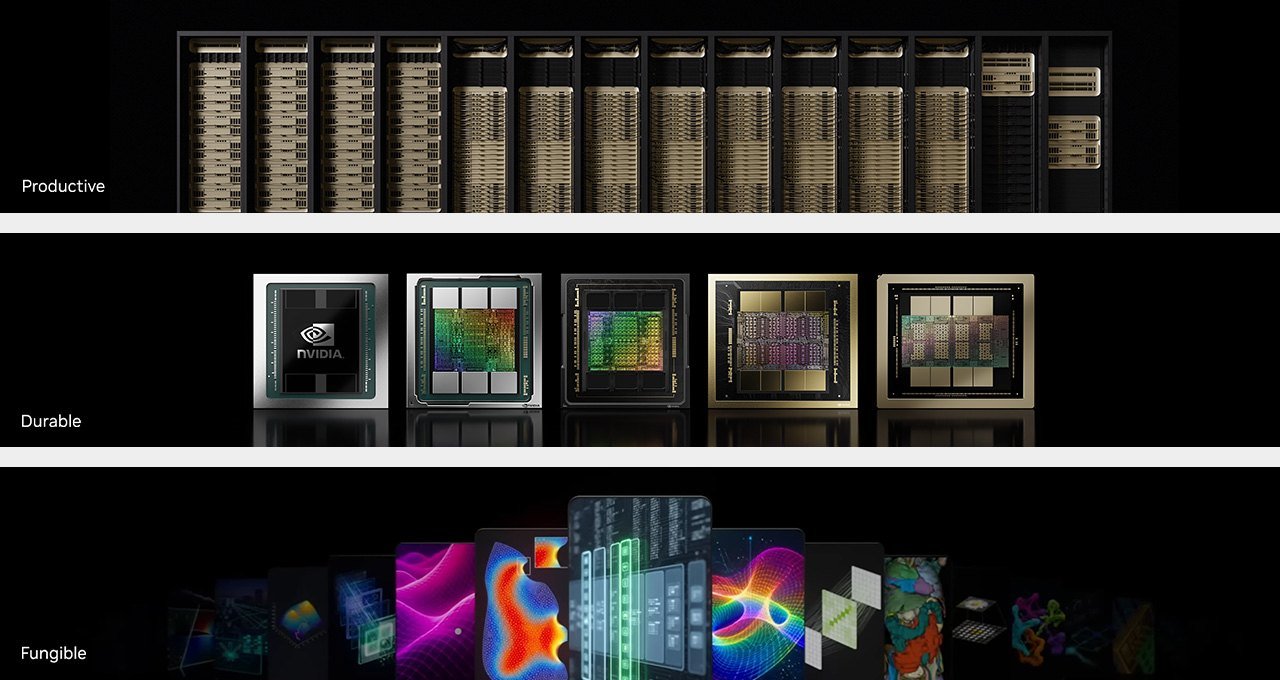
Nvidia saw this coming, and built a door for it. On Aug. 10 it announced partnerships with Apollo, BlackRock, Blackstone, Brookfield, Goldman Sachs and KKR to mobilize more than US$500 billion (about CA$695 billion) of third-party capital for its customers’ build-outs. Goldman CEO David Solomon described the goal in that release as creating “a market for credit backed by NVIDIA compute.” The SpaceX deal, with Apollo in the lead, looks like an early product of that pipe.
“In AI, compute is revenue.” Jensen Huang, Nvidia founder and CEO, Aug. 10
Our read: that sentence is the whole credit thesis. Lenders are being asked to treat GPUs as income-producing assets, like aircraft or cell towers. Nvidia’s own blog made the case on Oct. 1, arguing that “every major operator has extended the depreciation schedule on its servers” and estimating five to six years of useful life for an eight-GPU H100 system. If that holds, the debt is serviceable. If the chips age faster, the collateral shrinks before the loans do.
The scale is no longer small. Morgan Stanley strategist Vishwas Patkar said in August 2025 that the bank had identified a US$1.5 trillion (about CA$2.1 trillion) financing gap that “has to be met by external capital” over four years, with about US$800 billion expected from private credit. Amazon, Microsoft, Alphabet, Meta and Oracle sold about US$200 billion of investment-grade bonds in the first half of 2026 alone, nearly double their 2025 total, according to iShares data cited by Benzinga.
What it means for you
If you hold a Canadian bond fund, a pension or a balanced ETF, some of this paper will likely end up in it; investment-grade debt is exactly what those products buy. Check your fund’s top holdings for the issuers above. If you own Nvidia directly, the stock’s next leg depends partly on how cheaply its customers can keep borrowing, which is a question about credit spreads as much as about chips.
Watch SpaceX’s five-year swap. It started trading at 110 in June. On Oct. 7 it was 194.

Jeff Cameron writes about the business and policy side of AI for prompt/power. A chief operating officer by trade, he also writes for Not An Atlas.
Keep reading

Canada’s Instant-Payment Rail Is Coming. Big Six Banks Might Not Be on It

Uber and Pony.ai Robotaxis Head for London Tests. Here’s What’s Approved

Manus Raises More Than US$500 Million After China Blocked Meta’s Deal

Microsoft’s H-1B Green Card Freeze Puts Canada’s Promise to the Test
Latest from prompt/power
- Cohere Opens an Ottawa Office as Its AI Agents Head to Navy ShipsOct 11
- Beijing Warns Officials Off ‘Blind Investment’ in AI and High TechOct 11
- TSMC Q3 Revenue Beat Its Forecast: What to Watch in ASML and TSMC EarningsOct 11
- China Gave AI Influencer Yuri an Official ID. What It Unlocks for CreatorsOct 11
- Double Counter Discord Breach: What to Do If Your IP Address LeakedOct 11
Leave a Reply