San Francisco and Oakland Pause New Data Centres in AI’s Hometown
Both councils passed 45-day moratoriums on Oct. 6, freezing a Bayview expansion and a proposed Dogpatch site. Ontario towns did it first, and Quebec is fighting over power rates.

The parcel at 1215 Michigan St. sits on San Francisco’s central waterfront in Dogpatch. On Aug. 31, a lobbyist for private equity firm Nestory Park Capital met two of Mayor Daniel Lurie’s policy chiefs about permits there, the San Francisco Standard reported. Two weeks after that meeting, Supervisor Shamann Walton introduced a moratorium.
Updated Oct. 19, 2026: Mayor Daniel Lurie signed San Francisco’s 45-day data centre moratorium on Oct. 16, the San Francisco Standard reported, and the city’s legislative digest confirms it bars any approvals for new data centres or for expanding existing ones. Oakland’s version took effect on adoption on Oct. 6.
On Oct. 6 the Board of Supervisors passed it unanimously: a 45-day halt on permits for new data centres, and for expanding existing ones, in the city where OpenAI and Anthropic keep their headquarters. Across the bay that same night, Oakland’s City Council voted 7-0 for a 45-day pause of its own.
The AI industry has been fighting zoning boards in exurbs and farm towns for two years. Now it has lost a vote at home.
What San Francisco’s data centre moratorium stops
Walton, who represents District 10 (Bayview-Hunters Point through Potrero Hill and Dogpatch), wrote the measure with co-sponsors Connie Chan, Jackie Fielder and Chyanne Chen, according to SFist. He told colleagues the pause is for “energy, water, air quality, land use, and community impacts,” per the Standard. Planning staff will report back at a hearing.
Two projects are directly in the way. NOVVA’s campus at 400 Paul Ave. in Bayview switched on its first 9 megawatts this summer and planned to reach 36 megawatts by 2028, Mission Local reported; that expansion is now paused. At 1215 Michigan St., permits have been filed for a 160,000-square-foot data centre, but construction has not started.
San Francisco does not know how many data centres it already has; a Planning Department spokesperson told the Standard in September that it doesn’t keep count, and private tracker Data Center Map lists at least six sites. The city still files them under “internet service exchange,” a land-use category dating to about 2001, so the ordinance borrows its definition from U.S. Sen. Alex Padilla’s federal legislation.
“We do not track the number of data centers in San Francisco.” (Patrick Hannan, San Francisco Planning Department)
The 45 days are a floor, not a ceiling. If the Planning Commission finds significant impacts, the pause can be stretched by up to 22 months and 15 days, according to Mission Local. Reports split on timing: Bay City News and Mission Local said the urgency ordinance took effect immediately, while the Standard reported it takes effect in 10 days unless Lurie returns it sooner or vetoes it. Lurie signed it on Oct. 16.
Oakland, Richmond and a Bay Area domino run
Oakland’s version came from Councilmember Carroll Fife, who has criticised developers for using non-disclosure agreements to keep project details from city officials. The vote followed scrutiny of a Behring Companies plan to put a data centre on the ground floor of a downtown building near 20th and Franklin streets, KTVU reported. “This is a moment to have the public weigh in,” Mayor Barbara Lee said. Fife has scheduled a community meeting for Oct. 24 at Beth Eden Baptist Church in West Oakland.
Neither city was first. Richmond became the third Bay Area city to pause new data centres in mid-September, after Oakley and Gilroy. Hayward’s council voted 7-0 on Sept. 15 to direct staff to begin the process of prohibiting future approvals and planned to revisit the question in October. Santa Clara, home to 56 data centres, is starting a year-long impact review; its municipal utility stopped accepting new data centre applications in 2023.
Raleigh’s council approved a six-month pause on certain large data centres the same evening, 7-1.
Our read: very little of the industry’s compute actually runs in San Francisco, so the moratorium is more signal than supply shock. The signal matters. The city that sells the AI boom to the world just decided it wants to see the bill first.
Ontario got there first; Quebec is fighting over rates
Canadians have seen this play. Oakville passed Ontario’s first data centre pause in August, an interim control bylaw that runs one year and can be extended to two under the Planning Act. It had no application in hand. “A data centre could happen anywhere in Town. There is no application before us,” Mayor Rob Burton said.
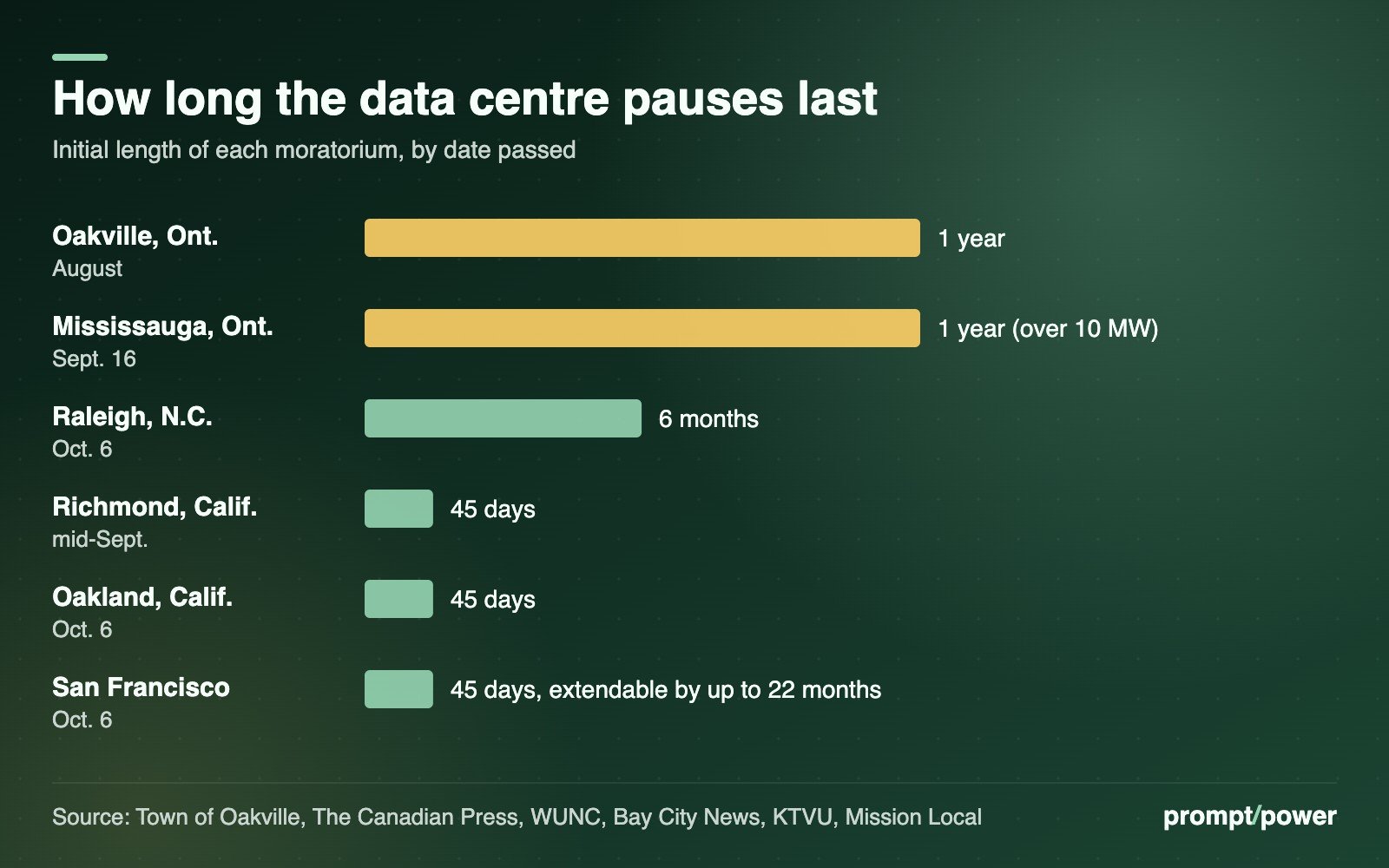
Mississauga followed on Sept. 16 with a unanimous one-year freeze on projects drawing more than 10 megawatts, leaving a 40-megawatt Prologis proposal in limbo, The Canadian Press reported. “It’s kind of a Wild West,” said Councillor Martin Reid, who moved it. Hamilton, Burlington and Milton rejected moratoriums but ordered studies, while Toronto and Ottawa have told staff to review their rules, according to a CP tally.
Quebec’s fight is about price rather than zoning. At a Régie de l’énergie hearing, Hydro-Québec is asking for a new rate for data centres over 5 megawatts that would lift their average from about 6.82 cents per kilowatt-hour to about 13 cents, La Presse Canadienne reported. Google asked the regulator to reject it. The first phase of hearings ran through Oct. 9, with a second scheduled for December.
What’s happened since: Lurie signs, and the clocks start
Mayor Daniel Lurie signed San Francisco’s moratorium on Oct. 16, the San Francisco Standard reported, settling the question of when it took effect. Lurie’s statement spoke of building a framework that keeps “electricity rates low” without naming data centres. The Planning Department now has to study the impacts and draft permanent controls.
The city’s legislative digest for File No. 261021 spells out what is frozen. The urgency ordinance bars the city from issuing “any approvals or authorizations” for data centres, defined as a facility or part of one that houses computing infrastructure, “including graphics and central processing units,” mainly to process, store or distribute data. Two things are exempt: accessory uses to other permitted uses, and repair or maintenance of existing data centres that “does not increase the size or capacity” of the site. That second carve-out is why NOVVA’s Bayview campus can keep running its first 9 megawatts but not grow.
Oakland’s measure, File 27-0050 from Councilmember Carroll Fife, is listed as passed on Oct. 6 and was written “to take effect immediately upon adoption.” It covers land-use entitlements and agreements for building or operating data centres.
Our math: 45 days from those start dates puts Oakland’s pause near Nov. 20 and San Francisco’s near the end of November. Each city would need an extension vote under California Government Code Section 65858 to keep it going.
What it means for you
If you live near a proposed site in the GTA, note the Bay Area pattern: residents moved faster than permits did. Planning studies are under way across Ontario, and council meetings are where the energy and water numbers go on the record. We have laid out the six numbers that matter on AI electricity use before, and London’s Charlton data centre fight shows what happens when homes and server halls compete for the same land.
Walton terms out in January. All three frontrunners to replace him support a data centre moratorium, and 1215 Michigan St. is still an empty lot with a permit file.
Researched and drafted with AI tools, fact-checked against primary sources and approved by a human editor before publishing. Prices and dates are as of publication. Our standards →
Sources- sfstandard.com — the San Francisco Standard reported
- sfstandard.com — the San Francisco Standard reported
- sfgov.legistar.com — city's legislative digest
- oakland.legistar.com — took effect on adoption
- sfstandard.com — passed it unanimously
- ktvu.com — voted 7-0

Andrew Lovesey is the editor-in-chief of prompt/power and the founder of Loveseyland, a Toronto studio that builds worlds and the companies inside them. Before that he spent 12 years at Canadian Geographic and the Royal Canadian Geographical Society, finishing as Director of Digital and Video, and later led the digital practice at Navigator. He is a Fellow of the RCGS and received its Quest Medal for his part in the expedition that located the wreck of Shackleton's Quest. At prompt/power he covers Apple and writes the big-picture analysis. He has helped find a ship lost for more than a century, and still can't reliably find a phone charger that works. He is also Editor-in-Chief of Not An Atlas and The Remote.
All stories by Andrew →Keep reading




Latest from prompt/power
- How to turn off AI features on your iPhone, Android phone, Windows PC and in Google and Meta appsNov 26
- TSMC’s US$165-billion Arizona plan: what’s running and what’s still promisedNov 26
- The WHO’s 40-plus rules for AI in health care, and why they matter nowNov 26
- Celestica and Nvidia now share the lead in AI network switches as Ethernet sales more than double, Dell’Oro saysNov 26
- Can you return a tech gift? Your rights in Canada, the U.S. and the U.K. are not the sameNov 26
[…] from prompt/power: San Francisco and Oakland pause new data centres · Hydro-Québec wants data centres to pay double · AI’s electricity bill in six […]
[…] cleanest-looking power can be the thirstiest. Siting fights are where that lands locally, from the San Francisco and Oakland pause on new data centres to Greenwich’s objection to a Charlton site. More in our climate […]
[…] on how AI’s power demand is counted, see our six numbers on AI electricity use, our report on data-centre moratoriums in the Bay Area, and the climate […]