
Hydro-Québec Wants Data Centres to Pay Double. Bell Turns to Gas
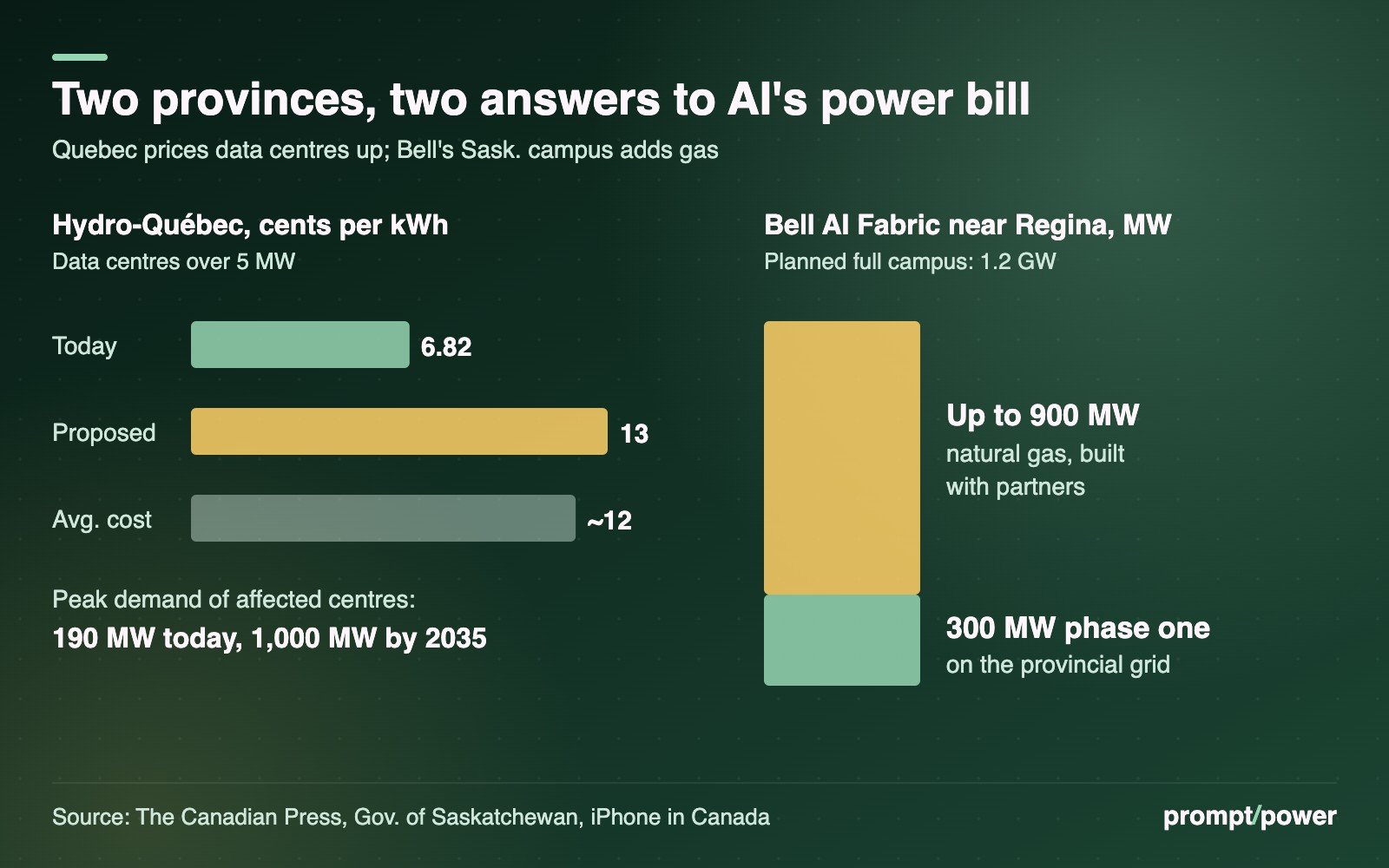
Data centres in Quebec pay Hydro-Québec an average of 6.82 cents a kilowatt-hour, by the utility’s own calculation. Hydro-Québec wants the big ones to pay an average of 13 cents. The first part of the hearing on that request before the Régie de l’énergie, Quebec’s energy regulator, wrapped up on Oct. 9, and Google is among those opposing it, The Canadian Press reported.
Three provinces west, Bell is asking a rural council near Regina to let it grow the footprint of its AI data centre campus more than sixfold. Most of the extra power would come from natural gas. Put the two side by side and you get Canada’s sovereign-AI build-out with two very different power bills attached.
Hydro-Québec data centre rate: what’s proposed
The new rate would apply to data centres needing more than five megawatts. Those centres draw 190 megawatts at peak today, and Hydro-Québec projects that could reach 1,000 megawatts by 2035, according to the Oct. 1 report. The utility’s average cost of energy is around 12 cents a kilowatt-hour and rising, so today’s data-centre price sits well below it.
Sarah Trabelsi, Hydro-Québec’s chief of costs and pricing, put the utility’s case bluntly at the hearing: “the era of energy surpluses is now behind us.” Hydro-Québec says it does not want to keep selling power to data centres at a discount that leaves other customers paying more.
On Oct. 8, consultants from Dunsky, hired by Hydro-Québec, testified that data-centre demand will more than double between 2024 and 2030, The Canadian Press reported. Analyst Alexis Renaud-Bezot said other jurisdictions had raised data-centre rates to limit the impact on residential customers.
Google, other tech companies, the Canadian Federation of Independent Business and an environmental coalition including Greenpeace and Nature Québec have all taken part. Google’s specific arguments have not been reported in detail. Energy analyst Jean-François Blain said, per CP, that the cheap rate “creates an exceptional draw that benefits Quebec, as long as they can supply those companies.” A second part of the hearing is planned for December, and the new Parti Québécois minority government elected on Oct. 5 inherits the fight.
Bell’s Regina AI campus and its gas plan
Bell AI Fabric’s 300-megawatt campus in the Rural Municipality of Sherwood is already under construction, with more than 500 people on site and the first data hall on track for the first half of 2027, the Saskatchewan government said on Oct. 1. Dynamo Electric is building the high-voltage substation that ties that first phase to the provincial grid. Total investment, including customer computing hardware and power generation, could exceed CA$50 billion if fully built, the province says, which would make it the largest capital investment in Saskatchewan’s history.
Now Bell wants room to grow. It has conditional deals for about 895 acres of farmland around its 160-acre site, which would take the campus to roughly 1,055 acres, iPhone in Canada reported, citing rezoning documents first reported by CBC News. Bell’s application calls for up to nine more buildings, built from 2027 through 2030 or later, for a full campus of 1.2 gigawatts, 980 CJME reported.
The power math is the climate story. Under a non-binding memorandum of understanding announced in September, Bell could add up to 900 megawatts on top of the original 300, using natural gas generation developed with partners rather than the provincial grid, according to iPhone in Canada. Bell’s application says the gas plant would be built “at a location further from Regina.” The province says Saskatchewan families won’t pay for that power, iPhone in Canada reported, though the “Bring Your Own Power” arrangement behind that promise had not been signed as of Sept. 19.
The RM’s council gave the rezoning and Official Community Plan bylaws first reading at a special virtual meeting on Oct. 7, iPhone in Canada reported. Deputy reeve Kevin Chekay is among the landowners and recused himself, Reeve Ray Orb confirmed. Still to come: a public hearing with no date set, approval from the Farm Land Security Board, a development agreement, a provincial environmental impact assessment and consultation with First Nations.
What it means: clean power costs more
Our read: Quebec is treating cheap hydro as a scarce public asset and pricing it up. Saskatchewan is letting the builder bring its own fossil generation for most of the load. Both approaches protect household bills. Only one adds emissions. Global data-centre demand is climbing fast, as the IEA’s latest figures show, and places from San Francisco to small-town Ontario are already pushing back on new sites.
The open question for Quebec is whether 13 cents still beats the competition. Blain thinks the new rate would bring Quebec closer to other jurisdictions, not past them. For Saskatchewan, the open question is a place name: the gas plant that would power three-quarters of Bell’s campus still has no announced site.

Jeff Cameron writes about the business and policy side of AI for prompt/power. A chief operating officer by trade, he also writes for Not An Atlas.
Keep reading




Latest from prompt/power
- Cohere Opens an Ottawa Office as Its AI Agents Head to Navy ShipsOct 11
- Beijing Warns Officials Off ‘Blind Investment’ in AI and High TechOct 11
- TSMC Q3 Revenue Beat Its Forecast: What to Watch in ASML and TSMC EarningsOct 11
- China Gave AI Influencer Yuri an Official ID. What It Unlocks for CreatorsOct 11
- Double Counter Discord Breach: What to Do If Your IP Address LeakedOct 11
Leave a Reply