
OpenAI’s Revenue Run Rate Is Near US$50 Billion, Not US$70 Billion
OpenAI has told investors its annualized revenue was “approaching $50 billion” at the end of September, TechCrunch reported on Oct. 8, citing the Financial Times. Nine days earlier, Axios had reported that the same company’s annual recurring revenue was nearing US$70 billion. The difference, about US$20 billion (roughly CA$28 billion), is larger than the roughly US$13 billion OpenAI brought in during all of 2025, according to leaked financials TechCrunch cited.
Markets noticed. The Nasdaq fell 1.25% on Oct. 8, its worst day since mid-August, SiliconANGLE reported. Oracle, which jumped on the Axios number, gave all of that back.
Nobody on the record is alleging OpenAI lost US$20 billion of sales. The gap comes from how the bigger number was built and who built it. That is less alarming than a revenue miss. It is also more awkward, because the inflated figure was the one that travelled.
OpenAI’s revenue run rate: the math behind US$50 billion
A run rate is a snapshot, not a year of sales. When Reuters matched the Axios scoop on Sept. 29, it noted that run-rate figures can be misleading because they often multiply a single month’s revenue by 12. On that logic, US$50 billion implies OpenAI is billing a little over US$4 billion a month (about CA$5.8 billion). US$70 billion would have meant close to US$5.8 billion.
The Axios report, by Madison Mills, cited people familiar with OpenAI’s finances. It said the run rate had risen more than 70% since the start of the third quarter, that business revenue had more than doubled over the same stretch, and that OpenAI’s consumer side added more revenue in the quarter than in all of 2025. Axios also said it could not learn details of the company’s expenses.
The FT’s figure came from what OpenAI told prospective investors, SiliconANGLE reported, and OpenAI still pointed them to strong growth: 77% in its annual revenue run rate during the third quarter and 107% in its enterprise run rate. Our arithmetic: if that 77% applies to the lower, net number, OpenAI started the quarter near US$28 billion and ended it near US$50 billion. That is still a very fast-growing company. It is not the one that was briefly priced into Oracle’s stock.
Gross vs. net: why the Anthropic comparison broke
The two companies count differently. TechCrunch puts it plainly: Anthropic counts sales made through its cloud partners, while OpenAI does not. Investopedia names the partners as Amazon and Google.
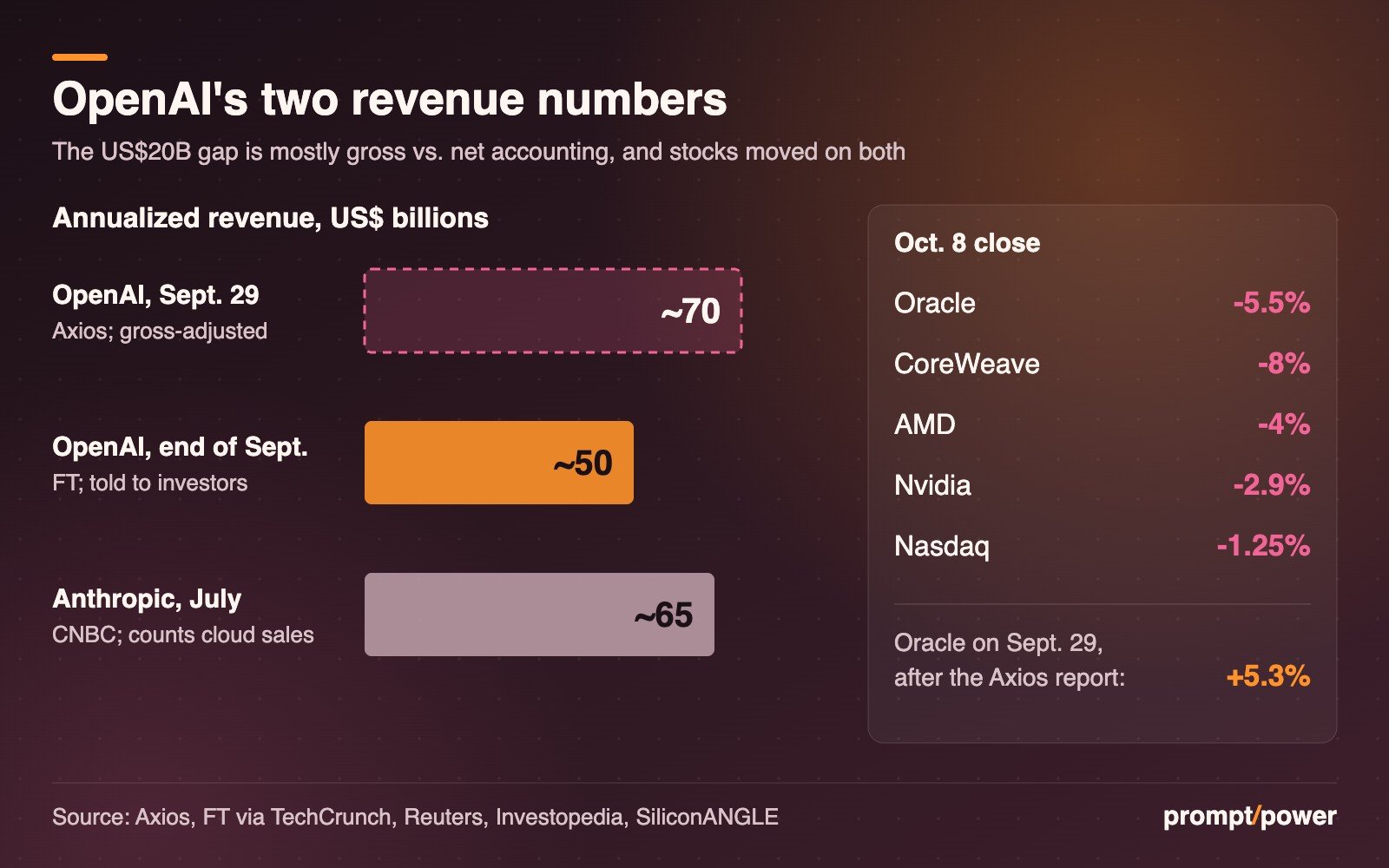
According to Benzinga’s account of the FT report, investors tried to fix that by adjusting OpenAI’s revenue upward so it would line up with Anthropic’s. Those adjustments produced reports of about US$40 billion in annualized revenue in August. Apply OpenAI’s later growth of more than 70% to that inflated base, and you land near US$70 billion. SiliconANGLE, citing an anonymous source, describes the same split: the higher figure included gross revenue from OpenAI’s partners, while the US$50 billion is net.
So the US$70 billion was not a forecast that missed. It was an investor-built, gross-equivalent number that got reported as OpenAI’s own. Futurum Equities chief market strategist Shay Boloor told Investopedia that the US$20 billion gap is the value of sales that flow through the platforms of AWS, Google and Microsoft Azure.
The comparison everyone wanted to make was with Anthropic, whose annualized revenue was reported at US$65 billion (about CA$90 billion) in July, TechCrunch noted, and which is reportedly expected to reach US$100 billion this year, per Investopedia. Our read: those figures are gross by design, OpenAI’s are net, and neither is an audited number. Any scoreboard that puts them side by side without saying so is comparing different things.
Oracle, CoreWeave and Nvidia took the hit
Oracle closed down 5.48% on Oct. 8 and Nvidia fell 2.94%, Investopedia reported, while the S&P 500 information technology sector dropped 1.8%, the worst of the index’s 11 sectors. CoreWeave lost 8%, and AMD and Broadcom each fell about 4%, according to SiliconANGLE. Investopedia quoted the FT calling it “a massive gap likely to damp optimism about the growth of AI demand.”
Oracle’s move is the clearest tell. On Sept. 29, the day of the Axios report, its shares rose 5.3%, Reuters reported, and D.A. Davidson analyst Gil Luria said OpenAI accounts for about half of Oracle’s compute backlog.
“OpenAI accelerating growth is a very good sign for Oracle.” Gil Luria, D.A. Davidson, to Reuters on Sept. 29
Nine days later, the same logic ran in reverse. When one customer is that much of a supplier’s order book, the customer’s revenue becomes the supplier’s collateral.
What it means for the 2027 IPO and the AI debt pile
OpenAI raised US$122 billion (about CA$170 billion) in a funding round in March, and its IPO, once expected in 2026, has been pushed to early 2027, TechCrunch noted. OpenAI declined to comment to the FT, per Benzinga, and did not respond to Investopedia before publication. The detail that the US$50 billion was shared with prospective investors suggests OpenAI is still raising, and that it chose the conservative number when it mattered.
Our read: the bigger exposure sits with the companies borrowing against AI demand rather than with OpenAI’s own valuation. On Oct. 9 we reported that SpaceX is lining up US$40 billion in debt to buy Nvidia hardware, and that the cost of insuring its debt hit a record. Lenders price those deals on forecasts of how much the big labs will spend. A US$20 billion swing in the most-quoted revenue figure in AI is the sort of thing credit desks notice.
Per-token prices are also falling. Anthropic’s Claude Haiku 5.5 launched at US$0.10 per million input tokens, a tenth of its predecessor’s price and level with OpenAI’s GPT-6 Luna. Cheaper tokens can mean more usage. They also mean each unit of usage brings in less, which makes the quality of the revenue number matter more, not less.
What it means for you
If you hold a U.S. tech index fund or ETF through an RRSP or TFSA, Oct. 8 showed how much of it now trades on reports about two private companies. A few questions to ask the next time a run-rate figure makes headlines:
- Gross or net? Does it include sales a cloud partner made and passed through?
- Which month? A run rate is usually one month times 12. A strong September does not make a year.
- Whose number? Did the company say it, or did investors build it from the company’s data?
OpenAI has not published a figure of its own. The one it gave investors at the end of September, by the FT’s account, begins with a 5.

Mira Okonkwo covers the business of technology for prompt/power: venture capital, startups, IPOs and earnings. She treats a valuation as a mood rather than a number until the S-1 says otherwise.
Keep reading

Arena, the Leaderboard That Ranks AI Models, Is Now Worth US$3.1 Billion

Canada’s Instant-Payment Rail Is Coming. Big Six Banks Might Not Be on It

Uber and Pony.ai Robotaxis Head for London Tests. Here’s What’s Approved

Manus Raises More Than US$500 Million After China Blocked Meta’s Deal
Latest from prompt/power
- Cohere Opens an Ottawa Office as Its AI Agents Head to Navy ShipsOct 11
- Beijing Warns Officials Off ‘Blind Investment’ in AI and High TechOct 11
- TSMC Q3 Revenue Beat Its Forecast: What to Watch in ASML and TSMC EarningsOct 11
- China Gave AI Influencer Yuri an Official ID. What It Unlocks for CreatorsOct 11
- Double Counter Discord Breach: What to Do If Your IP Address LeakedOct 11
Leave a Reply