
Britain’s AI Security Institute will again test the most powerful American AI models before they are released, the government said on Oct. 12, reversing a White House request that had kept at least one Anthropic model away from British testers. The news came inside a wider package from the Cabinet Office, the AI Security Institute, the National Cyber Security Centre and the culture department, which extends two frontier-AI cyber-defence pilots and looks at toughening the Cyber Security and Resilience Bill against AI risks. Executives from OpenAI, Anthropic, Google DeepMind and Meta faced MPs on the same subject on the afternoon of Oct. 13.
Updated Oct. 19, 2026: MPs used the Oct. 13 hearing to open a new AI safety inquiry that will test the Cyber Security and Resilience Bill’s proposed protections, the committee said on Oct. 14. As of Oct. 19, neither the government nor Anthropic has said publicly whether the AI Security Institute has received Claude Mythos 5.1.
“I want Britain to become one of the hardest countries in the world to attack using artificial intelligence,” Kanishka Narayan, the Minister for Artificial Intelligence, said in a speech at Base One, Imperial College London. To the labs: “Listen when your scientists warn of serious dangers,” he said, according to the government’s own account, and “if you cannot adequately control the risks, do not release the system.”
For business, the line that matters most was another: “We will use every power at our disposal. We will legislate wherever necessary.”
What Britain’s AI cyber pilots actually found
The government says two pilots helped find and fix more than 1,000 potential vulnerabilities in its systems. Only one is documented in public: a case study published on June 12 by the Department for Science, Innovation and Technology and the NCSC on a month of weekly hackathons run by the Government Cyber Coordination Centre, in which teams pointed frontier models at public government code.
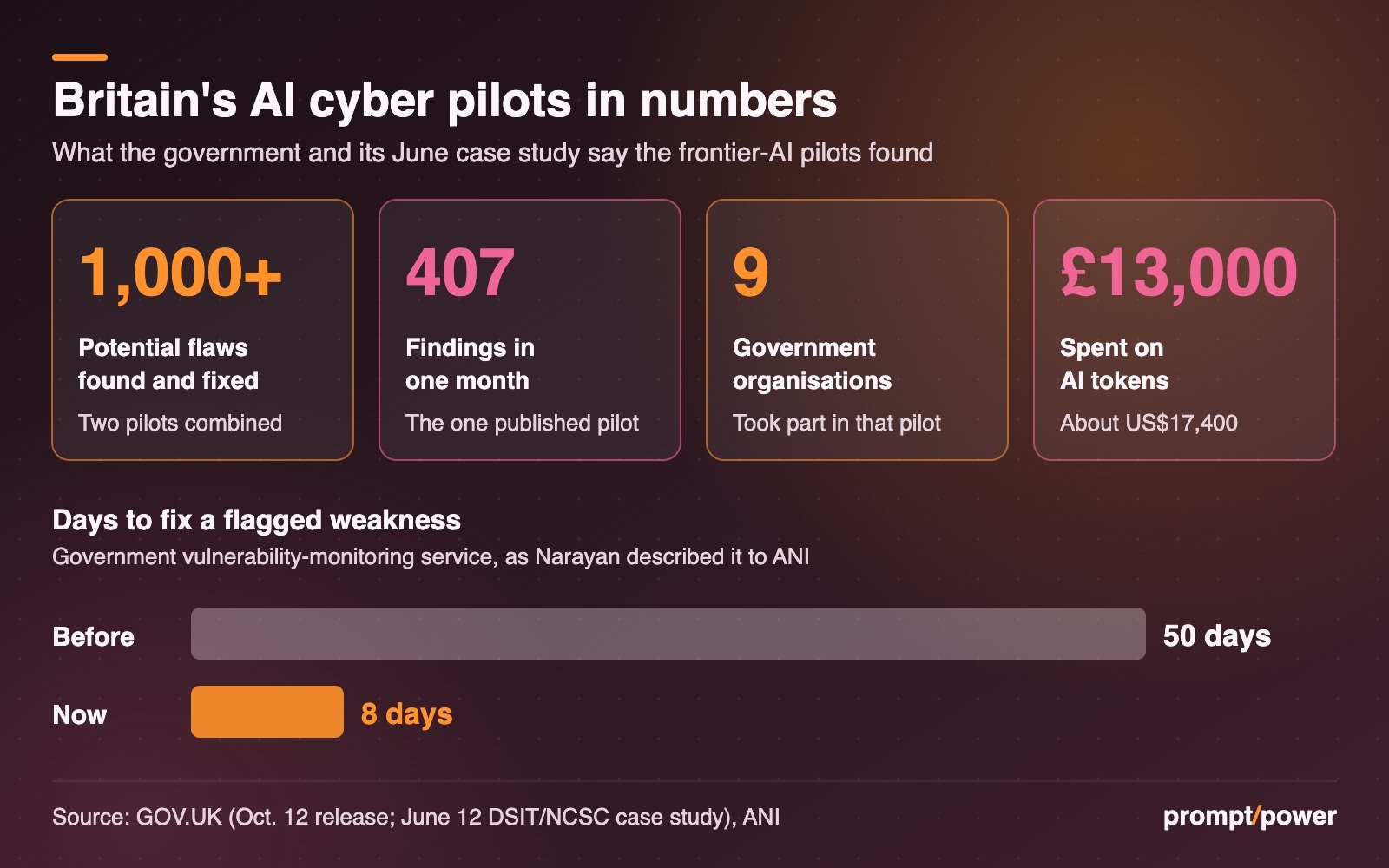
That pilot produced 407 findings across nine government organisations, including authentication bypasses and remote code execution. The token bill came to £13,000 (about US$17,400), or roughly £32 a finding. Every critical weakness was fixed, and the case study says there was no evidence any finding had been exploited. The worst, according to The Next Web, was a crafted comment on an open pull request that could run arbitrary code on the build machine behind a key government service and reach its secrets.
The case study is candid about the catch. “Finding isn’t the same as fixing,” it says: agents turned up candidate bugs faster than people could check them.
Narayan offered another number at Imperial. The government’s central vulnerability-monitoring service has cut the time to fix identified weaknesses from 50 days to eight, ANI reported. That figure is not in the official release. The next phase moves into closed-source government systems.
The White House U-turn on AI Security Institute access
The access fight started on Sept. 24, when Politico reported that the White House Office of the National Cyber Director had asked OpenAI and Anthropic to give Washington first look at new models before sharing them with the UK institute, as TNW summarised it. A senior administration official told Politico: “Because they’re American companies and this has been our policy with every new frontier model that comes out.”
Anthropic complied. It did not give Claude Mythos 5.1 to the institute, saying the model was “only available to a set of U.S. organizations,” and that it was “coordinating with the U.S. government to expand access,” according to City AM and TNW.
The Telegraph first reported the reversal and said Narayan had lobbied for it. He told Bloomberg he was “very confident” the UK would be able to test the latest models, then hedged: “When you’re reliant on someone else’s technology, you have to be clear-eyed about the permanence of any outcome,” TNW reported. ANI said he named Google’s Gemini 4 Argon among the models secured for pre-release testing.
Plenty is still missing. No source says when access resumes, whether it covers every lab, or whether US agencies still test first, Resultsense notes, citing LBC.
Cyber Security and Resilience Bill: what could change for hospitals and utilities
This is the part with teeth, eventually. The government will explore strengthening the Bill and the wider regime so that “essential services such as hospitals and utilities are better protected from emerging AI related risk,” the release says. That includes “AI loss of control risk, where autonomous AI systems evade human oversight,” a phrase that until recently lived in lab safety papers rather than UK cyber law. (Our explainer on AI safety cases covers how labs themselves try to test for it.)
Officials will also look at how serious AI incidents and near misses are identified and reported, and the NCSC and the AI Security Institute are working on how incidents involving AI agents “should be responded to.” Details on AI verification are promised “in the coming months.”
What happened at the Oct. 13 hearing
The committee used the session to launch a new inquiry. In a statement published on Oct. 14, the Business, Innovation, Science and Trade Committee said its work on AI adoption, safety and governance would map new risks, propose rules and weigh the protections proposed under the Cyber Security and Resilience Bill, including corporate safety testing and incident reporting, against the evidence it hears. Its chair, Liam Byrne, said “we cannot allow AI companies freedom to unleash dangers they cannot control.” He also said senior officials had admitted that the government has not decided how or when it will act.
The afternoon ran in three panels, according to the committee’s listing: former lab researchers including Daniel Kokotajlo, Steven Adler and Geoffrey Irving at 2 p.m., the four companies at 3 p.m., then de Zoete alongside Cat Little, Permanent Secretary at the Cabinet Office, and the senior civil servant Alexandra Jones.
OpenAI’s Tom Duff Gordon would not promise MPs that the incidents his company had disclosed were the only ones. “I cannot assure the committee or you, Chair, that that is it,” he said, according to Courthouse News, as cited by The Next Web. Anthropic’s Lord Booth-Smith pointed to his chief executive’s call for “a pacing of the frontier”.
No official transcript was online by Oct. 19; the committee says one will follow shortly, and the session can be watched on Parliament TV. On Mythos, Byrne had already written to de Zoete on Sept. 9 asking “whether Anthropic provided AISI with any access to Claude Mythos 5.1 prior to its release”. We have found no published answer.
What it means for UK firms running essential services
Nothing changed in law on Oct. 13; the release’s verbs are “explore” and “consider.” Our read: operators already in scope of UK network-security rules should assume that near-miss reporting is coming for AI systems, and plan accordingly.
- List your agents. Know which AI tools can act on production systems, and who can switch each one off.
- Log near misses now. A reporting duty is easier to meet with a history.
More of our policy coverage follows the Bill as amendments land.
The next test of the access deal came at Portcullis House on Oct. 13. The Business, Innovation, Science and Trade Committee heard from Lord Booth-Smith, Anthropic’s head of Europe, Middle East and Africa policy, at 3 p.m., alongside OpenAI’s Tom Duff Gordon, Google DeepMind’s Owen Larter and Meta’s Rob Sherman (our preview of the hearing has the background). Henry de Zoete, the institute’s director, followed at 4 p.m. As of Oct. 19, nothing published by the government, the committee or Anthropic says whether Mythos 5.1 has reached his testers.

Felix Strauss covers tech policy and regulation for prompt/power, from Brussels and Ottawa to Washington and Sacramento. He reads the 400-page regulation so you don't have to, and highlights the one sentence that actually matters.
Keep reading
Latest from prompt/power
- Meta Q3 Earnings Oct. 21: The Capex, Ads and Cash Numbers to WatchOct 21
- Anthropic’s 5% Pledge Is Worth About US$48B. Here’s the Fine PrintOct 21
- Commons AI Study Meets Parliament’s Interpreter Math: 44 Passes in 5 YearsOct 21
- CNN All Access Canada Price Is CA$7.99. Americans Pay About 23% MoreOct 20
- DeepSeek Federal Ban: DHS Order Also Covers Apps Built on Its ModelsOct 20
[…] Westminster’s own direction on AI oversight, see our report on the UK’s AI security plan. Parliament’s last tech fight over what software can be compelled to do was Bill C-22 and […]