
A Slack workspace run by the Centers for Medicare & Medicaid Services, with about 1,700 members and active since August 2025, has given tech vendors a standing line to senior Trump health officials on how apps get into Americans’ medical records, according to an investigation KFF Health News published Oct. 9 and CBS News republished. The chat room is also where a CMS adviser invited companies to a February FDA listening session on patient chatbots, with Microsoft, Anthropic, OpenAI, Apple and Google among the invitees. That session wasn’t on the FDA’s public calendar. CMS declined to tell KFF whether the workspace is legal, and we found no further public statement from CMS or HHS as of Oct. 12.
The reporting is KFF’s: Amanda Seitz, Maia Rosenfeld and Darius Tahir reviewed thousands of Slack messages, meeting transcripts and video recordings. One correction to how the story has travelled. Some write-ups have the AI labs lobbying inside the Slack. KFF doesn’t say that. It names the labs as invitees to the FDA session that was arranged through the Slack; the Slack participants it names are firms like Oura Health, Palantir and the venture firm 8VC.
What KFF Health News found in the CMS Slack
The workspace grew out of the Health Technology Ecosystem, which the administration launched at a White House event on July 30, 2025. More than 60 companies pledged to take part that day, and CMS named Amazon, Anthropic, Apple, Google and OpenAI among them. Amy Gleason, now chief product officer of CMS’s Office of Health Technology and Products and a former acting DOGE administrator, welcomed the first Slack members that August.
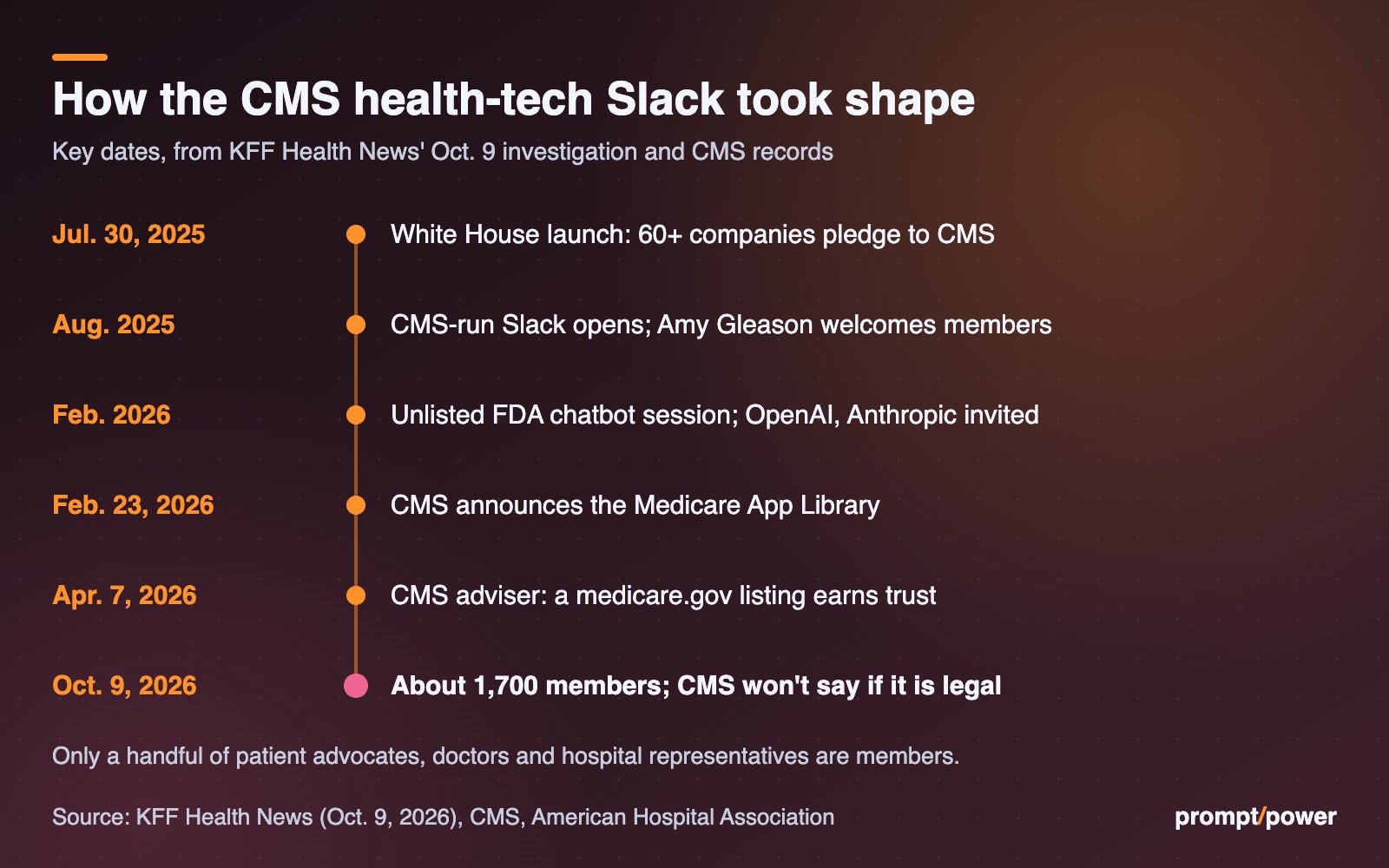
A year on, KFF reports, “only a handful of patient advocates, doctors, and hospital representatives are in it.”
Much of the traffic is about TEFCA, the national network providers use to swap electronic medical records. Vendors pushed for a “frictionless pathway” that would let verified apps pull a patient’s records through it after a single consent, standing “in the shoes” of the patient. Kristen Valdes, CEO of the health-data firm b.well, wrote: “My opinion is that we need to stop protecting patients from themselves.” She later told KFF the line reflected frustration with the health system’s “paternalism.”
The FDA invitation came from Morgan Taylor, a CMS senior policy adviser, who asked companies to share what they knew about conversational AI to help the FDA shape future guidance. “This is a great opportunity to support HHS’ goals,” Taylor wrote. At least 35 industry organizations attended.
The Medicare App Library and the ‘sales engine’
Here’s where the records fight turns into money. CMS announced a Medicare App Library on Feb. 23: a directory of patient apps that connect to CMS Aligned Networks, sorted into three uses, including conversational AI assistants. KFF found that the library’s page steers older and disabled Americans toward “two dozen AI-driven apps developed by some of the world’s largest corporations, including Microsoft and Google.” CMS didn’t tell KFF how apps are chosen.
The officials were frank about what a listing is worth. In a February Zoom call, Jacob Shiff, chief AI and technology officer at the CMS Innovation Center, said he hoped the agency’s work would be a “sales engine” for the apps. On an April 7 call, Taylor put it this way: “If medicare.gov is promoting it, for lack of a better word, then yeah, it would be an app that I would trust and explore.” In at least two meetings, CMS officials suggested listed apps would get priority in a new program that reimburses companies for AI chatbot advice or wearable tracking.
A recording of the February call sat on a public Google Drive link. It went private the day after KFF asked about comments made on it.
One overlap KFF’s story touches but doesn’t dwell on. Ryan Howells, a lobbyist with the CARIN Alliance, asked in a March Slack message: “What more can you do to have trust in these apps?” CMS’s own App Library page names the CARIN Alliance as one of two outside groups that vet apps before CMS reviews them. Howells didn’t respond to KFF’s questions.
Does the CMS Slack break the Federal Advisory Committee Act?
The Federal Advisory Committee Act exists for groups like this one, or tries to. Per the General Services Administration’s FACA guide, an advisory group established or used by a federal agency that has at least one non-federal member must comply, which means advance notice in the Federal Register, meetings open to the public, records available for inspection and membership “fairly balanced in terms of the points of view represented.”
CMS saw the question coming. The workspace’s code of conduct states: “This group does not meet the definition of an ‘advisory committee’ under 5 U.S.C. § 1001(2) or 41 C.F.R. § 102-3.25.” It also calls the group “not a forum for obtaining advice or recommendations.”
“That was all done just — no regulation, no rulemaking — just by challenging industry to work together.” Amy Gleason, CMS, at a MAHA Institute event, quoted by KFF Health News
Joseph Daval, a former FDA lawyer and research specialist at Harvard Medical School who reviewed the messages at KFF’s request, said the chat room resembles an advisory committee. The law, he said, “was passed in part out of a concern about interest group capture, about anticompetitive capture of agency policymaking, about corruption.” A formal committee would face membership requirements on independence and fair balance.
Our read: the code-of-conduct disclaimer is doing a lot of work. A CMS adviser asking members to share their understanding of conversational AI so the FDA can shape guidance sounds a lot like obtaining advice. And Gleason’s line describes a policy outcome, one-click record transfers to any app, reached without the public comment that rulemaking requires. In her emailed statement to KFF, Gleason called the Health Technology Ecosystem “an open, voluntary technical collaboration.”
We’ve covered how AI companies shape the rules that bind them before: see the White House audit pledge where labs pick their own auditors and the FTC’s investigation of the labs and their evaluator. For the state AI laws already on the books, our state AI law map has the dates.
What to watch next
- A CMS answer on legality. CMS declined several of KFF’s questions, including on the workspace’s legal status. The FDA didn’t respond at all.
- FDA chatbot guidance. If guidance on conversational AI for patients appears, watch whether it reflects input from a session the public couldn’t attend.
- The App Library’s selection rules. CMS calls the initiative “a movement, not a mandate,” but its App Library page pitches developers on reaching “68+ million Medicare enrollees.”
More policy coverage lives in our policy section, including Utah’s AI prescribing sandbox.
The public part of this process was a Google Drive link to one recorded Zoom call. It stayed open until a reporter asked about it, and closed the next day.

Priya Natarajan covers science and society for prompt/power: climate and energy tech, data centres, and the physical cost of the digital world. Every query has a water bill, and she would like to see the receipt.
Keep reading




Latest from prompt/power
- Meta Q3 Earnings Oct. 21: The Capex, Ads and Cash Numbers to WatchOct 21
- Anthropic’s 5% Pledge Is Worth About US$48B. Here’s the Fine PrintOct 21
- Commons AI Study Meets Parliament’s Interpreter Math: 44 Passes in 5 YearsOct 21
- CNN All Access Canada Price Is CA$7.99. Americans Pay About 23% MoreOct 20
- DeepSeek Federal Ban: DHS Order Also Covers Apps Built on Its ModelsOct 20
Leave a Reply