
The Supreme Court hears Salazar v. Paramount Global (No. 25-459) on Wednesday, Oct. 14, according to the Court’s October argument calendar. The question sounds like trivia from the VHS era: who counts as a “consumer” under the 1988 Video Privacy Protection Act? The answer will decide whether people who merely sign up for a free newsletter can sue a website when a tracking tool such as the Meta Pixel shares the videos they watched. The law carries US$2,500 per violation in statutory damages, a ruling is due by the end of the term, and Meta has filed a brief urging the justices to side with Paramount.
What is Salazar v. Paramount about?
In 2022 Michael Salazar subscribed to the email newsletter of 247Sports.com, a Paramount-owned college sports recruiting site, SCOTUSblog’s Amy Howe recounts. He watched videos on the site while logged into Facebook. A piece of code called a Pixel, installed without his consent, sent Facebook information about what he watched, he alleges, along with his Facebook ID. He sued in federal court in Nashville on behalf of a class, seeking US$2,500 per violation for himself and every member, plus punitive damages and fees.
He has not yet got to argue any of that. A district judge dismissed the case because the newsletter was not “audio-visual content,” so Salazar was not a “consumer.” On April 3, 2025, a divided panel of the 6th Circuit agreed. Judge John Nalbandian, joined by Judge Alice Batchelder, read “goods or services” in the law as limited to audio-visual materials. Judge Rachel Bloomekatz dissented: “But the statute doesn’t have this limitation. The majority has written it in.”
The majority framed its own question this way: “Is ‘goods or services’ limited to audio-visual content—or does it extend to any and all products or services that a store could provide?” The Supreme Court agreed to answer it on Jan. 26, 2026.
The Video Privacy Protection Act, from Bork’s rentals to the Meta Pixel
Congress passed the VPPA in 1988 after a journalist published Judge Robert Bork’s video rental history during his Supreme Court confirmation fight, as Bloomberg Law recounts. The law bars a “video tape service provider” from knowingly disclosing a consumer’s personally identifiable viewing information without consent. It defines a consumer as “any renter, purchaser, or subscriber of goods or services from a video tape service provider,” as Salazar’s lawyers quote it.
For decades almost nobody sued under it. Then the web filled with embedded video and with tracking code. A pixel is a small snippet a site owner adds to its pages; it reports what visitors do back to an ad platform, which can match that activity to a logged-in account. When the page plays a video and the URL names it, the pixel can carry a viewing record. That is the theory behind most modern VPPA suits.
The volume is real. Around 200 VPPA cases were filed a year in recent years, according to a 2025 analysis in the American Bar Association’s Business Law Today. Meta’s own brief says “hundreds of putative class action lawsuits have been filed against companies (like Meta)” over pixel technology, without breaking out how many cite the VPPA.
The money explains the appetite. Here is our arithmetic, not a figure from the case: a class of 100,000 newsletter subscribers at the US$2,500 floor is US$250 million in potential statutory damages, before punitive damages or fees.
The circuit split: two readings of one word
Two appeals courts have read “consumer” broadly and two narrowly, Paul, Weiss notes:
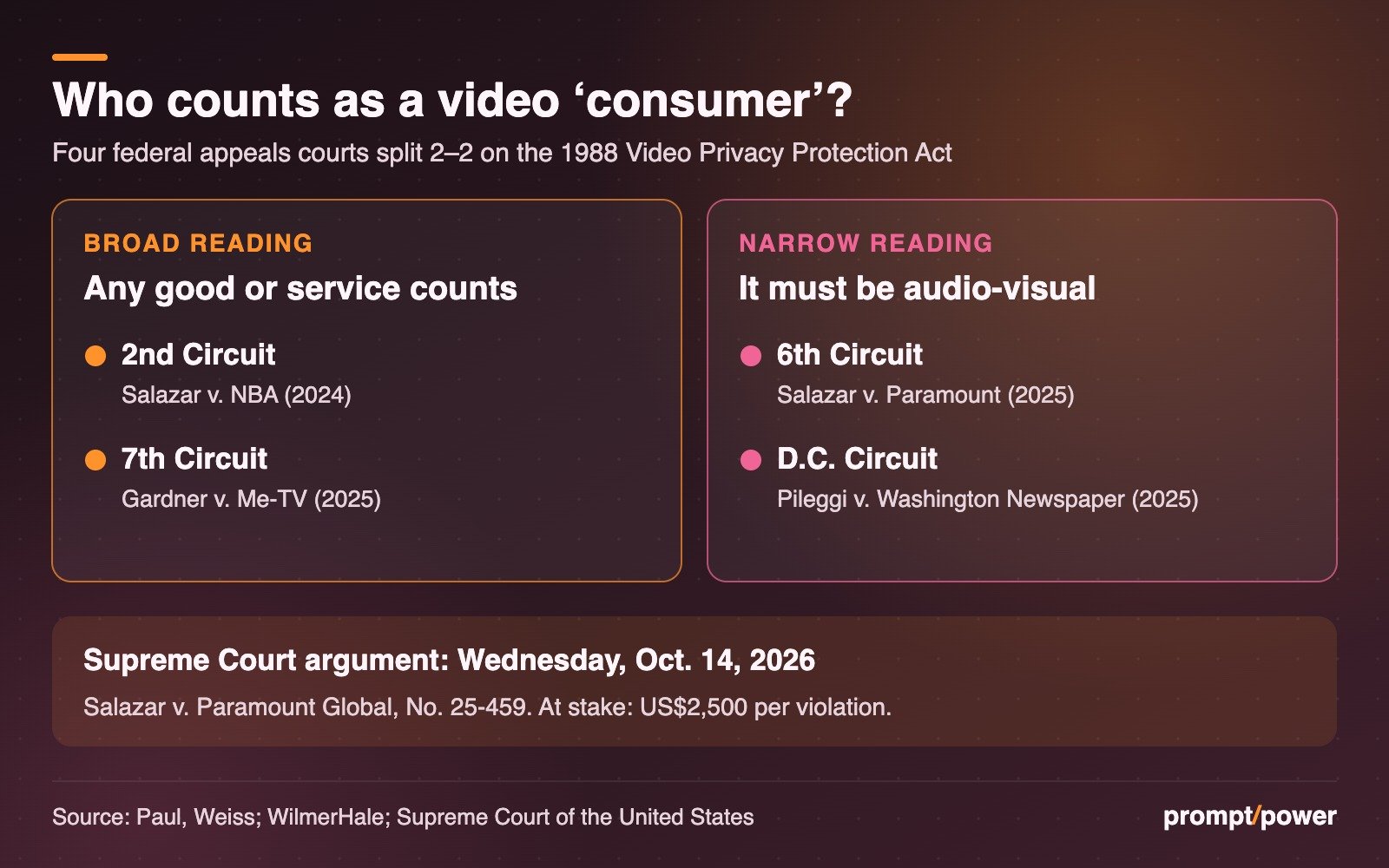
- Broad (any good or service counts): the 2nd Circuit in Salazar v. National Basketball Association (2024) and the 7th Circuit in Gardner v. Me-TV (2025).
- Narrow (it must be audio-visual): the 6th Circuit in this case and the D.C. Circuit in Pileggi v. Washington Newspaper Publishing Co. (2025).
Salazar’s reply brief argued that the conflict can “lead to different ultimate outcomes on materially identical facts.” In practice, a newsletter subscriber in New York or Chicago can bring the claim that a subscriber in Nashville or Washington, D.C., cannot. The Court passed on the NBA case in December 2025, then took this one.
Salazar’s argument is about grammar. The phrase “from a video tape service provider” limits where the goods come from, not what they are, he says. His brief, as SCOTUSblog describes it, imagines a Blockbuster store selling candles and dog bandanas: a customer who bought a candle would still be a consumer. Congress limited other VPPA definitions to video materials and chose not to here, his lawyers argue.
Paramount’s answer is history. The law was about video rental records, so a consumer must transact for video. A broader reading would create an “unworkable internet-privacy regime,” it argues, and could expose any company with a website to liability for “commonplace computer activity,” per SCOTUSblog’s preview.
“The fact that Meta’s Pixel system causes websites to disclose this private information to Meta is not a legal defense.” EPIC and 18 privacy scholars, amicus brief for Salazar
Meta, the Chamber and Hollywood back Paramount
Meta is not a party, but its product is the case’s main character, and it filed an amicus brief on June 30 backing Paramount, written by Latham & Watkins. “Pixel code is a ubiquitous and highly important feature of the modern internet,” the brief says. Meta stresses that developers decide whether and where to install the code and what data it sends.
The U.S. Chamber of Commerce, the Motion Picture Association, the National Retail Federation and Chamber of Progress also sided with Paramount, MediaPost reported; the Chamber warned of “a sweeping and harmful transformation of the internet.” The Entertainment Software Association says a broad ruling could “expose ordinary game-related products and services to sweeping liability.” The Retail Litigation Center wants the law “interpreted as written, not expanded into a broad internet privacy statute.”
On Salazar’s side, the Electronic Privacy Information Center filed with 18 scholars and technical experts, among them Bruce Schneier, Daniel Solove and Danielle Citron. They argue that sites can still sell ads through first-party and contextual targeting without handing viewing data to third parties.
The lawyers at the lectern are a study in contrast. Joshua Hammack of Bailey Glasser, arguing for Salazar, is making his first Supreme Court argument; Paul Clement, one of the most experienced advocates in the building, argues for Paramount, Bloomberg Law reports.
What a ruling would mean for websites, and for you
If Paramount wins, the narrow reading becomes national law. Only people who rent, buy or subscribe to video itself could sue under the VPPA. That would end most newsletter-and-pixel suits and probably many cases built on free accounts and apps, though paid streaming subscribers would keep their claims.
If Salazar wins, any site that offers video and something else, a newsletter, a store, a login, could face class actions whenever a pixel shares viewing data with an ad platform. Paul, Weiss advises clients to audit cookies, pixels and non-video offerings such as newsletters now. Settlements already happen: Dapper Labs agreed to a US$5 million video-privacy class settlement that won final court approval in April 2026.
For you, the case changes your legal leverage, not what is already being collected. You can still limit the pixel’s reach today. Pixel matching depends on the ad platform recognising you, so logging out of Facebook in the browser you use for video, or using a browser that blocks third-party trackers, weakens the link between a viewing record and your account. Our explainer on New Mexico’s US$40 billion privacy case against Meta shows how per-violation penalties add up, and our report on Meta’s Muse agent covers what else the company keeps on you. More policy coverage here.
Decisions in argued cases usually arrive by late June. Until then, a statute written after one reporter got hold of a judge’s rental list will decide whether a few lines of JavaScript count as a video store clerk talking.

Jeff Cameron writes about the business and policy side of AI for prompt/power. A chief operating officer by trade, he also writes for Not An Atlas.
Keep reading




Latest from prompt/power
- Meta Q3 Earnings Oct. 21: The Capex, Ads and Cash Numbers to WatchOct 21
- Anthropic’s 5% Pledge Is Worth About US$48B. Here’s the Fine PrintOct 21
- Commons AI Study Meets Parliament’s Interpreter Math: 44 Passes in 5 YearsOct 21
- CNN All Access Canada Price Is CA$7.99. Americans Pay About 23% MoreOct 20
- DeepSeek Federal Ban: DHS Order Also Covers Apps Built on Its ModelsOct 20
Leave a Reply