
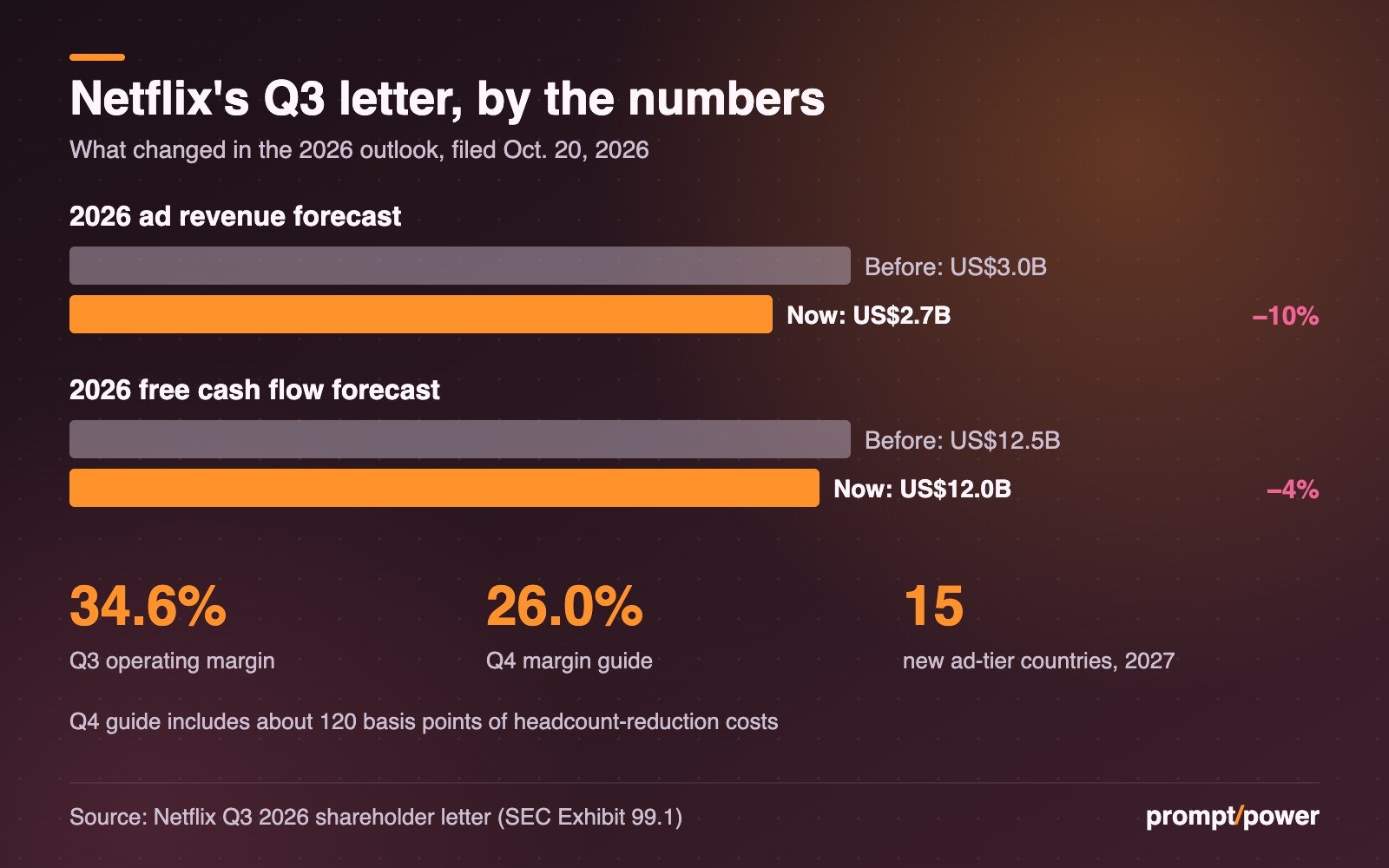
Netflix now expects about US$2.7 billion in advertising revenue for 2026, down from the roughly US$3 billion it had been forecasting, according to its third-quarter shareholder letter filed with the SEC on Oct. 20. The reason it gives is a “slightly slower than expected rollout of some ad product capabilities.” In the same letter, Netflix says members took this year’s price increases in stride, and it plans to bring its ad tier to 15 more countries in 2027, starting in March.
The quarter itself was fine. Revenue was US$12.9 billion, up 12% from a year earlier, operating margin was 34.6% and diluted earnings per share came to US$0.87, against US$0.59 a year ago. Deadline reported that the stock fell anyway, on the lowered guidance. Read the letter line by line and the reason is plain: the part of the business that is supposed to grow fastest is the part that slipped.
Netflix ad revenue forecast: what the letter says
A US$300 million trim is about 10% of the old ad target. In a company guiding to US$51.1 billion in 2026 revenue, it is a rounding error, roughly half a percent. What makes it matter is what it says about pace. Advertising is the business Netflix has been building since it launched its ad tier in 2022, and the forecast it just lowered was its own.
The letter doesn’t say which “ad product capabilities” are late. It does list what shipped: programmatic access through “globally-available CTV marketplace deals” and new partnerships with MercadoLibre in Latin America and AdForm in Europe, the Middle East and Africa. Those are plumbing for selling ads automatically to more buyers. Our read: the delay is on the self-serve and targeting tools that let smaller advertisers buy in, which is where the next billion dollars would come from. Netflix hasn’t confirmed that.
“Member response to our 2026 price changes is consistent with prior adjustments and our expectations.” Netflix Q3 2026 shareholder letter
That sentence carries a lot of weight. If ads are arriving slower, pricing is what keeps revenue on plan, and Netflix says members are paying. Q3 revenue growth reflected “increases in memberships and pricing,” the letter says, and the company describes its approach as creating “member value that lets us occasionally raise prices.” The letter gives no paid membership total; Netflix no longer reports that figure each quarter. It says only that it is “serving an audience approaching one billion people,” a reach number, not a subscriber count.
Netflix prices in the US and UK, and what the ad plan saves
Here is what Netflix charges in the US, from its plans and pricing help page on Oct. 21, with approximate Canadian-dollar conversions at the Bank of Canada’s Oct. 19 rate of US$1 = CA$1.4097. Taxes are extra.
| US plan | Monthly price | Extra member |
|---|---|---|
| Standard with ads | US$8.99 (about CA$12.67) | n/a |
| Standard | US$19.99 (about CA$28.18) | US$7.99 with ads, US$9.99 without |
| Premium | US$26.99 (about CA$38.05) | Up to two, same prices |
The gap between the ad tier and Standard is US$11 a month, or US$132 a year. That is the price Netflix puts on not seeing ads, and it is also the number advertisers are being asked to beat: in effect, each subscriber on the cheaper tier has to bring in close to that much in ads to be worth as much to Netflix as a Standard member.
In Britain, Netflix’s UK site says plans “range from £7.99 to £20.99/month,” or about US$10.63 to US$27.92 at roughly US$1.33 to the pound. UK prices include VAT. We couldn’t confirm current Canadian prices from a Netflix page before publication, so Canada isn’t in the table.
The 2027 ad tier expansion, and the live slate selling it
The expansion is the bigger long-term story. Netflix says it “will introduce our advertising tier to 15 new countries in 2027.” The first tranche lands in March 2027: nine countries in EMEA plus Colombia, Peru and New Zealand, which the letter calls “a new addition from our previous announcement.” The nine EMEA markets aren’t named.
Fifteen new markets means fifteen new ad sales operations, which is slow work. The faster lever is live programming, and the fourth quarter is stacked. The letter promises “our biggest quarterly live slate to date”: the NFL’s first Thanksgiving Eve game, a Christmas Day doubleheader and the Tyson Fury vs. Anthony Joshua fight.
Live sport is the format TV ad buyers already understand. Nobody fast-forwards a fight, and the audience is there at a known time. For creators and media people watching Netflix’s moves, the message is that the streamer’s ad pitch now leans on the event, not the catalogue. A brand can sponsor a moment on Thanksgiving Eve rather than buy a slot in a show people will watch whenever.
Q4 guidance and the cost of the layoffs
For the fourth quarter, Netflix guides to US$13.4 billion in revenue, up 12%, and a 26.0% operating margin. That margin “includes ~120 basis points negative impact associated with our recently announced headcount reductions,” the letter says. For the full year, it expects a 31.5% operating margin against 29.5% in 2025, with about 30 basis points of drag from the same cuts.
Free cash flow is now forecast at about US$12.0 billion, down from US$12.5 billion. The letter ties that to “the expected closing of a real estate transaction in Q4,” not to weaker operations, though it doesn’t describe the deal.
What it means for you
- No new US price change is in the letter. The language is about how members took the 2026 increases, not about the next round.
- Expect more ads around live events, because that is where Netflix is selling hardest this quarter.
- If you’re in Colombia, Peru or New Zealand, a cheaper ad-supported plan is due from March 2027.
We’ve tracked other streaming price moves this autumn, including the Disney Plus UK increase and Discovery Plus in the US and Canada. Netflix’s appetite for AI production tools came up in our story on Ben Affleck’s AI firm, and if you want to read filings like this yourself, start with our guide to the numbers that matter in an S-1. More on our business page.
Netflix’s ad business missed its own target by US$300 million this year. On Christmas Day it gets two NFL games to make the case that next year’s number is the right one.

Casie Stewart covers the creator economy, social platforms and wellness tech for prompt/power: who gets paid, who gets seen, and what the algorithm is really asking of the people who feed it. She has been publishing online since 2005, long before "creator" was a job title, and has spent most of that time on the other side of the platforms she now writes about. Based in Toronto. Her rule for any new app: if it promises to save you time, check how much of it you just spent reading the onboarding.
Keep reading

Meta Q3 Earnings: A US$64.6B Beat, US$34.9B of Capex and Negative Cash Flow

Meta Q3 Earnings Oct. 21: The Capex, Ads and Cash Numbers to Watch

Anthropic’s 5% Pledge Is Worth About US$48B. Here’s the Fine Print

Bumble Buyout: Ithaca Holdings Pays US$6.05 a Share, a 138% Premium
Latest from prompt/power
- Westminster’s AI Fortnight: Ofcom Grilled, Bot Bill Slips to Nov. 27Oct 23
- Blink Mini 4K+ Is US$79.99. Two Years of Its AI Plan Costs MoreOct 23
- Anthropic’s AI Safety Bill, Explained: The 50-Death Test and Who DecidesOct 22
- ChatGPT Locked Chats: What the PIN Protects, and What It Doesn’tOct 22
- WhatsApp’s Hidden AI Notes Said Don’t Suggest a Regulator. Here’s YoursOct 22
Leave a Reply